
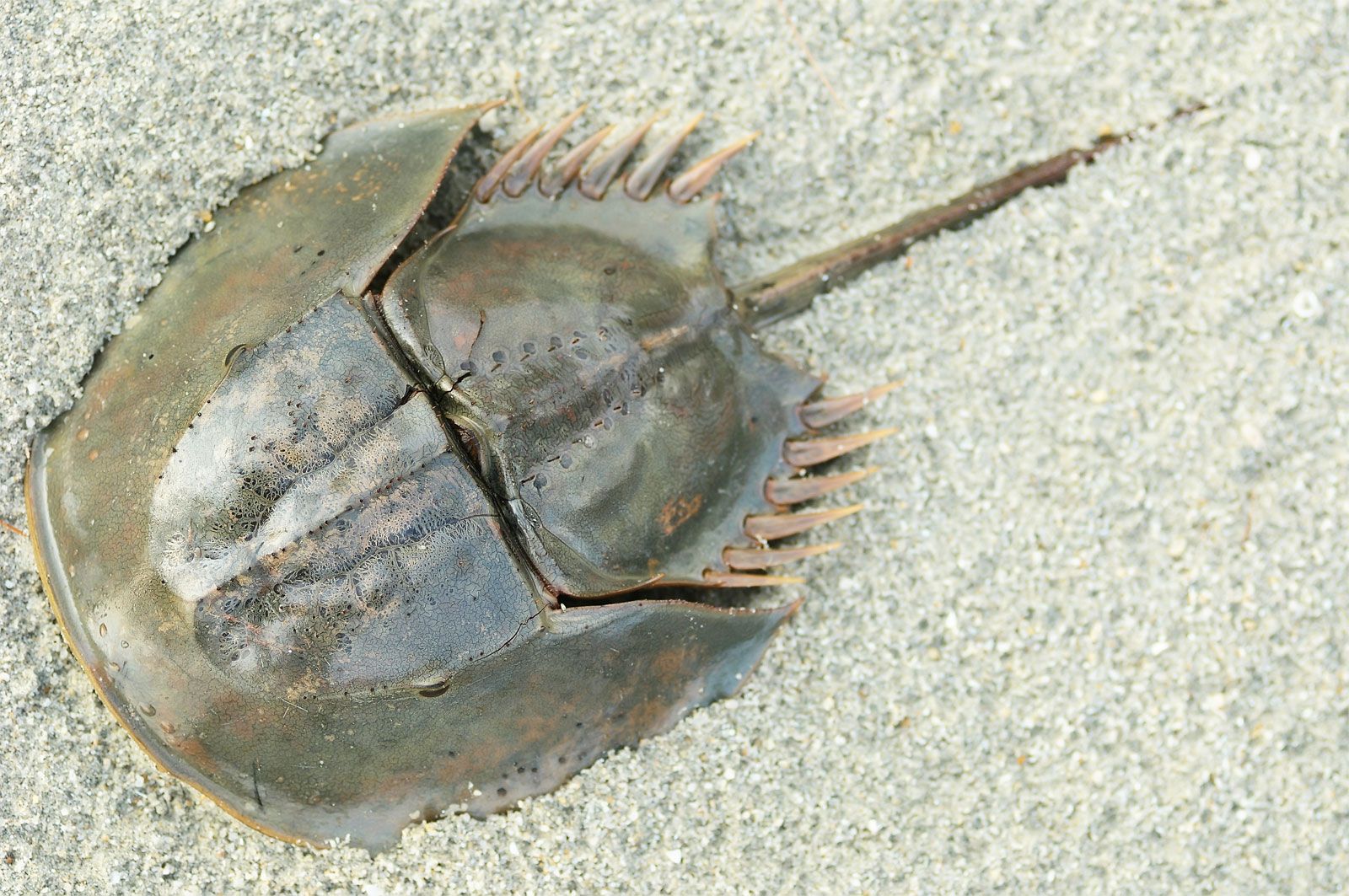






horseshoe crab
-
What is a horseshoe crab?
Horseshoe crabs are ancient arthropods, not true crabs, but more closely related to spiders. They are considered living fossils, with relatives dating back 485 million years. The best-known species is Limulus polyphemus, found in America, but other species inhabit Asian waters.
These creatures have a three-part body: a horseshoe-shaped cephalothorax, a smaller abdomen, and a long tail-spine. They reside mainly in estuaries, consuming algae, marine worms, clams, and dead fish.
Horseshoe crabs are ecologically and medicinally significant. Their eggs are a vital food source for migrating birds like the American red knot. Their blood contains coagulogen, a clotting agent used to detect bacteria in medical injections. However, their populations are threatened by habitat loss and overfishing.
2 Britannica SourcesCreated from Britannica articles using AI. AI can make mistakes, so verify using Britannica articles. -
Where do horseshoe crabs live?
Horseshoe crabs, often called living fossils due to their ancient lineage dating back to the Ordovician Period, reside in estuarine waters. The American horseshoe crab (Limulus polyphemus) is commonly found along the Mid-Atlantic states, with Delaware Bay hosting the world's largest population.
The other three species—the Japanese, or tri-spine, horseshoe crab (Tachypleus tridentatus), the coastal horseshoe crab (T. gigas), and the mangrove horseshoe crab (Carcinoscorpius rotundicauda)—inhabit the coastal waters of Asia from Japan to India. These crabs favor estuarine environments, where they feed on a variety of organisms, including algae, marine worms, clams, and dead fish.
2 Britannica SourcesCreated from Britannica articles using AI. AI can make mistakes, so verify using Britannica articles. -
What does a horseshoe crab look like?
The horseshoe crab, often called a living fossil, is an ancient marine arthropod. Its body consists of three hinged parts: a broad, horseshoe-shaped cephalothorax, a smaller, segmented abdomen, and a long, sharp tail-spine or telson.
The smoothly arched upper surface of the cephalothorax features a pair of lateral compound eyes and a smaller median pair that responds to ultraviolet light. Underneath, the cephalothorax has six pairs of legs. The first pair, chelicerae, are used to seize prey. The other five pairs are used for walking and eating, with spiny projections that tear food and roll it into the mouth.
3 Britannica SourcesCreated from Britannica articles using AI. AI can make mistakes, so verify using Britannica articles. -
What is a chelicerate, and how is the horseshoe crab related to them?
A chelicerate is an arthropod in the subphylum Chelicerata, characterized by having chelicerae (first pair of appendages near the mouth), and lacking antennae. Chelicerata includes arachnids like spiders, scorpions, mites, and ticks, as well as horseshoe crabs and sea spiders.
Horseshoe crabs are marine chelicerates with book gills and a dorsal carapace. They belong to the class Merostomata, which also includes the extinct Eurypterida. Horseshoe crabs are considered living fossils, with relatives dating back 485 million years.
4 Britannica SourcesCreated from Britannica articles using AI. AI can make mistakes, so verify using Britannica articles. -
How do horseshoe crabs eat and move?
Horseshoe crabs use their chelicerae, the first pair of their six legs, to grab worms, mollusks, and other prey. The other five pairs of legs around the mouth help with both walking and eating. Biting projections on these legs tear food and move it into the mouth. A gizzard further breaks down the food. They usually move by plowing through the mud, arching their bodies, and pushing with their telson (tail-spine) and last pair of legs, but they can also swim on their backs using their gill flaps.
2 Britannica SourcesCreated from Britannica articles using AI. AI can make mistakes, so verify using Britannica articles. -
Why are horseshoe crabs important to humans and ecosystems?
Horseshoe crabs are vital to both humans and ecosystems. They serve as a food source for various species, most notably the American red knot, whose migration patterns are linked to horseshoe crab spawning. The commercial fishing industry utilizes them as bait for eel and whelk.
In the biomedical industry, horseshoe crab blood is crucial because it contains coagulogen, a clotting agent used to detect bacteria in medical injections and equipment. This Limulus amoebocyte lysate (LAL) test protects humans from harmful bacteria.
However, horseshoe crab populations are declining due to overfishing and habitat loss, which is alarming because many species depend on them.
2 Britannica SourcesCreated from Britannica articles using AI. AI can make mistakes, so verify using Britannica articles.
horseshoe crab, (order Xiphosura), common name of four species of marine arthropods (class Merostomata, subphylum Chelicerata) found on the east coasts of Asia and of North America. Despite their name, these animals are not crabs at all but are related to scorpions, spiders, and extinct trilobites.
Natural history
Horseshoe crabs are an extremely ancient group and are often referred to as living fossils. Their fossil relatives are recognized as far back as the Ordovician Period (485.4 million to 443.8 million years ago), and forms similar to modern-day horseshoe crabs date back to the Jurassic Period (201.3 million to 145 million years ago). Best known is the single American species Limulus polyphemus, specimens of which can reach a length of more than 60 cm (2 feet), though males and females typically average lengths of 36.6–38.1 cm (14–15 inches) and 45.7–48.3 cm (18–19 inches) respectively. The other three species—the Japanese, or tri-spine, horseshoe crab (Tachypleus tridentatus), the coastal horseshoe crab (T. gigas), and the mangrove horseshoe crab (Carcinoscorpius rotundicauda)—are found along Asia from Japan to India and closely resemble Limulus in both structure and habits. The animals are most abundant in estuarine waters, where they feed on algae, marine worms, clams and other mollusks, and dead fish. Horseshoe crabs have been used as food by humans.
The body of the horseshoe crab is divided into three parts that are hinged together: a broad horseshoe-shaped cephalothorax; a much smaller, segmented abdomen; and a long, sharp tail-spine, or telson. The smoothly arched upper surface of the cephalothorax has a pair of lateral compound eyes and a much smaller median pair of eyes that respond to ultraviolet light. Underneath, the cephalothorax bears six pairs of legs: the first pair, called chelicerae, are used exclusively to seize worms, thin-shelled mollusks, crabs, and other prey. The mouth is surrounded by the next five pairs of legs, which are used both for walking and for eating. Spiny biting projections at the base of each leg tear the food and roll it into the mouth. Behind the bases of the last legs is a pair of reduced appendages called chilaria.


 " height="20" alt="HEW Logo">
Further physical breakdown of food occurs in the gizzard. Digestive enzymes are secreted into a long stomach-intestine by a large organ called the hepatopancreas. The principal organs of excretion are long coxal glands that open just behind the base of the fourth pair of legs. The chief ganglia (masses of nervous tissue) are fused into a ring around the esophagus. The gonads (reproductive organs) branch profusely through much of the body. Behind the legs is a transverse flap, or operculum, which covers the book gills. The gills are ventilated by their rhythmic beating. Although horseshoe crabs can swim on their backs, propelled by the beating gill flaps, they usually plow through the mud, arching the body and then pushing with the telson and last pair of legs.
Spawning takes place on sandy beaches in spring and summer, usually after sunset, and frequently during high spring tides. Each female, accompanied by one or more males, scoops out a series of depressions in the sand and lays a clutch of several thousand eggs in each. The males then cover the eggs with sperm. Usually the nests are just below the high-water mark. After several weeks the larvae hatch from the eggs. They are about 5 mm (0.2 inch) long, have no telson, and live off a store of yolk. Individuals in the second larval stage have a short telson, swim for short periods, and feed on small organisms. Although some larvae disperse more widely during this period, others remain close to beaches and pass the winter in the sediments of mud flats. Those in the third stage resemble miniature adults. Between the stages, the larvae molt—i.e., the cuticle (outer covering) splits around the margin of the cephalothorax and is shed. Growth in length is about 25 percent immediately after each molt. Horseshoe crabs reach sexual maturity after about 16 molts, at an age of 9 to 12 years. The mature adults feed on marine worms (polychaetes) and often become covered with a variety of encrusting organisms.

Biomedical applications
The American horseshoe crab is harvested by the commercial fishing industry for use as bait to capture American eels (Anguilla rostrata), which in turn are used as bait for striped bass (Morone saxatilis), and whelks. In addition, the American horseshoe crab has been harvested by the biomedical industry since the 1960s, because the species contains a very primitive clotting agent called coagulogen in its blood.
The discovery of coagulogen in 1956 by American scientist Frederick Bang allowed a fellow researcher, American hematologist Jack Levin, to develop the Limulus amoebocyte lysate (LAL) test for the presence of gram-negative bacteria in injections during the 1960s. This test, which was cleared by the U.S. Food and Drug Administration in 1973 and first licensed in 1977, protects people from much of the harmful bacteria that could appear in fluids injected into the body (such as drugs and intravenous solutions) or on the surfaces of medical instruments and containers. When these items come in contact with LAL, coagulogen reacts with gram-negative bacteria or endotoxin (the toxic substance bound to the bacterial cell wall) and forms a clot (called a “gel” with respect to LAL testing) around them at concentrations as small as one part per trillion. Compared with other methods that test for the presence of bacteria, the LAL test is quick: an answer can be provided within about 45 minutes. To recover coagulogen, however, blood must be drawn from live horseshoe crabs, whose mortality rate from the bleeding process is roughly 30 percent.
The trusted destination for professionals, college students, and lifelong learners.
SUBSCRIBE

