

- Also known as:
- EDM
- Key People:
- Deadmau5
- Related Topics:
- trap music
- trip-hop
- Techno
- house
- grime music

electronic dance music
-
What is electronic dance music?
Electronic dance music (EDM) is an umbrella term for a wide variety of musical styles that emerged in the mid-1980s. Rather than being a single genre, EDM includes styles from ambient music to hardcore, with house, techno, drum and bass, dubstep and trance as examples.
EDM is typified by inorganic sounds and timbres, often produced by equipment from the early 1980s or samples. Live music is often featured as a garnish. Rhythm is emphasized in EDM styles, while ambient music provides a cushion. EDM recordings are produced to be played in dance clubs by DJs, in mixes with other recordings of the same type, rather than by home listeners, though many tracks have crossed over to the pop audience.
2 Britannica SourcesCreated from Britannica articles using AI. AI can make mistakes, so verify using Britannica articles. -
What are the main styles or genres of electronic dance music?
Electronic dance music (EDM) is an umbrella term for many musical styles that emerged in the mid-1980s. Instead of being a single genre, EDM includes styles from beatless ambient music to 200-beats-per-minute hardcore.
Some of the most notable examples of EDM styles and genres include:
* House
* Techno
* Drum and bass
* Dubstep
* Trance
* TrapEDM is typified by inorganic sounds and timbres, frequently produced by gear from the early 1980s, like the 303 bass synthesizer and the 808 drum machine. Rhythm is emphasized in most EDM styles, and EDM recordings are produced primarily to be played in dance clubs by DJs.
5 Britannica SourcesCreated from Britannica articles using AI. AI can make mistakes, so verify using Britannica articles. -
Which instruments or equipment are commonly used to make electronic dance music?
Electronic dance music (EDM) relies on various instruments and equipment to create its distinct sound. Synthesizers, including analog and digital models, are central to EDM, capable of generating and manipulating a wide array of sounds. Drum machines, such as the Roland 808, are also essential for creating the rhythmic foundation of EDM tracks.
MIDI (Musical Instrument Digital Interface) technology allows different electronic instruments to communicate with each other and with computers, offering extensive control and flexibility in music production. These tools enable artists to craft the diverse soundscapes that characterize EDM, from ambient textures to high-energy beats.
5 Britannica SourcesCreated from Britannica articles using AI. AI can make mistakes, so verify using Britannica articles. -
How is a DJ important in electronic dance music culture?
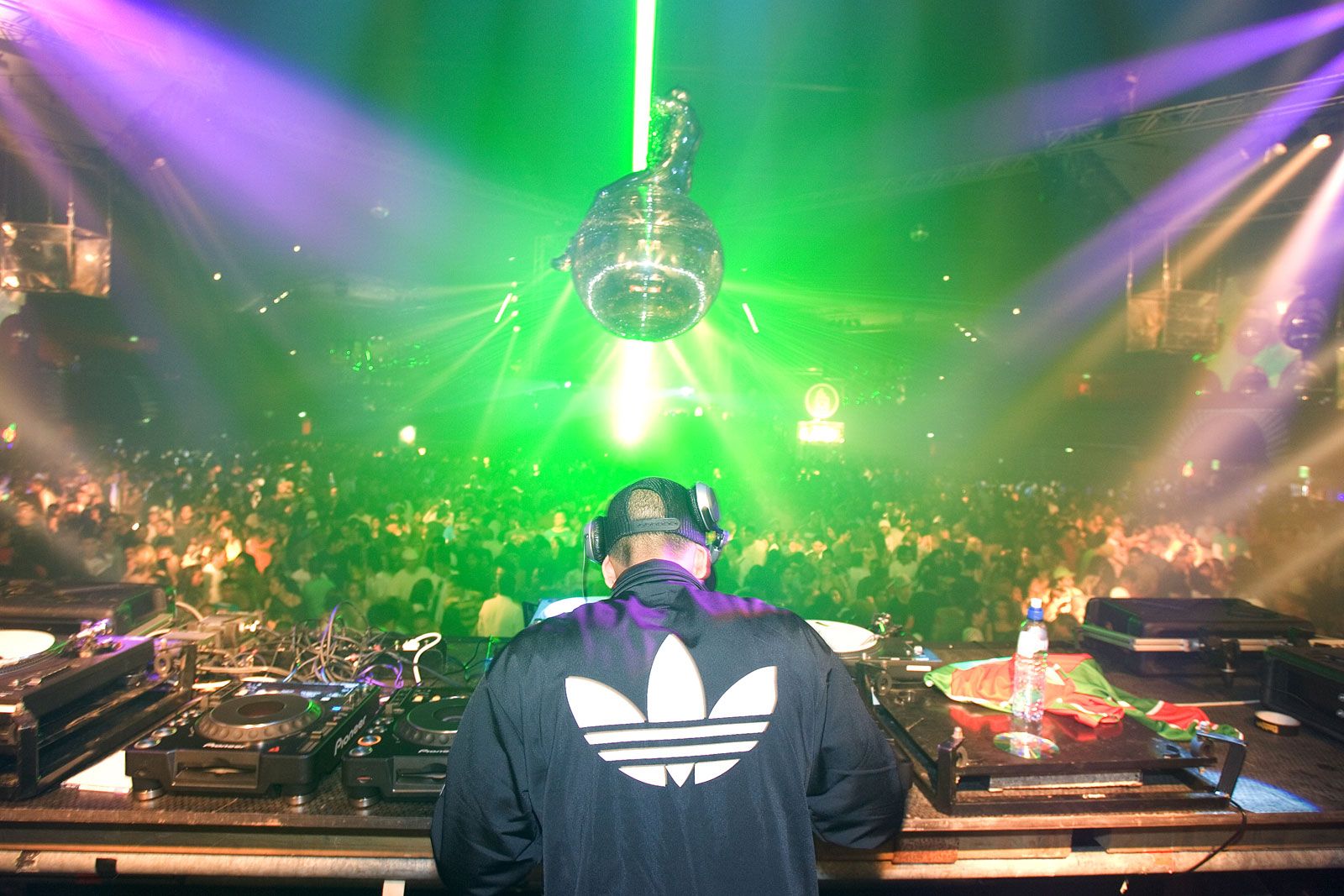
In electronic dance music (EDM) culture, the DJ is essential for live performance and production. Emerging in the early 1980s, EDM relies on DJs to mix recordings in dance clubs, creating a continuous musical experience.
DJs like Frankie Knuckles in Chicago and Juan Atkins in Detroit innovated the genre. Knuckles, by editing disco tracks and adding drum machines, essentially codified house music. Atkins helped to establish Detroit techno.
The role of the DJ has further evolved with technology, using devices like the CD-J 1000 and software such as Ableton Live to compose and blend tracks. A DJ's roles can be multi-faceted: finding music, playing popular tracks, maintaining equipment, producing beats, and improvising instrumental solos.
2 Britannica SourcesCreated from Britannica articles using AI. AI can make mistakes, so verify using Britannica articles. -
Where are electronic dance music events usually held?
Electronic dance music (EDM) events are typically held in various venues, with the music created specifically for all-night dancing. These events gained popularity in the United States during the second half of the 2000s, with Los Angeles becoming a major hub.
Common venues include:
* Dance clubs EDM recordings are produced primarily to be played in dance clubs by disc jockeys (DJs).
* Stadiums DJs regularly fill stadiums.
* Fields and warehouses Parties often occurred illegally in these locations.Large-scale events, such as the Electric Daisy Carnival (EDC), have expanded to multiple cities, drawing massive crowds. The global party scene, modeled after early raves in England, has led to the emergence of DJ-based dance scenes worldwide.
1 Britannica SourceCreated from Britannica articles using AI. AI can make mistakes, so verify using Britannica articles. -
How has electronic dance music influenced popular music around the world?
Electronic dance music (EDM) has significantly shaped popular music worldwide since the mid-1980s. Emerging from Chicago house and Detroit techno, EDM quickly influenced youth culture, especially through the "rave" scene, characterized by all-night dance parties.
British producers fused house and techno with hip-hop and Jamaican dancehall, creating styles like drum and bass and downtempo. Germany, particularly Berlin, became a hub for techno after the Berlin Wall's demolition, attracting artists globally.
The internet's growth and the integration of dance music techniques into pop and hip-hop further boosted EDM's popularity. By the late 1990s, techno had diversified into subgenres such as trance, electronica, jungle, and gabba, influencing even mainstream rock. Today, EDM encompasses a wide range of styles and continues to evolve, impacting various genres and solidifying its place in global popular music.
2 Britannica SourcesCreated from Britannica articles using AI. AI can make mistakes, so verify using Britannica articles.
electronic dance music, umbrella term for a panoply of musical styles that emerged in the mid-1980s. Rather than designating a single genre, electronic dance music (EDM) encompasses styles ranging from beatless ambient music to 200-beats-per-minute hardcore, with house music, techno, drum and bass, dubstep, and trance among the most-notable examples.
Considered as a whole, electronic dance music is characterized by several defining features. It is typified by deliberately inorganic sounds and timbres, frequently produced by cheap early-1980s gear—such as the 303 bass synthesizer and the 808 drum machine, both made by Japanese electronics firm Roland—or built from samples of previous recordings. Live instrumentation and singing are often featured but usually as a garnish rather than the main dish. Most important, the music is created specifically for the social function of dancing all night. A strong emphasis on rhythm is therefore common to most styles of EDM, while ambient music, which is less focused on maintaining a beat, provides an aural cushion for settling down at the end of the night. Furthermore, EDM recordings are produced primarily to be played in dance clubs by disc jockeys (DJs), in a mix with other recordings of the same type, rather than by home listeners—though many tracks have crossed over to the pop audience.
Chicago and Detroit

Electronic dance music has existed in some form since at least the early 1970s. Sly and the Family Stone’s number-one pop hit “Family Affair” (1971), for example, employed a drum machine. As well, disco producers (such as Giorgio Moroder) and synth-pop acts (such as Kraftwerk) played crucial roles in EDM’s sonic development. However, the electronic dance music that would become a global culture was hatched in the American Midwest through the early 1980s. In Chicago Frankie Knuckles, resident DJ at the members-only African American gay club the Warehouse, would make his own edits, on reel-to-reel tape, of the cult disco he played, extending the grooves to keep the all-night dance floor filled. When Knuckles—along with other DJs in Chicago, such as Ron Hardy, Steve (“Silk”) Hurley, and Farley (“Jackmaster”) Funk—added a drum machine to his sets, it codified the basic formula of house music.



 " height="20" alt="HEW Logo">
Similarly, Detroit techno has many early pioneers but one widely agreed-upon formative figure: Juan Atkins, who in 1981 partnered with Rik Davis as Cybotron and issued the single “Alleys of Your Mind.” Shortly after releasing an album, Enter (1983), the duo split up, at which point Atkins started his own label, Metroplex, and began releasing 12-inch vinyl singles under the name Model 500. In quick succession, Kevin Saunderson and Derrick May—who, with Atkins, made up the DJ collective Deep Space—also started labels (KMS and Transmat, respectively) and put out their own music. The sound that emerged from the Detroit scene was largely abstract instrumental funk, though Saunderson often used vocalists and had his biggest hits with the soul-influenced duo Inner City. It became formalized as a style after Atkins, in 1988, named a track “Techno Music,” which was included on (and inspired the title of) that year’s defining anthology, Techno! The New Dance Sound of Detroit.
Shoom
Electronic dance music’s reputation as “drug music” stems from one of its crucial origin stories. In the late summer of 1987, a group of English DJs visited the Spanish island of Ibiza for a week of partying. At an outdoor venue called Amnesia, the Argentine-born DJ Alfredo played a wide-open mix of tracks, heavy on Chicago house and Detroit techno, and the visitors found that the MDMA (a mood-enhancing drug also known as Ecstasy) that they had taken made the music seem revelatory. (See also Balearic Beat.) That December one of the DJs, Danny Rampling, started a weekly party called Shoom in a London fitness centre. The scene was dubbed “acid house,” after the seething, burbling “acid” sound produced by the 303 bass synthesizer and prominently featured on Chicago house records.

Within a year of Shoom’s launch, acid house was England’s biggest youth-culture musical phenomenon since punk a decade earlier, and soon the parties were taking place in fields and warehouses, in many cases illegally. Those “raves”—filled with Day-Glo paraphernalia and outlandish oversized clothes that combined the bagginess of hip-hop apparel with candy-coloured video-game aesthetics—became the model for a global party scene. By the beginning of the 1990s, raves had become widespread throughout Europe and, eventually, North America. Thereafter, DJ-based dance scenes sprouted in nearly every part of the world as new subgenres and tweaks of existing styles continually made their way onto club floors.