

- Key People:
- Georg Brandt
- Related Topics:
- chemical element
- nitrogen group element
- On the Web:
- ACS Publication - Inorganic Chemistry - Bismuth - The Magic Element (Oct. 15, 2026)

bismuth
-
What is bismuth?
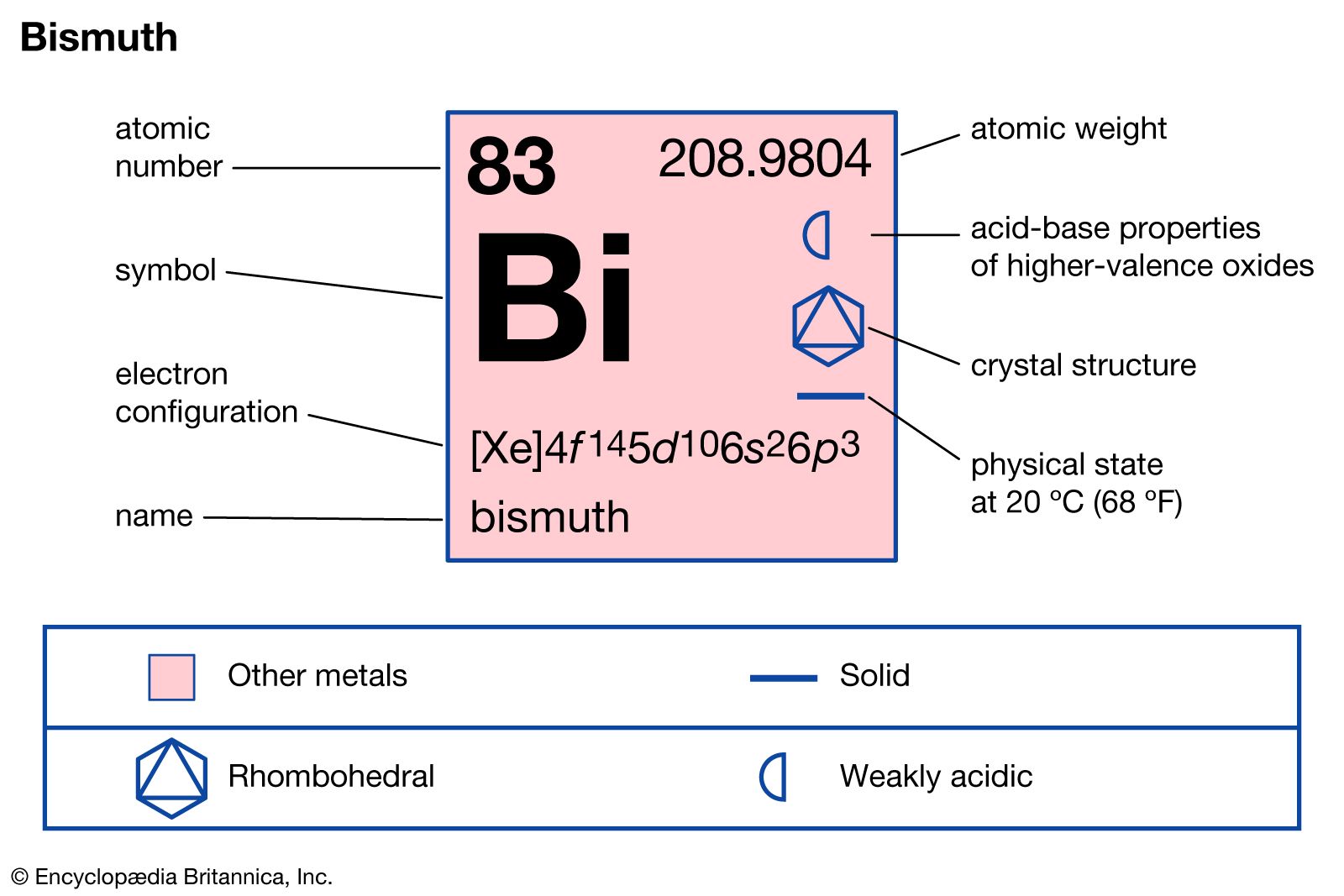
Bismuth (Bi) is a chemical element that is the most metallic and least abundant in the nitrogen group. It is a hard, brittle, lustrous, coarsely crystalline metal with a gray-white color and a reddish tinge.
Bismuth has an atomic number of 83 and an atomic weight of 208.98040. It has a melting point of 271.3 °C (520.3 °F), a boiling point of 1,560 °C (2,840 °F), and a density of 9.747 gram/cm3 at 20 °C (68 °F). Bismuth is the most diamagnetic of all metals and has poor electrical conductivity, but it is relatively nontoxic.
Bismuth is used principally in alloys, to which it imparts its own special properties of low melting point and expansion on solidification.
2 Britannica SourcesCreated from Britannica articles using AI. AI can make mistakes, so verify using Britannica articles. -
What does bismuth look like?
Bismuth is a somewhat brittle metal that has a pinkish, silvery, metallic luster. It is hard and coarsely crystalline. When bismuth solidifies from a molten state, it expands by 3.3 percent.
When heated, bismuth will form an oxide coating, and at its boiling point, it oxidizes rapidly. The yellow color of this oxide distinguishes it from those formed by other metals. Bismuth is the most diamagnetic of all metals, which means it has the greatest opposition to being magnetized.
2 Britannica SourcesCreated from Britannica articles using AI. AI can make mistakes, so verify using Britannica articles. -
Where is bismuth found in nature?
Bismuth, nearly as abundant as silver, constitutes approximately 2 \u00d7 10⁻⁵ weight percent of Earth's crust. It is found both in its native form and in compounds. Native bismuth is located in veins alongside ores of lead, zinc, tin, and silver in areas such as Bolivia, Canada, England, and Germany.
Naturally occurring compounds of bismuth include the oxide (bismite or bismuth ochre, Bi₂O₃), the sulfide (bismuthinite or bismuth glance, Bi₂S₃), and two carbonates (bismutite, (BiO)₂CO₃, and bismutosphaerite). China leads in both the mining and refining of bismuth. Bismuth is also commercially produced as a by-product in the smelting and refining of lead, tin, copper, silver, and gold ores.
3 Britannica SourcesCreated from Britannica articles using AI. AI can make mistakes, so verify using Britannica articles. -
What are some common uses of bismuth?
Bismuth is a somewhat pinkish, silvery metal used in various applications due to its unique properties, such as a low melting point and expansion upon solidification.
Common uses of bismuth:
* Alloys Bismuth is a component of type-metal alloys for clean castings and fusible alloys, useful in fire-detection equipment.
* Permanent magnets A bismuth-manganese alloy can be used to create permanent magnets.
* Improving machinability Small amounts of bismuth can improve the machinability of aluminum, steel, stainless steel, and other alloys.
* Thermoelectric devices Bismuth telluride ((Bi_2Te_3)) and bismuth selenide ((Bi_2Se_3)) are used in thermoelectric refrigeration.
* Nuclear energy Liquid bismuth has been used as a fuel carrier and coolant in nuclear energy generation.
* Catalysis Bismuth phosphomolybdate ((BiPMo_{12}O_{40})) is a catalyst for air oxidation of propylene and ammonia to acrylonitrile, which is used to make acrylic fibers, paints, and plastics.
* Pharmaceuticals Bismuth is used in indigestion remedies, antisyphilitic drugs, and treatments for wounds and gastric disorders. It is also used to outline the alimentary tract during X-ray examinations.
* Cosmetics Bismuth oxychloride ((BiOCl)) adds a pearlescent quality to lipstick, nail polish, and eye shadow.2 Britannica SourcesCreated from Britannica articles using AI. AI can make mistakes, so verify using Britannica articles. -
Why is bismuth considered a safe metal compared to lead?
Bismuth is considered a relatively safe metal compared to lead due to its low toxicity. It is the least toxic of the heavy metals and is generally not an industrial hazard. Lead, on the other hand, is highly toxic, with the main sources of lead poisoning being lead-based paint and drinking water carried through lead pipes.
Bismuth has even found therapeutic uses, although some authorities recommend alternative remedies. Metallic bismuth is used in alloys, fire-detection equipment, and to improve the machinability of other metals. In contrast, lead exposure can result in a wide array of symptoms, including nervous system and gastrointestinal issues, and is especially dangerous for children, potentially causing permanent brain damage.
3 Britannica SourcesCreated from Britannica articles using AI. AI can make mistakes, so verify using Britannica articles. -
How does bismuth’s unique properties make it useful in science and medicine?
Bismuth stands out due to its unique properties, such as being the most diamagnetic of all metals, meaning it has the greatest opposition to being magnetized. Bismuth is also known for expanding when it solidifies, similar to water.
Bismuth has found uses in both science and medicine:
* Pharmaceuticals Bismuth compounds have been used for centuries to treat various ailments, including indigestion and syphilis. Insoluble salts of bismuth can be utilized in treating wounds and gastric disorders, for outlining the alimentary tract during X-ray examinations, and are sometimes injected as a finely divided metal or as suspensions of its insoluble salts.
* Cosmetics Bismuth oxychloride is used in cosmetics to provide a pearlescent effect in products like lipstick and eye shadow.
* Catalysis Bismuth phosphomolybdate is an effective catalyst for the air oxidation of propylene and ammonia to acrylonitrile, which is used to make acrylic fibers, paints, and plastics.
* Nuclear energy Liquid bismuth has been used as a fuel carrier and coolant in the generation of nuclear energy.1 Britannica SourceCreated from Britannica articles using AI. AI can make mistakes, so verify using Britannica articles.
bismuth (Bi), the most metallic and the least abundant of the elements in the nitrogen group (Group 15 [Va] of the periodic table). Bismuth is hard, brittle, lustrous, and coarsely crystalline. It can be distinguished from all other metals by its colour—gray-white with a reddish tinge.
| atomic number | 83 |
|---|---|
| atomic weight | 208.98040 |
| melting point | 271.3 °C (520.3 °F) |
| boiling point | 1,560 °C (2,840 °F) |
| density | 9.747 gram/cm3 at 20 °C (68 °F) |
| oxidation states | +3, +5 |
| electron configuration | 1s22s22p63s23p63d104s24p64d104f 145s25p65d106s26p3 |
History
Bismuth evidently was known in very early times, since it occurs in the native state as well as in compounds. For a long period, however, it was not clearly recognized as a separate metal, having been confused with such metals as lead, antimony, and tin. Miners during the Middle Ages apparently believed bismuth to be a stage in the development of silver from baser metals and were dismayed when they uncovered a vein of the metal thinking they had interrupted the process. In the 15th-century writings of the German monk Basil Valentine this element is referred to as Wismut, a term that may have been derived from a German phrase meaning “white mass.” In any case it was Latinized to bisemutum by the mineralogist Georgius Agricola, who recognized its distinctive qualities and described how to obtain it from its ores. Bismuth was accepted as a specific metal by the middle of the 18th century, and works on its chemistry were published in 1739 by the German chemist Johann Heinrich Pott and in 1753 by the Frenchman Claude-François Geoffroy.
Occurrence and distribution
Bismuth is about as abundant as silver, contributing about 2 × 10⁻⁵ weight percent of Earth’s crust. Its cosmic abundance is estimated as about one atom to every 7,000,000 atoms of silicon. It occurs both native and in compounds. In the native state, it is found in veins associated with lead, zinc, tin, and silver ores in Bolivia, Canada, England, and Germany. Its naturally occurring compounds are chiefly the oxide (bismite or bismuth ochre, Bi2O3), the sulfide (bismuthinite or bismuth glance, Bi2S3), and two carbonates (bismutite, (BiO)2CO3, and bismutosphaerite). Commercial bismuth, however, is produced largely as a by-product in the smelting and refining of lead, tin, copper, silver, and gold ores. Thus, it comes—for example—from tungsten ores in South Korea, lead ores in Mexico, copper ores in Bolivia, and both lead and copper ores in Japan. By the early 21st century, however, China was leading the world in both the mining and the refining of bismuth. Pure bismuth can also be obtained by reducing the oxide with carbon or by roasting the sulfide in the presence of charcoal and metallic iron to remove the sulfur.



 " height="20" alt="HEW Logo">
Bismuth forms only one stable isotope, that of mass 209. A large number of radioactive isotopes are known, most of them very unstable.
Commercial production and uses
Bismuth is volatile at high temperature, but it usually remains with the other metals after smelting operations. Electrolytic refining of copper leaves bismuth behind as one component of the anode sludge. Separation of bismuth from lead by the Betterton–Kroll process involves the formation of high-melting calcium or magnesium bismuthide (Ca3Bi2 or Mg3Bi2), which separates and can be skimmed off as dross. The dross may be chlorinated to remove the magnesium or calcium, and finally the entrained lead. Treatment with sodium hydroxide then produces highly pure bismuth. An alternative separation, the Betts process, involves electrolytic refining of lead bullion (containing bismuth and other impurities) in a solution of lead fluosilicate and free fluosilicic acid, bismuth being recovered from the anode sludge. Separation of bismuth from its oxide or carbonate ores can be effected by leaching with concentrated hydrochloric acid. Dilution then precipitates the oxychloride, BiOCl. This, on heating with lime and charcoal, produces metallic bismuth.
Metallic bismuth is used principally in alloys, to many of which it imparts its own special properties of low melting point and expansion on solidification (like water and antimony). Bismuth is thus a useful component of type-metal alloys, which make neat, clean castings; and it is an important ingredient of low-melting alloys, called fusible alloys, which have a large variety of applications, especially in fire-detection equipment. A bismuth–manganese alloy has been found effective as a permanent magnet. Small concentrations of bismuth improve the machinability of aluminum, steel, stainless steels, and other alloys and suppress the separation of graphite from malleable cast iron. Thermoelectric devices for refrigeration make use of bismuth telluride, Bi2Te3, and bismuth selenide, Bi2Se3. Liquid bismuth has been used as a fuel carrier and coolant in the generation of nuclear energy.
The principal chemical application of bismuth is in the form of bismuth phosphomolybdate (BiPMo12O40), which is an effective catalyst for the air oxidation of propylene and ammonia to acrylonitrile. The latter is used to make acrylic fibres, paints, and plastics. Pharmaceutical uses of bismuth have been practiced for centuries. It is effective in indigestion remedies and antisyphilitic drugs. Slightly soluble or insoluble salts are utilized in the treatment of wounds and gastric disorders and in outlining the alimentary tract during X-ray examination, and bismuth is sometimes injected in the form of finely divided metal, or as suspensions of its insoluble salts. Substantial quantities of the oxychloride, BiOCl, have been used to impart a pearlescent quality to lipstick, nail polish, and eye shadow.
The trusted destination for professionals, college students, and lifelong learners.
SUBSCRIBE

