




The kinetic-theory explanation of heat conduction is similar to that for viscosity, but in this case the molecules carry net energy from a region of higher energy (i.e., temperature) to one of lower energy (temperature). Internal molecular motions must be accounted for because, though they do not transport momentum, they do transport energy. Monatomic gases, which carry only their kinetic energy of translational motion, are the simplest case. The resulting expression for thermal conductivity is which has the same basic form as equation (23) for viscosity, with (3k/2) replacing m. The (3k/2) is the heat capacity per molecule and is the conversion factor from an energy difference to a temperature difference.
It can be shown from equation (24) that the independence of density and the increase with temperature is the same for thermal conductivity as it is for viscosity. The dependence on molecular mass is different, however, with λ varying as 1/m1/2 owing to the factor v̄. Thus, light gases tend to be better conductors of heat than are heavy gases, and this tendency is usually augmented by the behaviour of l.
The behaviour of the thermal conductivity of mixtures may be qualitatively explained. Adding heavy gas to light gas reduces the thermal conductivity because the heavy molecules carry less energy and also interfere with the energy transport of the light molecules.
The similar behaviour of λ and η suggests that their ratio might provide information about the constants a and a′. The ratio of a′/a is given as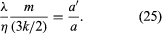
Although simple theory suggests that this ratio should be about one, both experiment and more refined theory give a value close to 5/2. This means that molecules do not “forget” their past history in every collision, but some persistence of their precollision velocities occurs. Molecules transport both energy and momentum from a somewhat greater distance than just one mean free path, but this distance is greater for energy than for momentum. This is plausible, for molecules with higher kinetic energies might be expected to have greater persistences.
Attempts to calculate the constants a and a′ by tracing collision histories to find the “persistence of velocities” have not met with much success. The molecular “memory” fades slowly, too many previous collisions have to be traced, and the calculations become almost hopelessly complicated. A different theoretical approach is needed, which was finally supplied about 1916–17 independently by Enskog and Chapman. Their theory also shows that the same value of l applies to both η and λ, a fact that is not obvious in the simple theory described here.
The thermal conductivity of polyatomic molecules is accounted for by simply adding on a contribution for the energy carried by the internal molecular motions: where cint is the contribution of the internal motions to the heat capacity (per molecule) and is easily found by subtracting (3k/2) from the total measured heat capacity. As might be expected, the constant a″ is only about half as large as a′.
The pressure or density dependence of λ must be similar to that of η—an initial linear increase in the free-molecule region, followed by a constant value in the dilute-gas region and finally an increase in the dense-fluid region.
Diffusion and thermal diffusion
Both of these properties present difficulties for the simple mean free path version of kinetic theory. In the case of diffusion it must be argued that collisions of the molecules of species 1 with other species 1 molecules do not inhibit the interdiffusion of species 1 and 2, and similarly for 2–2 collisions. If this is not assumed, the calculated value of the diffusion coefficient for the 1–2 gas pair, D12, depends strongly on the mixture composition instead of being virtually independent of it, as is shown by experiment. The neglect of 1–1 and 2–2 collisions can be rationalized by noting that the flow of momentum is not disturbed by such like-molecule collisions owing to the conservation of momentum, but it can be contended that the argument was simply invented to make the theory agree with experiment. A more charitable view is that the experimental results demonstrate that collisions between like molecules have little affect on D12. It is one of the triumphs of the accurate kinetic theory of Enskog and Chapman that this result clearly emerges.
If 1–1 and 2–2 collisions are ignored, a simple calculation gives a result much like those for η and λ: where a12 is a numerical constant, is an average relative speed for 1–2 collisions given by 2 = (1/2)(2 + 2), and l12 is a mean free path for 1–2 collisions that is inversely proportional to the total molecular number density, (N1 + N2)/V. Thus, D12 is inversely proportional to gas density or pressure, unlike η and λ, but the concentration difference is proportional to pressure, with the two effects canceling one another, as pointed out previously. The actual transport of molecules is therefore independent of pressure. The numerical value of a12, as obtained by refined calculations, is close to 3/5.
The pressure dependence of pD12 should be qualitatively similar to that of η and λ—an initial linear increase in the free-molecule region, a constant value in the dilute-gas region, and finally an increase in the dense-fluid region.
Thermal diffusion presents special difficulties for kinetic theory. The transport coefficients η, λ, and D12 are always positive regardless of the nature of the intermolecular forces that produce the collisions—the mere existence of collisions suffices to account for their important features. The transport coefficient that describes thermal diffusion, however, depends critically on the nature of the intermolecular forces and the collisions and can be positive, negative, or zero. Its dependence on composition is also rather complicated. There have been a number of attempts to explain thermal diffusion with a simple mean free path model, but none has been satisfactory. No simple physical explanation of thermal diffusion has been devised, and recourse to the accurate, but complicated, kinetic theory is necessary.