They get better with age (to a point).
© trekandphoto/stock.adobe.com
Would you like an investment vehicle that is guaranteed to double in 20 years, that you can purchase for as little as $25, and that’s backed by the U.S. government so there is essentially no chance of default? Depending on current interest rates and your portfolio, you might want to look into purchasing Series EE savings bonds for yourself or gifting some to your children or grandchildren.
As part of a balanced portfolio, bonds provide guaranteed interest without the risks of the stock market. In periods when you think interest rates will fall, you can lock in a rate and reap the benefits in 20 years.
Key Points
- Savings bonds are loans to the federal government that pay interest to purchasers.
- Series EE savings bonds are guaranteed to double in value at the end of a fixed time period (currently 20 years).
- Interest on savings bonds is taxed at the federal level, but is tax-free at the state level.
According to Treasury.gov, private citizens first purchased $27 million in government bonds to finance the Revolutionary War. During the Great Depression, savings bonds were issued to encourage personal savings through a government-backed vehicle. In 1963, President John F. Kennedy established the Payroll Savings Plan to encourage Americans to save a portion of each paycheck. Several bond series (from “A” through “K”) have been used and retired over the years between 1935 and 1980. Series EE bonds were first issued in 1980, and the inflation-linked Series I bonds were first issued in 1998.
Today both Series EE and Series I bonds are available for purchase. Series EE and Series I savings bonds are different from Treasury bonds, notes, and bills, which are “marketable securities,” meaning they can be bought and sold after they’re issued. To get a savings bond, you must either purchase it directly from the government or receive it as a gift.
Unlike other investments, savings bonds don’t pay cash to you during the period you hold the bond. The interest is added to the value of the bonds, which you get in one lump sum when you cash out or “redeem” them, hopefully at maturity (either original or final–more on this below).
- Series I savings bonds. Designed to protect against inflation, Series I savings bonds are available electronically (or as paper bonds when purchased with a tax refund) and provide both a fixed interest rate and a variable rate. The variable inflation rate is reset every six months, and interest is earned until maturity at 30 years. (Learn the pros and cons of I bond investing.)
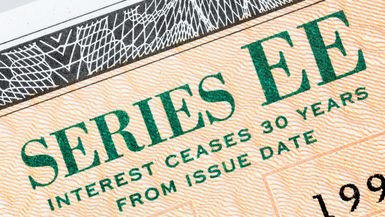
- Series EE savings bonds. Currently guaranteed to double in value in 20 years, Series EE savings bonds are available electronically and continue earning interest for 30 years—10 years after their original maturity date.
Series EE savings bond interest calculations
Interest on Series EE savings bonds is compounded semiannually, meaning the interest you earn is added to the value of the bond every six months. Series EE bonds are guaranteed to double in value at the end of a period of time, called “original maturity.” A published interest rate is used to calculate interest before and after a bond’s original maturity, up to 30 years. If the interest earned does not double the value of the bond at original maturity, a balloon interest payment is made at that original maturity date.
Until 2012, Series EE bonds were priced at one-half the face value (a $100 bond was sold for $50). Interest was earned on a savings bond’s cost, not its face value. When paper Series EE bonds were discontinued, electronic Series EE bonds started being issued at face value, meaning you purchase a $100 bond for $100 and earn interest on top of the face value.
The time value of money and the rule of 72
Want to estimate the time it will take for a bond to double in value? Divide the interest rate by 72. Want to estimate the effective interest rate of a bond that has doubled in value over a specific time period? Divide the time period by 72.
It’s not magic; it’s math. And if you want the lowdown on present value, future value, interest rates, and compounding, here’s an explainer on the time value of money, plus an interactive calculator.
- Series EE bonds sold from 1980 through April 1995 were guaranteed to double at the time of maturity. Thus, the original maturity date varied, ranging from 8 to 19 years. The resulting effective interest rates ranged from 4% to 9%, depending on the year. After their original maturity dates, bonds issued through 1993 earned at least 6%, and those issued after 1993 earned at least 4%, until they stopped earning interest at the end of their 30-year life.
- Bonds sold from May 1995 through April 2003 earned a variable interest rate that changed every six months. The original maturity date was set at 17 years, making the effective interest rate on bonds held to maturity about 4.2% (see the rule of 72 sidebar). After the original maturity date, the bond continues to earn variable interest until its “final maturity date” at the end of its 30-year life.
- Bonds sold from June 2003 through April 2005 also earned a variable interest rate that changed every six months. The original maturity date was set at 20 years. The effective interest rate on bonds held to maturity during the period is about 3.6% (72 divided by 20 years). After the original maturity date, the bond continues to earn variable interest until its “final maturity date” at the end of its 30-year life.
- Bonds sold since May 2005 have fixed interest rates. These bonds are also guaranteed to double in value 20 years after their issue date, making the effective interest rate roughly 3.6%. The government may change the fixed interest rate after the first 20 years until the final maturity date at the end of their 30-year life.
How do I know how much my bonds are worth?
If you have electronic savings bonds, your account will list the current value of your bonds. If you have paper bonds, use the TreasuryDirect Savings Bond Calculator.
Buying savings bonds for yourself or as a gift
Electronic savings bonds. Both Series EE and I savings bonds are available for purchase through the online platform TreasuryDirect. You must have a Social Security number (SSN), email address, and bank information (account and routing number) in order to open an account. You may name yourself or anyone else as the owner of the bond when you make the purchase.
To name a gift recipient, that person must already have a TreasuryDirect account, and you must know their full name, Social Security number, and TreasuryDirect account number. If you give a bond to a child under age 18, the child’s parent must have a TreasuryDirect account and set up a linked account for the child.
Payroll Savings Plan. Series EE and Series I savings bonds can be purchased from your paycheck every pay period. Begin by setting up an online account at TreasuryDirect, then provide your TreasuryDirect routing and account numbers (and the amount you want to spend each pay period) to your company’s payroll department.
Once your employer sets up the direct deposit, a portion of each paycheck will be automatically placed into your bond account. TreasuryDirect will purchase bonds every time your balance has enough money for the purchase. For example, if you have $50 withheld from each check and wish to purchase $100 bonds, a bond will be purchased in your account every other paycheck.
Paper Series I savings bonds. Before 2025, taxpayers could use federal tax refunds to purchase paper I bonds in $50 increments by filing IRS Form 8888. This option has since been discontinued. Today, savings bonds are issued electronically through TreasuryDirect.
How much can I spend on savings bonds each year?
Each year, any individual with a Social Security number (or entity with an Employer Identification Number) may buy between $25 and $10,000 in Series EE savings bonds and $10,000 in Series I savings bonds.
You may cash in (“redeem”) your Series EE or I savings bonds anytime after owning them for one year, but you’ll earn the most money from them if you hold Series EE bonds at least until original maturity. And if you cash any savings bond before you’ve owned it for five years, you’ll lose three months of interest.
- Electronic bonds (Series EE or Series I) can be cashed by using the appropriate link in your TreasuryDirect account.
- Paper bonds (Series EE sold before 2012 or Series I) can usually be cashed at your bank. Contact your bank to confirm whether it will cash them, what documentation you’ll need, and any limits on the amount it will cash. You can also send your bonds to TreasuryDirect, although wait times might be as long as six months.
What do I do with paper bonds if the owner has passed away?
When the owner(s) of a paper bond have passed away, any bonds become part of the estate of the last living owner.
Taxation of savings bonds
Interest earned on savings bonds is subject to federal income tax at your marginal tax rate, but not state income tax. You may either pay tax on interest as it accrues over the life of the bond, or pay tax on the total amount of earned interest when you cash the bond (or when the bond reaches its final maturity date, whichever comes first). You’ll receive a form 1099-INT from TreasuryDirect (for electronic bonds) or your financial institution (for paper bonds you cashed there) telling you the amount to report on your tax return.
What if the bonds are used to pay for higher education expenses?
Savings bonds can be a safe way to put aside money as part of an overall portfolio—or a good way to help children save for their futures. Remember to consider the original maturity date when you invest. Although Series EE savings bonds have published rates of around 2.7% in 2026, if the bonds are held until their original maturity date in 20 years, that effective rate is roughly 3.6% (because they’re guaranteed to double in value).
You should also look through your fireproof box (and perhaps in Grandma’s attic) to see if you or any family members have paper bonds that have matured. If a bond is more than 30 years old, it’s no longer earning any interest, so make sure to cash it. But if any of your Series EE bonds—whether electronic or old paper ones—have not reached their original (maturity, hold onto them if you can to earn the maximum effective interest rate. And if the interest rate is still reasonable, hold them until final maturity as part of your fixed-income portfolio.
This article was most recently revised and updated by Nancy AshburnThis article was most recently revised and updated by Jennifer Agee