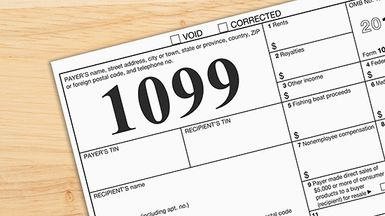
Reporting freelance, interest, and other miscellaneous income.
© Karen Roach/stock.adobe.com
It’s the end of January, and April 15 seems a long way off, but you may already be receiving 1099 tax forms in the mail. You may be wondering why you’re receiving them, whether they’ll affect your return, and if you’ll owe more income tax because of the amounts reported on these 1099 forms.
Key Points
- 1099 forms report income you received during the year from investments, freelance employment, and other sources.
- 1099s are used to help you prepare your taxes.
- If you receive a lot of 1099 income and haven’t paid taxes along the way, you might get hit with a big tax bill in April.
Businesses use 1099 forms to let you know that you received money or some type of benefit from them during the last calendar year. They’re mailed to you by January 31 (or February 15 for certain investment-related forms), and you’ll need them to prepare your taxes. Most 1099s report a taxable event—that is, an amount that needs to be added to your income to determine how much tax you owe. But sometimes they’re more informational, as long as you followed the rules when you received the money.
The different types of 1099s
The Internal Revenue Service (IRS) lists numerous 1099 forms issued to taxpayers and the types of taxable income or information they report, including:
- 1099-A, Acquisition or Abandonment of Secured Property: Used if a bank took over your house because you defaulted on your mortgage.
- 1099-B, Proceeds from Broker and Barter Exchange Transactions: Issued if you sold securities in the past year.
- 1099-C, Cancellation of Debt: Supplied when a bank or the government agrees to cancel debt you owe them and the amount is over $600.
- 1099-CAP, Changes in Corporate Control and Capital Structure: Advises shareholders about changes in a corporation’s structure, if the amount received from the change was more than $1,000.
- 1099-DIV, Dividends and Distributions: Sent to you if your investments paid dividends or you have capital gains distributions of more than $10.
- 1099-G, Certain Government Payments: Used to report state tax refunds and unemployment compensation over $10.
- 1099-H, Health Coverage Tax Credit Advance Payments: Provides information about health insurance premiums paid on behalf of some individuals.
- 1099-INT, Interest Income: Issued when you’ve earned interest income of more than $10.
- 1099-K, Payment Card and Third-Party Network Transactions: Reports income from credit cards or debit cards.
- 1099-LS, Reportable Life Insurance Sale: Reports payments from selling a life insurance policy.
- 1099-LTC, Long-Term Care and Accelerated Death Benefits: Shows payments under certain insurance contracts.
- 1099-MISC, Miscellaneous Information: Advises about rent payments, prizes you received, and other specialized payments.
- 1099-NEC, Nonemployee Compensation: Shows income over $2,000 for services provided by workers who are not employees.
- 1099-OID, Original Issue Discount: Reports the original issue discount, possibly from a U.S. Treasury obligation, certificate of deposit (CD), or bond of $10 or more.
- 1099-PATR, Taxable Distributions Received from Cooperatives: Reports certain taxable distributions from cooperatives.
- 1099-Q, Payments from Qualified Education Programs: Reports earnings from qualified tuition programs.
- 1099-QA, Distributions from ABLE Accounts: Reports distributions from ABLE accounts.
- 1099-R, Distributions from Pensions, Annuities, Retirement or Profit-Sharing Plans, IRAs, Insurance Contracts, Etc.: Advises about any distributions from retirement plans, including rollovers.
- 1099-S, Proceeds from Real Estate Transactions: Shows the price at which you sold real estate.
- 1099-SA, Distributions from an HSA, Archer MSA, or Medicare Advantage MSA: Reports money used from a health savings account (HSA) or medical savings account (MSA).
- 1099-SB, Seller’s Investment in Life Insurance Contract: Reports the amount you’ve earned from the sale of a life insurance contract.
1099s related to investments
If you invest money, such as purchasing CDs, buying stocks or bonds, or maintaining an interest-bearing checking or savings account, you’ll receive 1099s that show the money you made or lost on these investments during the year.
- If you sold stocks, you’ll receive a 1099-B. This form will be used in the preparation of Schedule D of your tax return to calculate gains or losses.
- If you earned interest or dividends, you will receive a 1099-INT, which you’ll use to prepare Schedule B of your tax return. You are taxed on these amounts.
- If you purchase a note or bond at a discount, the discount is spread over the life of the bond; you’ll receive an annual 1099-OID during that time.
What is a consolidated 1099?
Sometimes your bank or brokerage firm provides a consolidated 1099, which shows the amounts from your 1099-B, 1099-INT, 1099-DIV, and 1099-OID (and possibly a 1099-MISC) all on one form.
Nonemployee compensation is money that you receive when you provide a service to a business but not as a regular employee. Beginning with the 2026 tax year, you’ll generally receive Form 1099-NEC if a business paid you more than $2,000 in nonemployee compensation during the year.
The taxes you pay influence how you spend, earn, and invest money.
Encyclopædia Britannica, Inc.
Other 1099 forms you may see
- If you received a refund on your state tax return last year, you’ll receive a 1099-G. This form is used if you itemized your taxes in the year you got the refund. A 1099-G is also used to report unemployment benefits you received.
- If you have a child in college who is using a Section 529 plan to pay for education expenses, you will receive a Form 1099-Q. Use that form to determine if any of your child’s benefits are taxable.
- If you rolled over a 401(k) or any other type of retirement plan, or received distributions from a retirement plan, you’ll receive a 1099-R. You’ll use that form to either prove that you rolled over the amount without tax implication, or to put the distributions from the retirement plan into your income.
- If you sold your home during the past year, you’ll receive a 1099-S. You may be able to exclude all or part of your home sale proceeds from your income if you lived in your home for at least two of the last five years, and the gain (after considering capital home improvements) is less than $500,000 (married filing jointly) or $250,000 (single).
Income reported on Form 1099 may increase your tax liability
Typically, taxes are not taken out of income reported on a Form 1099. That means you might be adding income to your Form 1040 that you didn’t expect and didn’t cover when making your tax payments during the year.
If you’re an employee, you can update your Form W-4 to have additional tax withheld from your paycheck if you expect significant 1099 income. If you’re self-employed or retired, you may need to make quarterly estimated tax payments instead.
When you receive money during the year, whether it’s from investments (even if they are reinvested automatically), a side hustle, or any other source, that income is typically taxable. It’s best to think about your taxes during the year to make sure you’re withholding enough through your employer’s payroll tax deductions to cover any additional income streams. If you think that not enough tax is being withheld, you can use Form W-4 to request that an additional amount be withheld from each paycheck, or make quarterly estimated tax payments using Form 1040-ES (via mail or online).
Income reported on a Form 1099 often isn’t subject to withholding. If you regularly receive 1099 income, review your tax withholding or consider making estimated tax payments so you aren’t surprised by a large tax bill at filing time.
This article was most recently revised and updated by Nancy AshburnThis article was most recently revised and updated by David Schepp