A Treasury note (“T-note”) is a debt security issued by the U.S. Treasury with a maturity of more than one year and up to 10 years.
© ra3rn/stock.adobe.com, © trekandphoto/stock.adobe.com; Photo illustration Encyclopædia Britannica, Inc.
A Treasury note (“T-note”) is a debt security issued by the U.S. Treasury with a maturity of more than one year and up to 10 years. That makes T-notes shorter-term debt than Treasury bonds, but longer-term than Treasury bills.
The Treasury has adjusted T-note maturities over time. For example, the seven-year note was discontinued in the 1990s and reintroduced in 2009 amid increased borrowing during the global financial crisis.
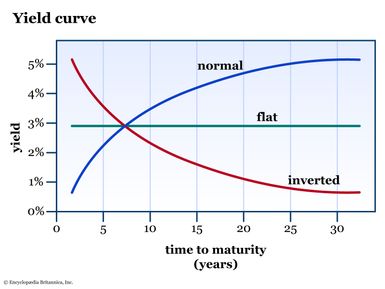
For this reason, Treasury notes tend to offer yields that fall between those of Treasury bills and Treasury bonds. In a typical upward-sloping yield curve (see figure 1), longer maturities carry higher yields to compensate investors for tying up their money for a longer period and taking on greater interest rate risk.
Figure 1: BUILDING A LADDER? CHECK THE YIELD CURVE. Upward-sloping is normal, flat is cause for caution, and inverted typically spells trouble.
Encyclopædia Britannica, Inc.
Financial institutions often hold Treasury notes as highly liquid assets because they can be sold quickly to raise cash when needed. The notes pay interest every six months until maturity, and that income is exempt from state and local taxes, though not federal taxes.
Duration risk is another way Treasury notes differ from bills and bonds. In simple terms, duration measures how sensitive a bond’s price is to changes in interest rates. When rates rise, bond prices fall—and longer-term bonds tend to fall more. That means Treasury bonds carry more duration risk, while Treasury notes fall somewhere in the middle. Treasury bills, with their very short maturities, are the least sensitive to interest rate changes.
Figure 2: FOLLOW THE BOUNCING YIELD CURVE. Compare the yields for Treasury 30-year T-bonds, 10-year T-notes, and 1-year T-bills. How do financial events line up?
Encyclopædia Britannica, Inc.
These differences in maturity and duration help explain why short-, intermediate-, and long-term Treasury yields often move in the same general direction over time, but not always by the same amount.
Why investors track (and buy) Treasury notes
T-notes tend to offer lower yields than bonds of comparable maturity issued by corporations or mortgage lenders. They attract investors primarily because they are seen as a safe asset with little risk of default. T-note yields are set by the Treasury at regular auctions open to financial firms and some individuals.
Treasury notes sit in the middle of the yield curve—often called the “belly”—covering maturities from about two to 10 years. This part of the curve is closely watched by investors because it reflects expectations about economic growth and future interest rates.
One commonly tracked measure is the 2–10 spread, the difference between yields on 2-year and 10-year Treasury notes. When the spread is positive, longer-term yields are higher than short-term yields—a typical, upward-sloping curve. When it turns negative, the yield curve is said to be “inverted,” a condition that has often preceded economic slowdowns (refer back to figure 1).
Held by domestic and foreign investors, T-notes remain a popular, liquid, and stable component of a diversified portfolio—though typically at the cost of lower returns than other debt securities.
This article was most recently revised and updated by Colin Dodds