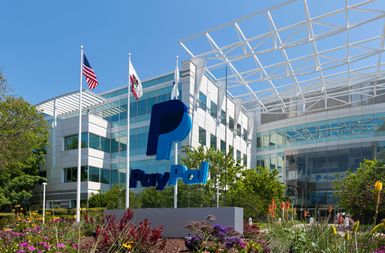
PayPal changed how millions of people pay, shop, and send money online.
© michelmond/stock.adobe.com
- Share price:
- $58.3 (mkt close, Nov. 12, 2026)
- Annual revenue:
- $34.29 bil.
- Earnings per share (prev. year):
- $5.24
- Industry:
- Financial Services
PayPal is an American financial technology company headquartered in San Jose, California, that provides digital payment services for consumers and businesses. Users can link PayPal accounts to bank accounts and credit cards to send money, make purchases, and accept payments online. At the end of 2025, the company had about 23,800 employees worldwide.
PayPal primarily generates revenue by charging transaction fees to businesses and consumers. It also earns fees from cross-border transactions, currency conversions, instant money transfers, and cryptocurrency transactions. In 2025, PayPal processed $1.79 trillion in payments and ended the year with 439 million active accounts.
The rise of PayPal (1998–2002)
Cofounded as Confinity in 1998 by entrepreneurs Peter Thiel and Max Levchin, the company launched the PayPal online payment service the following year. The service made it easier for consumers and businesses to send money over the Internet, and it caught on quickly with buyers and sellers on the online auction site eBay (EBAY).
By 2000, PayPal had more than one million users, and about 40% of eBay transactions used the service. In 2000, Confinity merged with X.com, the online bank co-founded by Elon Musk. The merged company adopted the PayPal name in 2001 and went public the following year, raising $70.2 million in its initial public offering.
The eBay years (2002–2015)
In October 2002, eBay acquired PayPal for $1.5 billion, making PayPal the official payments provider for eBay.
PayPal continued to grow. By 2011, it had more than 100 million active users in 190 markets and 25 currencies. In 2013, the company acquired Venmo, a popular peer-to-peer payment service, and cross-border payments service Xoom in 2015.
In 2015, eBay spun off PayPal into an independent company, but continued to use its services. PayPal shares began trading on the Nasdaq exchange under the ticker symbol PYPL.
Expanding beyond eBay (2015–2019)
PayPal continued to expand by partnering with major payment networks, financial institutions, and technology companies, including Visa (V), Mastercard (MA), American Express (AXP), andJPMorgan Chase (JPM). Agreements with Google Pay and Apple Pay further expanded the ways consumers and merchants could use PayPal online, in stores, and through mobile wallets.
PayPal also expanded through acquisitions, adding capabilities in small-business financing, in-store payments, business payouts, fraud detection, and buy now, pay later services through companies such as iZettle, Hyperwallet, Simility, and Paidy.
Along with acquisitions and partnerships, PayPal expanded internationally. In 2019, it became the first foreign payment service approved to provide online payment services in China.
Beyond online payments (2020–present)
PayPal made a major technological leap forward in 2021 with the integration of cryptocurrency. It introduced Checkout with Crypto, offering customers a way to pay for purchases using digital assets.
In 2023, PayPal introduced PayPal USD (PYUSD), a stablecoin backed by the U.S. dollar. That same year, Venmo added peer-to-peer cryptocurrency transfers, expanding PayPal’s digital asset offerings.
In 2024, PayPal began introducing AI-powered tools for consumers and merchants. By 2025, it was using artificial intelligence for fraud prevention, risk management, customer service, and product development.
Regulatory and public scrutiny
PayPal has faced several controversies over the years, including:
- Sanctions violations. In 2015, PayPal paid a $7.7 million settlement to the U.S. Treasury Department for processing payments for individuals involved with black market nuclear weapons and in sanctioned countries.
- Arbitrary account freezes and cancellations. In 2022, PayPal faced criticism after closing the accounts of two independent news organizations without publicly explaining why. The same year, three users filed a federal lawsuit alleging that the company froze their accounts and withheld their funds.
- Data privacy. Also in 2017, Venmo faced criticism after users’ transactions were public by default unless they changed their privacy settings. The company later made those settings easier to find and adjust.
Security and consumer protections
Despite the controversies, PayPal has invested heavily in security features designed to help protect users from identity theft, fraud, and phishing attempts. The service also offers buyer and seller protections that allow eligible users to dispute certain transactions and request refunds. Automated monitoring systems can flag suspicious activity and temporarily limit accounts when potential fraud is detected.
From online auctions to mobile wallets and cryptocurrencies, PayPal adapted as digital payments evolved. Along the way, it influenced how consumers send money, shop online, and pay businesses even as competitors such as Square (SQ), Stripe, Apple Pay, and Google Pay reshaped the market.
This article was most recently revised and updated by The Editors of Encyclopaedia Britannica