Encyclopaedia Britannica's editors oversee subject areas in which they have extensive knowledge, whether from years of experience gained by working on that content or via study for an advanced degree. They write new content and verify and edit content received from contributors.
Mastercard Inc. is a global payments company that operates a network connecting consumers, banks, merchants, and other businesses. It traces its roots to 1966, when a group of banks formed the Interbank Card Association to compete in the growing credit card market. The group introduced Master Charge: The Interbank Card in 1969, which was renamed Mastercard about a decade later. In 2025, about 3.4 billion Mastercard-branded cards were in circulation worldwide.
How has Mastercard expanded beyond credit and debit cards?
Mastercard has expanded into bank-to-bank payments, e-commerce, cybersecurity, artificial intelligence, and digital currencies. Its 2017 acquisition of Vocalink added systems for payments made directly between bank accounts, while its purchase of Brighterion that year added AI technology used in fraud detection. Mastercard later acquired cybersecurity company Recorded Future for $2.7 billion in 2024 and, in 2026, acquired digital-payments company BVNK in a deal valued at up to $1.8 billion, including $300 million in contingent payments.
Mastercard Inc. is an international payment card services corporation established in 1966. It provides various financial services in more than 220 countries and territories; in 2025, about 3.4 billion Mastercard-branded credit cards, debit cards, and prepaid cards were in circulation worldwide, and the company processed more than 175 billion transactions. The company is headquartered in Purchase, New York, with 39,800 employees worldwide as of 2026. It became a publicly traded company in 2006.
Founding and early growth
The company that would become Mastercard Inc. was conceived in 1966 when a consortium of banks met in Buffalo, New York, at the invitation of Karl H. Hinke, a vice president at Marine Midland Bank, to discuss banding together to offer credit card services. It was a sound idea spurred by reports regarding the strong growth of Bank of America’s BankAmericard, which would eventually become Visa Inc. The Buffalo meeting established the Interbank Card Association (ICA). Within a year, the ICA had 150 members, and Hinke was named chair.
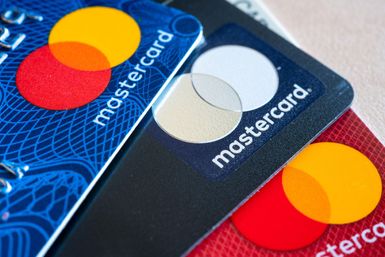
National branding was an issue at the concept’s beginning because each issuing bank had a say in its card design. In 1969, the ICA unveiled Master Charge: The Interbank Card, with a logo of overlapping orange and yellow circles. Also in 1969, New York City–based First National City Bank (now Citibank) added its Everything Card to the Master Charge family, expanding Master Charge’s national reach. A decade later, Master Charge: The Interbank Card was rechristened Mastercard.
International expansion
The ICA expanded outside the U.S. in 1968 by partnering with Eurocard. This gave the ICA inroads into the European market and equally benefited Eurocard, which gained access to the ICA network. That same year, the ICA allied with Mexico’s Banco Nacional and a handful of institutions in Japan.
The United Kingdom’s popular Access card joined the consortium in 1972; that brand name was discontinued in 1997 when it was assimilated by Mastercard. The ICA continued to expand internationally, and in the late 1970s, renamed itself Mastercard International. In the 1980s, Mastercard made important inroads in Asia and South America and became the first payment card issuer in the People’s Republic of China.
Further international expansion occurred in 2002 when Mastercard International merged with credit card issuer Europay International, which had assumed Eurocard a decade earlier. Mastercard International changed its name to Mastercard Worldwide in 2006 and adopted a new logo.
Acquisitions, mergers, and more
Mastercard Inc. has expanded its reach and capability through mergers, acquisitions, and new products, including:
Cirrus, a large ATM network, acquired in 1985.
Maestro, the first point-of-sale debit network, established by Mastercard in 1991. (Mastercard began phasing out the Maestro brand in 2023, as debit cards increasingly needed to work for online as well as in-person purchases.)
DataCash, a British payment processing and risk management company, acquired for about $520 million in 2010 as Mastercard expanded into e-commerce.
Vocalink, a British payments company that operates bank-to-bank and real-time payment systems, acquired in 2017 for about $920 million. The deal expanded Mastercard beyond card payments and into payments made directly between bank accounts.
Brighterion, a San Francisco–based provider of artificial intelligence (AI) and related software, purchased in 2017.
Recorded Future, a cyber threat intelligence company, acquired for $2.7 billion in 2024, marking a major expansion of Mastercard’s cybersecurity business.
BVNK, a digital-payments infrastructure company, acquired in 2026 in a deal valued at up to $1.8 billion, including $300 million in contingent payments.
Other acquisitions helped broaden Mastercard’s business along the way, including Orbiscom, whose technology became part of Mastercard Labs; the prepaid card operations of Travelex; and Nets and Finicity, which expanded the company’s capabilities in bank-to-bank payments and security of customer data.
Controversies and legal actions
Mastercard has faced several controversies and legal actions, including two significant antitrust class-action lawsuits. In the first, filed in 2005 on behalf of millions of retailers, Mastercard and Visa were alleged to have unlawfully fixed fees for credit and debit card transactions. The suit wound through the courts for several years, and in March 2024, the U.S. Court of Appeals for the Second Circuit in Manhattan upheld a $5.6 billion settlement initially approved in 2019 and became final in 2023. A related settlement that would have lowered and capped some merchant fees was rejected by a federal judge in 2024. A revised agreement reached in 2025 received preliminary court approval in June 2026.
A $66.7 million settlement was reached in 2020, but appeals by Visa and Mastercard regarding class certification kept the case in the courts. In September 2023, the U.S. Court of Appeals for the District of Columbia Circuit ruled against the companies and ordered the case to trial. In April 2024, the U.S. Supreme Court denied a request by Visa and Mastercard to review the Court of Appeals decision, allowing the class-action lawsuit to proceed.
Mastercard faced scrutiny in 2018 when media outlets reported that Google had paid Mastercard several million dollars for select user data, which it intended to use in its advertising. The report took Mastercard users by surprise because the sale of their data had not been publicly announced.
Cryptocurrencies
Mastercard began moving into crypto in 2021, announcing plans to support certain cryptocurrencies in its network. Later that year, it partnered with cryptocurrency platform Bakkt to allow member banks and merchants to offer crypto services. The following year, Mastercard partnered with Paxos, a cryptocurrency trading system, to establish Crypto Source, a program allowing member financial institutions to provide cryptocurrency trading to their clients.
Mastercard later expanded into stablecoins, cryptocurrencies designed to maintain a stable value by being tied to an asset such as the U.S. dollar. Its 2026 acquisition of BVNK connected Mastercard’s traditional payment network with infrastructure for digital-currency transactions.
Legacy
Mastercard was established by a group of banks eager to break into the burgeoning national credit card market. It found success through popular financial services, acquisitions, and global expansion, eventually growing into the world’s second-largest payment card network behind Visa. In 2025, Mastercard processed more than 175 billion transactions and generated $32.8 billion in revenue. Its business has also expanded beyond traditional card payments into areas such as bank-to-bank payments, cybersecurity, and digital currencies.