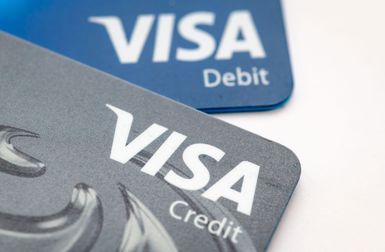
“Will that be debit or credit?”
© Yau Ming Low/Alamy
- Share price:
- $425.76 (mkt close, Nov. 13, 2026)
- Annual revenue:
- $45.90 bil.
- Earnings per share (prev. year):
- $12.32
- CEO:
- Mr. Ryan M. McInerney
- Industry:
- Financial Services
Visa Inc. is an international payment card services corporation established in 1958. It provides a variety of financial services in more than 200 countries and territories through an estimated 14,500 financial institutions, and its branded credit, debit, and cash cards are accepted by more than 130 million businesses worldwide. In 2023, the Visa network facilitated 276 billion transactions for a total volume of $15 trillion. Visa is headquartered in San Francisco, California.
1958–1960: Origin and start-up difficulties
Almost every American adult today has at least one credit card in their wallet, but the credit card concept was still a relative novelty in 1958, when Bank of America (BAC) first conceived a regional credit card called BankAmericard. The program was the brainchild of Joseph P. Williams, director of Bank of America’s customer services research group, and it was launched by sending unsolicited cards with a $300 limit to 65,000 Bank of America customers in Fresno, California. Fearful of rumored competition on its home turf, the bank extended the promotion throughout California in 1959, at which time more than 20,000 California merchants were accepting the card.
Are you protected from identity theft?
The fraudsters are getting more sophisticated, but so are the tools used to fight back. Learn about identity theft at Britannica Money.
But there were difficulties almost from the beginning, including a 22% delinquency rate among accounts and growing complaints of credit card fraud. Government officials and the press picked up the story, including the fact that customers were liable for any fraud involving their card—even if it wasn’t their fault. The resulting public backlash led to a loss for Bank of America of approximately $20 million. Williams resigned in December 1959.
1960–1970: Course correction and new leadership
Bank of America looked within following Williams’ resignation and determined that the BankAmericard program was worth saving. Management enacted more stringent financial controls and apologized through an open letter to millions of California households for the issues with credit card fraud and more. The mea culpa calmed cardholders, and BankAmericard showed a profit for the first time in May 1961—a fact the company kept close to its chest in an effort to keep potential competitors at bay.
A major player in bolstering BankAmericard’s early success was Dee Hock, who in 1968 was brought on to manage the card’s rollout in the Pacific Northwest. Hock saw issues when Bank of America began licensing outside its own network, and established a committee that persuaded the bank that its credit card could succeed outside the bank. In 1970, the bank placed control of the BankAmericard program with the card’s issuer banks, which established National BankAmericard with Hock as president and CEO.
1971–1979: International growth and the birth of Visa
The 1970s saw dramatic advances in the technology that drove the National BankAmericard program, starting in 1973 with the launch of the electronic authorization system that would become VisaNet. This was quickly followed by the industry’s first electronic clearing and settlement system. In 1975, Visa issued the first debit card through the First National Bank of Seattle; it would prove to be a huge revenue generator for years to come.
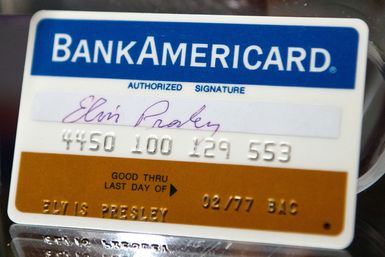
“One pair of blue suede shoes, please.”
© Zak Hussein—Corbis/Getty Images
Expansion overseas saw rapid growth, but also issues for licensees that resulted in the establishment of the International Bankcard Company (IBANCO) in 1974 to help manage BankAmericard’s international program.
Two years later, IBANCO decided to unite all of the international networks into a single global network. Some nations were reluctant to issue a card with the Bank of America name, so in 1977, National BankAmericard became Visa U.S.A. and IBANCO was rebranded Visa International. Two years later, Visa launched branded traveler’s checks. At the same time, it began offering merchants a new transaction-authorizing system that reduced credit card fraud by 85%.
1980–2005: Advances and setbacks
Visa experienced rapid growth under Hock’s direction in the early 1980s. The first Visa Premiere card was released in 1981, and the Visa Classic Card was redesigned with a hologram in 1983 to further reduce fraud. Hock also established the Visa ATM network, which competed with bank-owned automated teller machines.
Hock retired in 1984 and was replaced by Charles T. Russell, who helped grow the company’s ATM footprint by purchasing a 33% share of Plus Systems, the nation’s second largest ATM provider, for $5 million, thus providing Visa customers access to thousands of ATMs. In 1987, Russell was instrumental in helping Visa land a contract to operate Interlink, the world’s largest point-of-sale network for credit card transactions.
In the years that followed, Visa continued to add features and services to its card program that would benefit customers and reduce fraud, including:
- Electronic signature capability (1989)
- Neural network technologies (1993)
- The Visa check card (1995)
- A financial literacy program (1996)
Not every program was successful, however. A 1997 agreement between Visa International and the popular Internet search engine Yahoo! to jointly create an Internet shopping site, for example, was abruptly canceled by Yahoo!, which balked at having to share profits from online transactions. Yahoo! opted instead to buy out Visa International’s 45% stake in the project.
And although Visa’s debit card was a big hit with customers, its Visa Cash card, which enabled customers to load money from a checking account to be used as cash, was an unexpected failure.
Despite these setbacks, Visa experienced significant growth throughout the 1990s and into the new millennium, with nearly $1 trillion in global consumer purchases per year and more than 600 million cards in customers’ wallets. By 2001, more than one billion Visa cards were in use.
Visa was a relatively steady ship until 2005, when it and competitor Mastercard (MA) found themselves embroiled in a massive security breach via a third-party payment processor known as CardSystems Solutions, which affected nearly 40 million customers. Visa and Mastercard worked together to establish the independent Payment Card Industry Security Standards Council in an attempt to reclaim customer confidence.
Credit card fast facts
Although Visa’s predecessor, the BankAmericard, was a pioneer in revolving credit, the credit card concept was hardly new:
- What’s in your Sumerian handbag? Mesopotamians used baked clay tablets to keep track of transactions.
- Backed by the corn standard? In 19th century America, early credit cards in the form of coins or charge plates were often used by rural merchants to allow farmers to make purchases in advance of harvesting their crops.
- No reward points? In the 1920s, individual firms, such as oil companies and hotel chains, began issuing credit cards to customers for purchases made at company outlets.
- Swipe the cardboard? In 1950, Diner’s Club—which ultimately became the first universal credit card—allowed its 200 members (males only) to dine on credit at 27 New York restaurants. Diner’s Club eventually boasted more than 42,000 members nationwide. And, yes; that first one was made of cardboard. The first plastic credit card, ubiquitous today, was released in 1959 by American Express.
2006–present: Visa as a publicly held company
Visa reported its intention to become a public company in October 2006, and came out of the corporate restructuring a year later with a new name: Visa Inc. The restructuring merged Visa Canada, Visa International, and Visa U.S.A., while its operations in Western Europe became a separate entity operated by its member banks. Visa filed a $10 billion initial public offering (IPO) with the U.S. Securities and Exchange Commission in November 2007. The IPO was launched on March 18, 2008, with the sale of 406 million shares at $44 per share, making it the largest public offering at the time. The IPO’s underwriters purchased an additional 40.6 million shares on March 20, 2008, raising a total of $19.1 billion.
Visa continued its strong forward momentum following the IPO. In 2016, it acquired Visa Europe Ltd., making Visa a truly global company. In 2020, it established a program to help the Asia–Pacific region bolster its financial infrastructure by partnering with start-up companies to leverage Visa’s financial networks. During the COVID-19 pandemic in the early 2020s, Visa enhanced its technology capabilities in remote transactions and contactless payments.
Legacy. Visa started as an experimental statewide credit card with dreams of going national, and made those dreams come true through shrewd financial acumen and a broad understanding of what consumers desired in a credit card program. It learned from its mistakes and several industry challenges, and pioneered important steps to reduce credit card fraud and ensure the protection of electronic financial transactions.
Today, Visa is one of the largest, most successful, and widely recognized corporations in the world, enabling billions of financial transactions and generating trillions in total volume each year.
Don Vaughan