


King v. Burwell
-
What is the King v. Burwell case about?
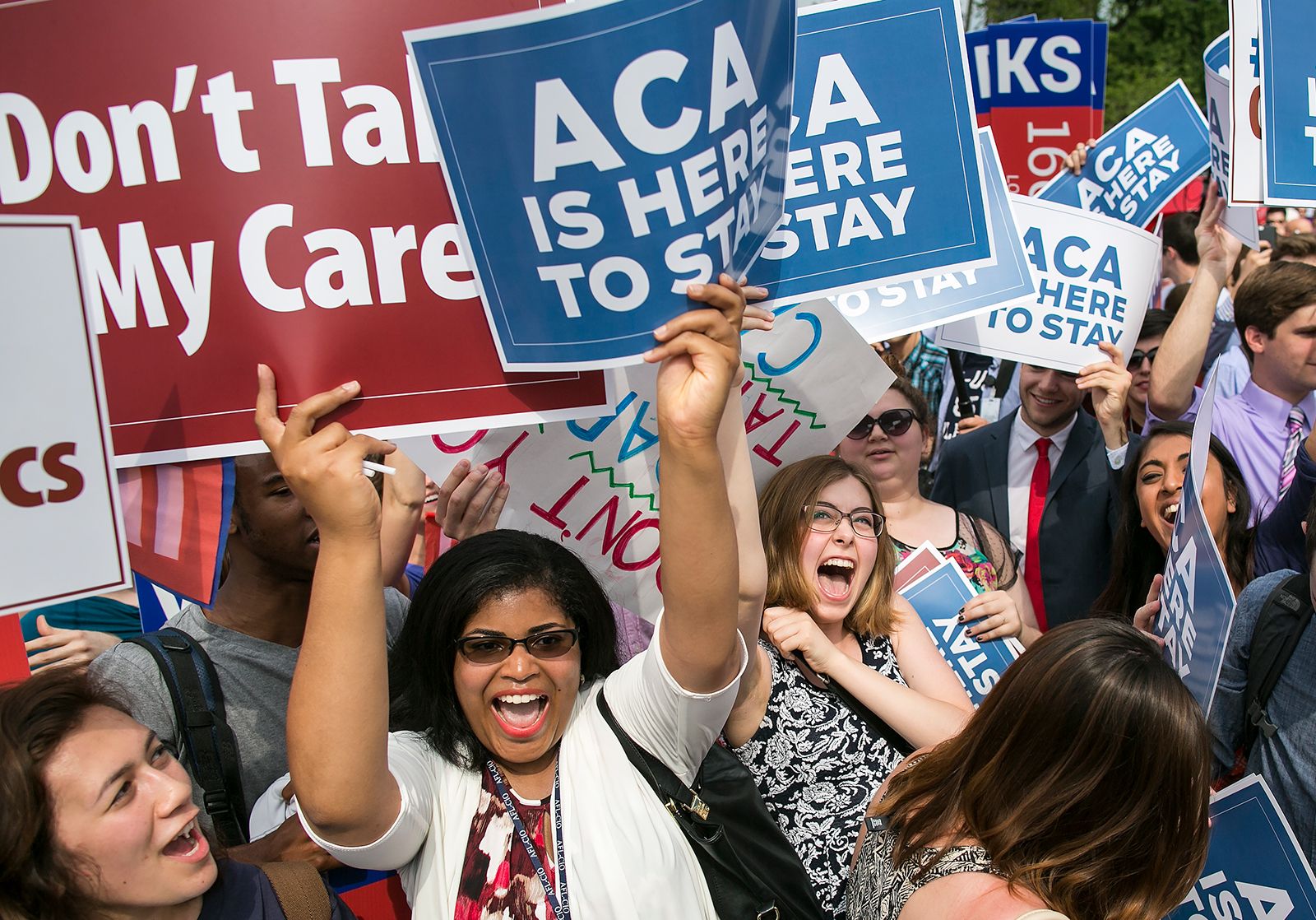
King v. Burwell was a 2015 Supreme Court case regarding the Affordable Care Act (ACA). The central question was whether people who bought health insurance through the federal government's exchange were eligible for tax credits, or if these credits were only for those using state-run exchanges.
The plaintiffs argued that the IRS could not issue tax credits for insurance purchased on the federal exchange because the ACA only defined such credits for state exchanges.
The Court ultimately held that tax credits were available to consumers using both federal and state exchanges. It reasoned that denying tax credits to those using the federal exchange would destabilize the insurance market and undermine the ACA's purpose of providing affordable health insurance to all Americans.
2 Britannica SourcesCreated from Britannica articles using AI. AI can make mistakes, so verify using Britannica articles. -
Why did King v. Burwell reach the Supreme Court?
King v. Burwell reached the Supreme Court because of conflicting interpretations of the Affordable Care Act (ACA). The central question was whether the ACA allowed the IRS to provide tax credits to consumers who purchased health insurance through the federal exchange, or only through state-run exchanges.
The plaintiffs argued that the ACA only authorized tax credits for state exchanges, potentially invalidating subsidies for millions using the federal exchange. The government countered that the federal exchange was a stand-in for state exchanges, thus qualifying for the tax credits. The Supreme Court ultimately ruled in favor of the government, ensuring the continuation of subsidies and the stability of the health insurance market.
1 Britannica SourceCreated from Britannica articles using AI. AI can make mistakes, so verify using Britannica articles. -
What is the Affordable Care Act (ACA) and how is it related to this case?
The Patient Protection and Affordable Care Act (PPACA), also known as the Affordable Care Act (ACA) or "Obamacare," is a US healthcare reform law enacted in March 2010. It aimed to make health coverage more accessible and affordable, reduce rising healthcare costs, and eliminate abusive insurance practices.
King v. Burwell was a legal case involving interpretation of the ACA. The Supreme Court was tasked with deciding whether the ACA permitted the IRS to issue tax credits to consumers who purchased insurance on the federal exchange, or whether those credits were only for those who used state exchanges. The court ultimately held that consumers who purchase health insurance on an exchange run by the federal government are eligible for subsidies.
3 Britannica SourcesCreated from Britannica articles using AI. AI can make mistakes, so verify using Britannica articles. -
What was the main legal question the Supreme Court had to answer in King v. Burwell?
In King v. Burwell, the central legal question before the Supreme Court was whether the Patient Protection and Affordable Care Act (ACA) allowed the IRS to provide tax credits to consumers who purchased health insurance through the federal exchange, or whether these credits were restricted to those who used state exchanges.
The plaintiffs argued that the ACA only defined the amount of tax credits for state exchanges, thus the IRS lacked the authority to issue tax credits for insurance purchased on the federal exchange. The government contended that the federal exchange was a stand-in for state exchanges in states that did not establish their own, and that denying tax credits would undermine the ACA's purpose of providing affordable health insurance to all Americans.
1 Britannica SourceCreated from Britannica articles using AI. AI can make mistakes, so verify using Britannica articles. -
How did the Supreme Court rule in King v. Burwell, and what was their reasoning?
In King v. Burwell, the Supreme Court ruled 6–3 that individuals who purchase health insurance through a federal exchange are eligible for tax subsidies.
The central issue was whether the ACA authorized tax credits only for consumers using state-run exchanges, given the law's language. The Court found the phrase "Exchange established by the State" ambiguous.
However, the Court rejected a narrow interpretation, stating that it would destabilize the individual insurance market in states with a federal exchange and create "death spirals" that the ACA was designed to avoid. The Court's decision upheld the IRS's interpretation, preserving the ACA's system of health-insurance financing.
2 Britannica SourcesCreated from Britannica articles using AI. AI can make mistakes, so verify using Britannica articles. -
How did the decision in King v. Burwell affect healthcare and insurance for Americans?
In King v. Burwell, the Supreme Court ruled (6–3) on June 25, 2015, that consumers buying health insurance on the federal exchange are eligible for subsidies via tax credits. This decision affirmed that the IRS could issue tax credits for insurance purchased on federal exchanges, crucial for the Affordable Care Act (ACA) system of health-insurance financing.
The court reasoned that denying these subsidies would destabilize the insurance market, causing a "death spiral" of rising premiums and fewer insured individuals. This ruling ensured that millions of Americans could continue to afford health insurance, preserving the ACA's aim to provide affordable healthcare to all.
1 Britannica SourceCreated from Britannica articles using AI. AI can make mistakes, so verify using Britannica articles.
King v. Burwell, legal case in which the U.S. Supreme Court on June 25, 2015, held (6–3) that consumers who purchase health insurance on an exchange (marketplace) run by the federal government under the Patient Protection and Affordable Care Act (PPACA; commonly ACA) are eligible for subsidies in the form of advanced tax credits (generally paid directly to insurers), despite a provision of the ACA that ostensibly authorized tax credits only for consumers using state-run exchanges. In so ruling, the Court affirmed a decision of a three-judge panel of the United States Court of Appeals for the Fourth Circuit, which had held (3–0) in July 2014 that, because the relevant text of the ACA was ambiguous, the Internal Revenue Service (IRS) had not exceeded its authority under the ACA by issuing a rule to implement tax credits for insurance purchased on either a state or a federal exchange. On the same day that the Fourth Circuit issued its decision, a three-judge panel of the United States Court of Appeals for the District of Columbia Circuit, in Halbig v. Burwell, reached the opposite conclusion, finding (2–1) that the ACA “unambiguously restricts the…subsidy to insurance purchased on Exchanges ‘established by the State.’ ” The D.C. Circuit’s decision, however, was vacated when that court agreed to hold an en banc hearing of the case (before all judges of the court) in December. (That hearing did not take place, however, as the en banc court agreed on November 12 to hold Halbig “in abeyance pending disposition by the Supreme Court of King v. Burwell.”) Meanwhile, the appellants in King v. Burwell, having decided not to seek an en banc hearing, filed a writ of certiorari (petition for review) with the United States Supreme Court, which was granted on November 7, 2014, despite the fact that there was technically no disagreement between the two appellate courts on the central issue. The Supreme Court heard oral arguments in the case on March 4, 2015.
Unlike the Affordable Care Act cases, which the Supreme Court decided in 2012, King v. Burwell was not a constitutional test of the ACA. The question presented was rather one of legislative interpretation: Did the relevant provisions of the ACA (Sections 1311, 1321, and 1401) permit the IRS to issue tax credits to consumers who purchased insurance on the federal exchange, or were the credits to be extended only to those who used the state exchanges? The answer to that question was momentous, for on it depended the viability of the system of health-insurance financing established by the law. That system incorporated three basic elements: (1) insurance companies were prohibited from denying coverage to persons with preexisting conditions or charging them higher premiums than those paid by healthier customers in the same age groups; (2) most Americans would be required to have health insurance by January 1, 2014, or pay a tax penalty (the “individual mandate”); and (3) subsidies in the form of advanced tax credits would be provided by the federal government to lower the premiums of persons who did not have health insurance through their employers and could not afford to buy it themselves. The expected increase in the number of relatively healthy insured persons would compensate insurance companies for the costs of covering people with preexisting conditions, and the individual mandate and tax credits would ensure that the pool of relatively healthy insured persons was large enough for that purpose. At the time of the Fourth Circuit’s decision, however, only 13 states and the District of Columbia had established their own exchanges. In the remaining states, those seeking health insurance relied on the federal exchange. During the ACA’s first enrollment period in 2013–14, some eight million previously uninsured people obtained private health insurance. Of those, about 5.4 million used the federal exchange. Among the latter group, most could not have afforded to buy insurance without the tax credits. Consequently, had the Supreme Court ruled in King that the IRS did not have authority under the ACA to issue tax credits for insurance purchased on the federal exchange, millions of people would have lost their health insurance, and the pool of relatively healthy insured persons would have shrunk to such an extent that insurance companies would have been forced to increase premiums, which would in turn have further shrunk the pool of relatively healthy insured persons, leading to additional premium increases, and so on (the so-called “death spiral”). In King, therefore, the Supreme Court had the power to destroy the ACA, not by declaring it unconstitutional but by making it impossible to implement.
In the provisions at the centre of the case, the ACA declared that “each State shall, not later than January 1, 2014, establish an American Health Benefit Exchange” (1311[b]); that states may “elect” to establish an exchange (1321[b]); that, for states that fail to establish an exchange or elect not to do so, “the Secretary [of Health and Human Services] shall…operate such Exchange within the State” (1321[c]); that the “premium assistance credit amount” is equal to “the sum of the premium assistance amounts” for all “coverage months…during the taxable year” (1401[a]); and that the premium assistance amount for any coverage month is equal to the monthly premium of “qualified health plans” that “were enrolled in through an Exchange established by the State under [Section] 1311 of the Patient Protection and Affordable Care Act” (1401[a]). The plaintiffs in King, citing in particular the phrase “Exchange established by the State,” argued that the IRS was not empowered to issue tax credits for health insurance purchased on the federal exchange, because the ACA defined the amount of such credits only for state exchanges, not for the federal one. The government argued in response that the phrase “the Secretary shall…operate such Exchange within the State” implied that the federal exchange was effectively a stand-in for state exchanges in states that could not or would not establish exchanges of their own. In such states, therefore, the federal exchange counted as an “Exchange established by the State.” The government further argued that the plaintiffs’ interpretation of Section 1321(c) was implausible because it was unsupported in the legislative history of the ACA and because it would defeat the basic purpose of the law, which was to provide affordable health insurance to all Americans.


 " height="20" alt="HEW Logo">

In its ruling, the Fourth Circuit panel found that “the statute is ambiguous and subject to at least two different interpretations.” Citing the Supreme Court’s decision in Chevron U.S.A., Inc. v. Natural Resources Defense Council, Inc. (1984), however, the panel concluded that it was obliged to defer to the IRS’s interpretation of the relevant provisions (to extend “Chevron deference”), because that reading constituted, in Chevron’s words, a “permissible construction of the statute.”
In affirming the Fourth Circuit’s decision, the Supreme Court agreed that the term “Exchange established by the State” was ambiguous but did not rely on Chevron deference to uphold the IRS’s interpretation. Instead, it argued that “the statutory scheme compels us to reject” the narrower reading “because it would destabilize the individual insurance market in any State with a Federal Exchange, and likely create the very ‘death spirals’ that Congress designed the Act to avoid.”