
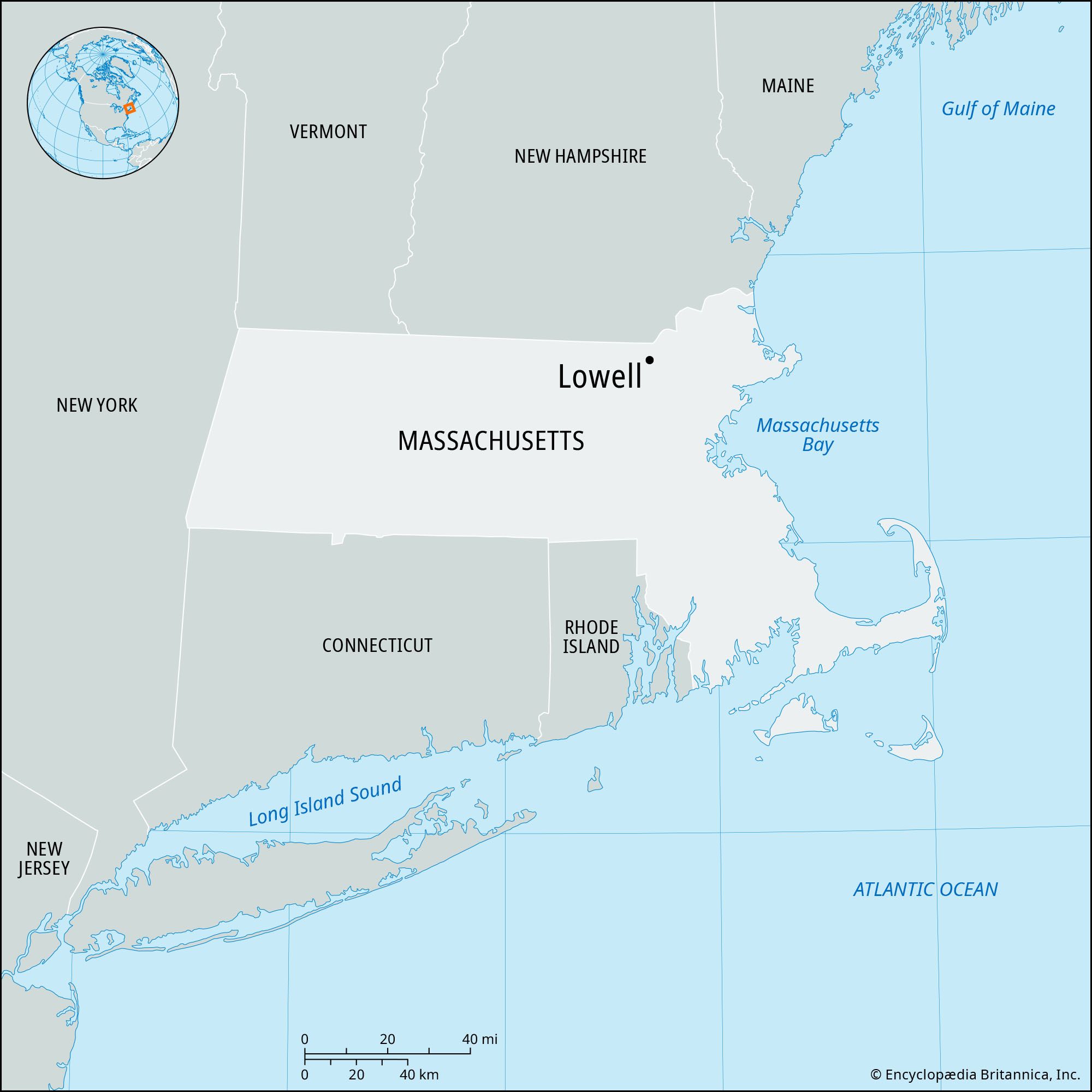




Lowell
News •
-
Where is Lowell located?
Lowell is a city in northeastern Massachusetts, United States, located in Middlesex County at the junction of the Concord and Merrimack rivers, 25 miles (40 km) northwest of Boston. Originally a farming community, Lowell grew into a major center for cotton textile manufacturing in the early 19th century, utilizing waterpower from the Merrimack River's Pawtucket Falls. Today, Lowell is known as one of the most ethnically diverse cities in the United States, with technology, health care, higher education, tourism, and the arts as its main economic activities.
2 Britannica SourcesCreated from Britannica articles using AI. AI can make mistakes, so verify using Britannica articles. -
Why is Lowell, Massachusetts, historically important?
Lowell, Massachusetts, is historically important as the first planned industrial town in the United States. Founded in the early 19th century, it became a major center for cotton textile manufacturing, utilizing waterpower from the Merrimack River. Lowell gained renown for its "mill girls," young women from rural communities who sought employment in the textile mills. By mid-century, Lowell was a major industrial city, drawing attention from European writers like Charles Dickens and Anthony Trollope. While the textile industry eventually declined, the establishment of the Lowell National Historical Park in 1978 preserved its historic downtown.
2 Britannica SourcesCreated from Britannica articles using AI. AI can make mistakes, so verify using Britannica articles. -
What role did Lowell play in the Industrial Revolution?
Lowell, Massachusetts, was the first planned industrial town in the U.S.. Named for Francis Cabot Lowell, a pioneer in textile industrialization, Lowell became a major center for cotton textile manufacturing in the early 19th century, thanks to the waterpower from the Merrimack River and a canal system.
Lowell's textile mills gained renown for employing "mill girls," young women from rural communities. Lowell's approach, which involved hiring young women from the countryside and housing them in boarding houses next to the mills, served as a paternalistic model. This was intended to create an American labor force unlike the exploited workers in Europe. By the mid-19th century, Lowell was a major industrial city, drawing attention from writers like Charles Dickens.
2 Britannica SourcesCreated from Britannica articles using AI. AI can make mistakes, so verify using Britannica articles. -
What were the textile mills in Lowell known for?
The textile mills of Lowell, Massachusetts, were known for several key features. They were the first in the U.S. to perform all operations converting raw cotton into finished cloth. The mills gained attention for employing "mill girls," young women from rural communities, and were known as the "spindle city" and the "Manchester of America" due to their large textile industries. These mills drew interest from European writers such as Charles Dickens and Anthony Trollope, who documented their impressions. Francis Cabot Lowell opened a textile factory in 1811 and played a crucial role as a paternalistic model employer.
3 Britannica SourcesCreated from Britannica articles using AI. AI can make mistakes, so verify using Britannica articles. -
Who were the Lowell Mill Girls?
The Lowell Mill Girls were young women from rural communities who worked in the textile mills of Lowell, Massachusetts, during the early 19th century. Francis Cabot Lowell, for whom the town was named, opened a textile factory in 1811 and recruited these women, offering them an opportunity for gainful employment.
These "girls," mostly in their teens or early twenties, were housed in boardinghouses near the mills and were supervised by matrons to ensure their moral behavior. They found the work in the mills, though demanding with 60-hour workweeks, less taxing than their previous lives as farmers' daughters. They also formed religious, dramatic, musical, and study groups.
However, as competition increased, their working conditions deteriorated, leading to strikes and their eventual replacement by immigrant laborers from Canada and Ireland. Despite this, the Lowell Mill Girls remain an important part of American industrial history, representing an early attempt to create a morally upright labor force.
2 Britannica SourcesCreated from Britannica articles using AI. AI can make mistakes, so verify using Britannica articles. -
How does Lowell preserve its industrial history today?
Lowell preserves its industrial history through the Lowell National Historical Park, established in 1978. The park commemorates America's first textile mills and has saved much of the historic downtown area, including vacant mills, from demolition. Many of the former mills have been converted into museums or residential and artist spaces. Lowell's history is further celebrated through the Lowell Folk Festival, which began in 1990 and features traditional music along with arts and crafts.
1 Britannica SourceCreated from Britannica articles using AI. AI can make mistakes, so verify using Britannica articles.
Lowell, city, Middlesex county, northeastern Massachusetts, U.S. It lies at the junction of the Concord and Merrimack rivers, 25 miles (40 km) northwest of Boston. It was the country’s first planned industrial town.
The site was originally settled in 1653 as a farming community known as East Chelmsford. Beginning in the early 19th century, the village grew to become a major centre of cotton textile manufacturing, with an abundance of waterpower from the Merrimack’s Pawtucket Falls (32 feet [10 metres]) and the completion of the Middlesex Canal link to Boston in 1803. By 1824 the locality was crisscrossed by a canal system that served numerous cotton textile mills along the Merrimack River. The community was incorporated as a town in 1826 and was named for Francis Cabot Lowell, a pioneer textile industrialist who was influenced by the organizational reforms of Robert Owen. Lowell’s mills gained attention and renown for being staffed by the so-called “mill girls,” young women predominantly from neighbouring rural communities who were given the opportunity to pursue gainful employment. The town’s growth was further sustained by the completion of the Boston and Lowell Railroad in 1835.
By the mid-19th century Lowell had become one of the country’s major industrial cities; it was called the “spindle city” and the “Manchester of America” because of its large textile industries. As such it aroused the interest of European writers such as Charles Dickens and Anthony Trollope, who recorded their impressions of it. By mid-century the mill girls had begun to be replaced by successive immigrant groups. The Irish came first and then French Canadians in the 1860s and ’70s, followed by eastern and southern European immigrants—including Greeks, Poles, and Lithuanians—by the century’s end. The city’s peak as a textile centre was reached about 1924.




Following a period of decline and eventual relocation of the textile mills to Southern states, Lowell’s economy stagnated through the middle of the 20th century. However, the city’s fortunes began to change with the establishment of Lowell National Historical Park in 1978, commemorating the first American textile mills and saving much of the historic downtown, which included the majority of the vacant mills, from demolition. An influx of immigrants from Southeast Asia, primarily refugees from Cambodia, that began in the late 1970s contributed to making Lowell one of the most ethnically diverse cities in the United States by the end of the 20th century. Many of the former mills have been converted either to museums or to residential and artist space. By the early 21st century, technology, health care, higher education, tourism, and the arts had become the city’s main economic activities.
Lowell is the birthplace of the artist James Abbott McNeill Whistler, author and poet Jack Kerouac, actor Michael Chiklis, and professional boxer Micky Ward. There are two prominent institutions of higher education there: the University of Massachusetts Lowell (1991; formerly the University of Lowell, which emerged in 1975 from the amalgamation of Lowell State College and the Lowell Technological Institute, each of which had origins in the 1890s) and a campus of Middlesex Community College (1970; Lowell campus established 1991). Two festivals honouring Kerouac are held annually, one in March to commemorate his birthday and another in October. The Lowell Folk Festival, which began in 1990, features traditional music along with arts and crafts. Inc. city, 1836. Pop. (2010) 106,519; (2020) 115,554.