This risk graph is so metal.
Encyclopædia Britannica, Inc.
When new options traders get their feet wet, learn the math behind the numbers, and go through a few (or more than a few) expiration cycles, they frequently move from single- or two-leg directional plays to something a little more complex, like volatility and magnitude plays. Such trades seek to capitalize on market movement—or lack of movement—and how the expected movement is priced into options.
That’s when they turn to straddles and strangles. These spreads say, “I expect the market to move by a certain amount, but I’m uncertain about the direction.” By themselves, the risk/reward profiles of straddles and strangles are undefined. But if you trade a straddle and a strangle together as a pair, you have a defined-risk spread that targets volatility and magnitude called an iron butterfly. Let’s rock ’n’ roll.
Key Points
- A short iron butterfly is short the body strike and long the two wing strikes; a long iron butterfly is long the body and short the wings.
- The best-case scenario for a short iron butterfly is an expiration-day settlement right at the middle strike; the maximum loss falls anywhere outside the wing strikes.
- Many traders use iron butterflies to target earnings and other news events, expected moves in volatility, and the passage of time.
Anatomy of an iron butterfly: Setup and payoff profile
A short iron butterfly is the simultaneous sale of a call and a put option at a strike price (the “body”), plus the purchase of one put option below that strike price and a call option above the strike price (the “wings”). For a standard iron butterfly spread, the strikes are the same distance apart.
For example, a short 200–210 iron butterfly would entail the purchase of a put at the 200-strike and a call at the 210-strike, and the sale of both a put and a call at the 205-strike (i.e., halfway between 200 and 210).
The objective of a short iron butterfly is for the underlying stock (or ETF or other security) to be within the two long strikes at expiration. The best-case scenario is an expiration-day settlement right at the middle strike. To initiate a short iron butterfly, you’ll collect a premium. If, at expiration, the underlying stock is outside either of the widest strikes (below $200 or above $210 in our example), you’ll lose the difference between the middle and either of the far strikes ($5 in this case), minus the premium you collected up front, plus any transaction costs incurred in the trade.
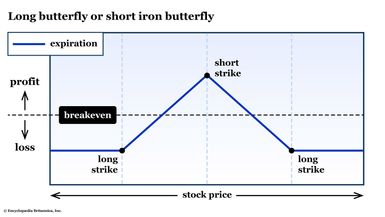
For any expiration-day settlement within the strikes (with enough padding on either side to cover the premium you paid), the butterfly will have a net profit. See figure 1.
Figure 1: BODY AND WINGS. A long butterfly spread—as well as a short iron butterfly—consists of a long option at each of two “wing” strikes and two short options at a “body” strike halfway between the wings. For educational purposes only.
Encyclopædia Britannica, Inc.
If you have the opposite point of view—if you expect a move outside the wing strikes—you could buy an iron butterfly. The risk and payoff profile would be an upside-down version of figure 1. You would pay a premium up front (which would represent your maximum loss if the underlying stock were to be outside the wings at expiration). Your maximum profit would be reached if the stock were to settle right at the middle strike at expiration.
Discover option strategies and spreads for protection, speculation, direction, and volatility with our interactive guide.
Encyclopædia Britannica, Inc.
Iron butterfly vs. call and put butterflies
A butterfly spread doesn’t have to be of the iron variety (a straddle and a strangle); it can be made up of all calls or all puts. And believe it or not, a call or put butterfly has the same risk profile as an iron butterfly, but there are a couple differences. (For a deep dive into call and put butterflies, refer to this primer.)
- Short iron butterfly="long" call or put butterfly. In a butterfly made up of all calls or all puts, the short body/long wings version (i.e., the one pictured in figure 1, with maximum profit at the peak and maximum loss outside the wings) is called a long butterfly because you’ll need to pay a premium to set it up. But it’s a short iron butterfly because you’ll collect more in premium from the short strikes (the body) than you’ll pay in premium for the wings. If you wish to get long the body and short the wings with an iron butterfly, you’ll pay a premium, so it’s called a long iron butterfly.
- Debit vs. credit. Again, whether you choose to pay or collect premium when initiating a butterfly or iron butterfly, the risk profile is the same. You’ll exercise any long in-the-money options, be assigned any short in-the-money options, and all out-of-the-money options will expire worthless. The only difference is whether, at expiration (or when you exit the position), you would settle up with a debit or a credit. Your net profit or loss is the same either way.
Fun fact: A short iron butterfly, with its short at-the-money straddle/long out-of-the-money strangle makeup, is similar to an iron condor, except that an iron condor has two middle strikes (i.e. it’s a short strangle and a long strangle) whereas the iron butterfly shares that middle strike. See figure 2.
Figure 1: Risk and reward in a range. Condor option spreads have four strikes. For educational purposes only.
Encyclopædia Britannica, Inc.
Doing the math on iron butterflies
Consider the following option chain. Assume the underlying stock is trading at $205 per share and that there are 30 days left until expiration. (Note: Options on stocks and exchange-traded funds—and many futures contracts, too—expire into a position in the underlying; that’s 100 shares in the case of a stock or ETF. The maximum risk and payoff numbers assume you would immediately liquidate your position in the underlying at that final price—not necessarily feasible in the real world—which is why most options trades are liquidated before expiration.)
| Call premium | Strike price | Put premium |
|---|
| 11.90 | 195.00 | 1.90 |
| 7.70 | 200.00 | 2.70 |
| 6.15 | 202.50 | 3.65 |
| 4.70 | 205.00 | 4.70 |
| 3.55 | 207.50 | 6.05 |
| 2.50 | 210.00 | 7.50 |
| 1.60 | 215.00 | 11.60 |
|
Suppose you were to sell the 200–210 iron butterfly. You’d be buying the 200-strike put for $2.70 and the 210-strike call for $2.55, and selling a call and put at the 205 strike for $4.70 apiece. You would collect a net premium of (-$7.70 + $4.70 + $4.70 – $2.55) = $4.15. (That’s $415 with the 100-share multiplier.) Here’s the math breakdown under several expiration scenarios.
Stock below $200 at expiration. Both the 205 and 210 calls finish out of the money (i.e., expire worthless). You’ll be assigned 100 shares of the underlying stock at $205, and you’ll exercise your option to sell the shares at $200 for a $5 loss, but because you collected $4.15 up front, your net loss on the trade is $0.85.
Stock above $210 at expiration. The 200 and 205 puts expire worthless. You’ll be assigned a short position at $205, and you’ll exercise your option to buy the shares at $210 for a $5 loss, but because you collected $4.15 up front, your net loss on the trade is $0.85.
Stock at $205 at expiration. This is the best-case scenario. The 200 put and the 210 call expire worthless. And if the underlying finishes right at $205, it’s likely you wouldn’t get assigned either the 205 call or the put. You pocket the entire up-front premium for a net profit of $4.15.
- Note: If the 205 call or put is in the money at expiration—even by a penny—you’ll likely be assigned the option (and the other will expire worthless). If so, you would need to buy or sell 100 shares to square up your position, and you might not be able to do that until the market opens the next day. This uncertainty is known as pin risk. It’s rare, but it does happen—and it’s another reason why most traders liquidate their option positions before expiration.
Breakeven points. In order to profit from this trade, the stock must be within $4.15 of the 205 strike (the premium you collected): $205 – $4.15 = $200.85 and $205 + $4.15 = $209.15. In between those two breakeven points, the closer the stock gets to $205, the closer you get to your max profit of $4.15. For example, if the stock finishes at $207.20, your profit would be $4.15 (the up-front premium) – $2.20 (the amount by which the 205 call is in the money) = $1.95 ($195 with the multiplier).
Iron butterfly strategies
Remember: A short iron butterfly is the combination of a short straddle and a long strangle; a long iron butterfly is a long straddle paired with a short strangle. So think of an iron butterfly as a straddle with endpoints. This is particularly useful in a short iron butterfly, because the risk in a short straddle is open-ended if the stock should experience a massive, meme stock–style rally or a financial crisis–type crash. Pairing it with a long strangle will give you an automatic stop-loss point for certain short straddle strategies, including:
Theta and vega: Navigating uncertainty
Veteran options traders have a saying: Volatility is time. Why? Because they’re both ways of expressing uncertainty. But time is a constant, whereas volatility is dynamic. Learn how options respond to the passage of time (“theta”) and volatility (“vega”).
- Fading an earnings report or other news event. Maybe the hype built into an earnings release has driven the implied volatility sky-high, and you think the stock won’t move much afterward.
- Expecting a fall in volatility. Or perhaps you think the volatility level is too high in general and is set to fall, irrespective of any impending news event. Because an option’s sensitivity to changes in volatility (“vega”) is highest in the at-the-money strike, a short iron butterfly is a short vega strategy with defined maximum risk.
- Collecting theta. Theta is an option’s sensitivity to the passage of time. All else being equal, an option with 25 days left until expiration is cheaper than the same option with 30 days left. And theta is highest in the at-the-money strike. If an iron butterfly has a theoretical value of $4.15, and its net theta is $0.09, when you log into your trading platform tomorrow, all else being equal, the iron butterfly would have a theoretical value of $4.06. The closer you get to expiration, the more rapidly an option’s premium decays.
And if you have the opposite view—you think volatility is set to rise, or you think the stock could experience an outsize move, for example—a long iron butterfly allows you to buy volatility exposure while offsetting the sometimes-steep price of a straddle with the premium you collect in a short strangle.
Iron butterflies allow you to target a specific move—or lack thereof—in a stock, ETF, or other security, while letting you define maximum risk and profit targets. But the spread has four components, which typically means higher transaction costs. Even if your broker offers commission-free trading, there are fees assessed by options exchanges, and those fees are typically passed on to you.
And remember: Most traders close out their positions or roll them to another expiration date well in advance of expiration. If expiration is approaching and you’re sitting on a big winner, consider sidestepping the eleventh-hour uncertainty and shut it down, even though you might be leaving a few theoretical ticks on the table. Or, if you’ve hit or approached your maximum risk, with a low likelihood of recovery, closing it out can declutter your trading account (and your trading mind) and free up some risk capital for the next trade.
This article was most recently revised and updated by Doug AshburnThis article was most recently revised and updated by Jennifer Agee