A metamorphosis into risk and reward.
Encyclopædia Britannica, Inc.
Options—on a stock, index, commodity, or whatever you’re trading—are a lot like chess. No matter how the market (or chessboard) is set up, there are strategies designed to give you good odds for a successful outcome. And if the market looks to be stuck in a range, or you think it’s poised to move outside a range but you’re not sure which direction, a butterfly spread might be the strategy for you.
You can set up a butterfly that’s made up strictly of call options, one that’s only put options, or an iron butterfly with two call options and two put options. No matter which butterfly type you choose:
- The butterfly will consist of four options spread over three strike prices (with two options in the middle strike).
- If the strike prices in your butterfly are equidistant, the risk profile of your butterfly will always take the same shape, whether it’s a call butterfly, put butterfly, or iron butterfly.
- If the strike prices are not equidistant, it’s called a broken-wing (or “unbalanced”) butterfly, and depending on your directional view, you might prefer it to the standard butterfly.
One more thing before you spread your wings: The simplest way to understand option spreads is to learn the risks and potential payoffs at expiration. That’s the date after which an option ceases to exist, and it’s either in the money (and worth its intrinsic value) or out of the money (and expires worthless).
Options on stocks and ETFs (and many futures contracts, too) expire into a position in the underlying (100 shares in the case of a stock or ETF). The maximum risk and payoff numbers assume you would immediately liquidate your position in the underlying at that final price. That’s not necessarily feasible in the real world, which is why most option trades are liquidated before expiration.
Key Points
- A long butterfly is short the body strike and long the two wing strikes; a short butterfly is long the body and short the wings.
- Whether a butterfly is made up of all calls or all puts, it has the same risk profile.
- Moving the wing strikes such that they’re no longer equidistant will create an unbalanced or “broken-wing” butterfly that adds a directional bias.
The long and short of butterfly spreads
A long call butterfly is the simultaneous sale of two call options at a strike price (the “body”), plus the purchase of one call option below that strike price and another call option above the strike price (the “wings”). In a standard butterfly spread, the strikes are the same distance apart. For example, a long 200–210 call butterfly would entail the purchase of a call at the 200-strike and at the 210-strike, and the sale of two calls at the 205-strike. A long 200–210 put butterfly would be the exact same makeup, but with put options instead of calls.
The objective of a long call or put butterfly is for the underlying stock (or other security) to be within the two long strikes at expiration, with the best-case scenario being an expiration-day settlement right at the middle strike. To initiate a long butterfly, you’ll pay a premium. If, at expiration, the underlying stock is outside the strikes (below $200 or above $210 in the example above), you’ll lose the entire premium you paid (plus any transaction costs).
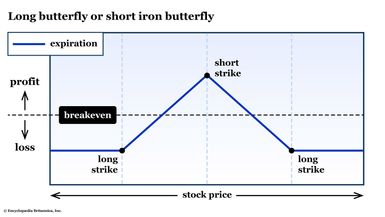
For any expiration-day settlement within the strikes (with enough padding on either side to cover the premium you paid), the butterfly will have a net profit. See figure 1.
Figure 1: BODY AND WINGS. A long butterfly spread—as well as a short iron butterfly—consists of a long option at each of two “wing” strikes and two short options at a “body” strike halfway between the wings. For educational purposes only.
Encyclopædia Britannica, Inc.
Of course, if you have the opposite point of view—if you’re expecting a move outside the wing strikes—you could sell a call or put butterfly. The risk and payoff profile would be an upside-down version of figure 1. You would collect a premium up front (which would represent your maximum profit if the underlying stock were to be outside the wings at expiration). Your maximum loss would be reached if the stock were to settle right at the middle strike at expiration.
Doing the math on butterflies
Consider the following option chain. Assume the underlying stock is trading at $205 per share and that there are 30 days left until expiration.
| Call premium | Strike price | Put premium |
|---|
| 11.95 | 195.00 | 1.95 |
| 7.70 | 200.00 | 2.70 |
| 6.15 | 202.50 | 3.65 |
| 4.70 | 205.00 | 4.70 |
| 3.55 | 207.50 | 6.05 |
| 2.55 | 210.00 | 7.55 |
| 1.75 | 215.00 | 11.70 |
Suppose you were to buy the 200–210 call butterfly. You’d be buying the 200-strike call for $7.70 and the 210-strike call for $2.55; you would sell two of the 205-strike calls for $4.70 apiece, for a net premium of ($7.70 – $4.70 – $4.70 + $2.55) = $0.85. (That’s $85 with the 100-share multiplier.) Here’s the math breakdown for several expiration scenarios.
The multiplier effect
The standard contract size for options on U.S. equities and exchange-traded funds (ETFs) is 100 shares. So in each of these examples, in order to convert your premium to dollar terms, multiply the premium by 100. If you need a refresher, visit Britannica Money’s guide to option specs, including contract size, expiration, exercise, and settlement.
Stock below $200 at expiration. All four options (remember there are two of the 205 calls) finish out of the money (i.e., expire worthless). You lose the entire premium of $0.85.
Stock above $210 at expiration. All four options expire in the money. You exercise the 200 call and 210 call, and you’re assigned two of the 205 calls. So you’re effectively going long 100 shares at $200, selling them at $205, going short 100 more shares at $205, and buying them back for $210. All the stock nets out. You’re left with no positions, but you lose the $0.85 premium.
Stock at 205 at expiration. This is the best-case scenario. The 210 call expires worthless. You exercise the 200 call and sell 100 shares of the stock in the open market at $205 for a $5 gain, less the $0.85 premium, for a net profit of $4.15.
- Note: If the owner of one of the 205 calls were to exercise their option, instead of selling 100 shares, the assignment of a 205 call would be matched against your 200 call. Same outcome. If, however, you were assigned both of the 205 calls, you would need to buy 100 shares to square up your position. This is known as pin risk. It’s rare, but it does happen—and it’s another reason why most traders liquidate their option positions before expiration.
Breakeven points. In order to profit from this trade, the stock must be between the butterfly’s wings with enough padding to cover the $0.85 premium you paid: $200 + $0.85 = $200.85 and $210 – $0.85 = $209.15. In between those two breakeven points, the closer the stock gets to the $205, the closer you get to your max profit of $4.15. For example, if the stock finishes at $207.20, your profit would be $209.15 – $207.20 = $1.95 ($195 with the multiplier).
Suppose you had opted for a put butterfly instead. The calculations would be essentially the same: A net premium up front of $0.85, a maximum profit of $4.15 (if the stock were to settle at $205 on expiration day), and a loss of the $0.85 premium if the stock finished expiration day below $200 or above $210.
Discover option strategies and spreads for protection, speculation, direction, and volatility with our interactive guide.
Encyclopædia Britannica, Inc.
Broken-wing butterfly (aka unbalanced butterfly)
In a standard butterfly, all the strikes are equidistant, which is why the risk profile and all the payoff scenarios are symmetrical. But they don’t have to be. If you have a directional bias, you can tip the strike prices one way or the other and increase your worst-case scenario in one direction while lowering it in the other direction. That’s called an unbalanced or “broken-wing” butterfly (see figure 2).
Figure 2: ONE SIDE FLOATS; THE OTHER STINGS LIKE A BEE. This long broken-wing call butterfly is set up for a credit, and the worst-case scenario to the downside is still a profit. However, if the stock rallies through the upper strike, the maximum loss is much higher. For educational purposes only.
Encyclopædia Britannica, Inc.
For example, suppose instead of the 200–210 call butterfly, you were to buy the 200–205–215 broken-wing call butterfly. You could place this trade and actually collect a credit of ($7.70 – $4.70 – $4.70 + $1.60) = $0.10. No matter how far the stock falls in this scenario, you’d still make a dime on this spread.
But with options, there’s always a trade-off. For this broken-wing call butterfly, the trade-off is a big rally—all the way through the 215 strike. Instead of an endpoint of $210 (as it would be in a standard, balanced butterfly), it’s $215. So your worst case is the premium you collected minus that extra $5 of in-the-money intrinsic value, or ($0.10 – $5) = $4.90.
If you have a directional bias to the downside, you might be fine with that risk/reward scenario. But it will hurt to be wrong.
Butterfly option spreads—like their cousin, the iron butterfly—can be an appropriate choice if you have a view on volatility and magnitude, but you’re unsure about the direction. For a few ideas on when to consider one, visit this rundown of iron butterfly strategies.
And if you do have a directional bias, but your primary expectations are still volatility and magnitude, by extending (“breaking” or “unbalancing”) one of your wing strikes, you can bias your risk/reward profile in one direction or the other.
But note: These are complex, multi-leg strategies with lots of moving parts (including transaction costs). Before you jump in, make sure you understand how options move, how expiration works, and how much risk you can tolerate. If you have access to a trading simulator, it’s probably best to practice with fake money before trading complex option spreads with real money.
This article was most recently revised and updated by Doug AshburnThis article was most recently revised and updated by Jennifer Agee