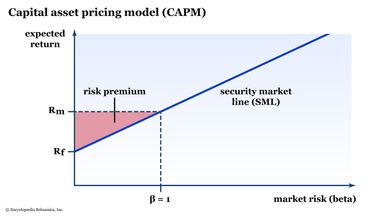
The capital asset pricing model (CAPM) explains how risky assets are priced and how they fit into a diversified portfolio.
Encyclopædia Britannica, Inc.
The capital asset pricing model (CAPM) is a financial model that calculates the expected return on a stock or other asset based on its sensitivity to the overall market. Developed by American economist William F. Sharpe in 1964, the model assumes that investors require higher returns for taking greater risks, but only for risks that can’t be reduced through diversification.
CAPM builds on the modern portfolio theory (MPT), a concept developed by Harry Markowitz and first published in 1952. The two economists, along with Merton H. Miller, received the 1990 Nobel Prize in Economics for their research in investment decision-making and portfolio allocation.
CAPM begins with a risk-free rate of return. For U.S. investments, that typically means the ten-year Treasury note. It then adds a premium based on how sensitive an investment is to movements in the market, typically represented by a broad market index such as the S&P 500:
R = rf + β (rm – rf)
Where:
- rf is the risk-free rate of return, typically represented by the yield on a government security such as the 10-year Treasury note.
- β (beta) measures the investment’s sensitivity to movements in the overall market.
- rm is the expected return on the market.
- ( rm – rf ) is the market risk premium, or the additional return investors expect for taking market risk.
CAPM and modern portfolio theory
Harry Markowitz’s modern portfolio theory (MPT) showed how combining investments with different risk characteristics can reduce a portfolio’s overall risk. CAPM builds on that work by calculating the return investors require for the market risk that remains after diversification.
Learn more about modern portfolio theory.
A stock with a beta of 1.0 has the same sensitivity to market movements as the market itself. A beta of 1.5 indicates 50% greater sensitivity than the broader market, while a beta of 0.5 indicates half the sensitivity. Beta is generally calculated using historical returns. Specifically, it’s the covariance of a stock’s returns with those of its market benchmark, divided by the variance of the benchmark’s returns. But beta isn’t fixed. Over time, changes in a company’s business, debt levels, and broader market conditions can significantly alter its sensitivity to the market.
Suppose a stock has a beta of 1.2, the 10-year U.S. Treasury note is 4%, and the expected annual return on the S&P 500 is 9% (which is roughly in line with the index’s long-term historical average). That gives us a market risk premium of five percentage points (9% − 4%).
Using the CAPM formula:
R = 4% + 1.2 (9% − 4%) = 10%
The stock’s expected return under CAPM is 10%. Of that, four percentage points come from the risk-free rate, and six from the market risk premium adjusted for beta. The calculation doesn’t mean the stock will earn 10%, or even that it would earn 10% if the S&P 500 is up 9%. It represents the return investors would (or should) require for accepting that amount of market risk.
A note on the risk-free rate
CAPM typically uses the yield on a government security, such as a U.S. Treasury, as a proxy for the risk-free rate. In practice, analysts typically use the 10-year Treasury yield for long-term investments, while shorter-term Treasury bills are more appropriate for a shorter investment horizon.
Although U.S. Treasurys are generally considered to have negligible default risk, they’re technically not “risk-free.” Think of it as a theoretical benchmark, with Treasury yields serving as a practical approximation.
Market risk and diversification
CAPM distinguishes between two types of risk. Systematic risk, also called market risk, affects the broader market. A recession, changes in interest rates, or an unexpected rise in inflation can impact all 11 sectors of the market at once. Holding more stocks won’t eliminate this risk.
Unsystematic (also called “idiosyncratic”) risk is specific to an individual company or industry. A failed product launch, an accounting scandal, or the loss of a major customer can hurt one company’s stock without necessarily affecting the broader market. You can reduce exposure to these risks by holding a diversified portfolio.
Under CAPM, investors aren’t rewarded for taking company-specific risks they can avoid through diversification. Instead, the model uses beta to calculate the additional return investors expect for taking on market risk.
Uses and limitations of CAPM
A company may use CAPM to estimate its cost of capital and evaluate expected returns on its investments. An investor may use CAPM to assess whether a stock’s expected return justifies its market risk or to compare the risk and expected returns of different portfolio allocations, a process known as beta weighting.
CAPM has its limitations. For one thing, it assumes all investors can borrow at the risk-free rate, which isn’t generally possible. It also relies on beta as the sole measure of market risk, although other factors, including company size and valuation, have been shown to influence stock returns. Even so, more than six decades after Sharpe introduced the model, CAPM remains widely used to evaluate the relationship between risk and expected return.
Diversification: A key principle of CAPM.
Encyclopædia Britannica, Inc.