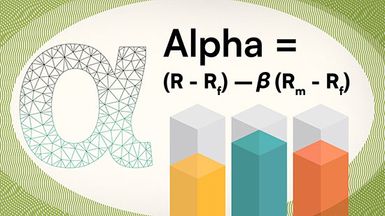
It takes rare skill to capture “excess” returns.
© Viktor/stock.adobe.com; Photo illustration Encyclopædia Britannica, Inc.
If you’re looking to invest in an actively managed fund, you probably have one goal in mind: to beat the market. You’re looking for added value above and beyond what a passive index fund can deliver.
This added value comes in the form of a fund manager’s superior skill (or their perceived skill, anyway) in picking and managing stocks and other financial instruments. And there’s a word for that extra gain above the broader market’s return: alpha.
Investors often talk about alpha. The fund management industry touts alpha. But is it real, measurable, and, most importantly, sustainable? Learn about the two types of alpha, how they’re measured and used (and misused), and judge for yourself.
Key Points
- Alpha, in its most basic form, is excess return above and beyond a benchmark’s return.
- Jensen’s alpha is excess return above what analysts were expecting, adjusted for risk and relative to the benchmark.
- True alpha—manager skill—is hard to measure and even harder to sustain.
Raw alpha vs. Jensen’s alpha
In its simplest definition, alpha is excess return above a benchmark’s return. This is also called raw alpha.
To illustrate, suppose the following:
- The S&P 500 returned 10% in a given year.
- A given fund returned 12% that same year.
That extra 2% is alpha, plain and simple.
But here’s where things get a bit more complicated. What if that fund took on more risks than the index itself? For example, what if it held more (or gave more weight to) volatile stocks, relative to the S&P 500?
In that case, analysts might have expected even more from the fund. What does this mean? Although the fund beat the S&P 500, it should have returned even more because it took on more risk. There’s another term for this, and it’s called Jensen’s alpha.
Put simply, Jensen’s alpha is excess return above what analysts were expecting, adjusted for risk and relative to the benchmark. But how do you know what analysts were expecting? For that, we turn to the capital asset pricing model (CAPM), William Sharpe’s Nobel-winning formula that essentially says stock returns are a function of market risk—nothing else.
Beta and the capital asset pricing model (CAPM) equation
Going back to the previous example, suppose the fund that returned 12% took on twice as much risk (2.0 beta in the CAPM formula) compared to the market (which returned 10% and had a 1.0 beta). Assume a 10-year Treasury yield (the risk-free rate) of 4%.
With a beta of 2.0, the CAPM would assume a return (R) of 4 + 2 (12 – 4) = 20%.
But because it only returned 12%, the fund’s Jensen’s alpha would be 12 – 20 = -8%.
Do you see the difference? The fund’s 12% return outperformed against the market measured in raw alpha, but it underperformed relative to CAPM expectations.
Note: When funds list their alpha, they’re usually referring to Jensen’s alpha, not raw alpha.
Alpha as the manager’s skill?
Funds list alpha to highlight the added value that their managers bring to the table; a fund’s outperformance is attributed to their skill. Without the fund manager, there would be no alpha.
As you’d expect, funds with higher alphas tend to charge higher management or performance fees. But is a fund’s outperformance due solely to a manager’s skill? Not always. In fact, some critics argue that the notion of alpha is highly problematic. Let’s look at why.
Where alpha may fall short
If alpha is difficult for money managers to achieve, it may be just as hard to find funds that, despite their alpha figures, achieve “true alpha” on a consistent and sustainable basis. Here’s where alpha can get tricky.
The Sharpe ratio
Although he was best known for developing the CAPM, Sharpe’s later work went a step further. He suspected that many portfolio managers were generating their returns by taking high levels of risk, but that their returns weren’t necessarily all that great after the amount of risk was factored in.
So he developed the Sharpe ratio to adjust for risk:
Sharpe ratio = (portfolio return – risk-free rate) ÷ portfolio standard deviation
Learn more about the Sharpe ratio and how it can be used in conjunction with (or instead of) alpha to assess manager skill.
- CAPM can be misleading. The CAPM model is based exclusively on market risk (beta) when forecasting returns, but other factors could have an effect. One famous example is the Fama-French three-factor model, which adds market capitalization and book value to market risk as determinants of fund return.
- Excessive risk-taking. There are times when a fund manager achieves alpha by taking on more risk and being lucky. High-risk strategies can definitely boost returns if they happen to work. But critics would argue that adding risk is essentially adding beta, not alpha.
- Consistency over a long time period. One-time alpha isn’t enough. But what is enough? Two times, three times, four, or more? Try a decade or two—long-term periods that can demonstrate a manager’s skill across multiple economic cycles and bull/bear markets.
- Manager and investment strategy changes. Funds change managers over time. Sometimes, a new manager will even change strategy. If alpha is associated with skill-based outperformance, then changes in manager or strategy might decrease the alpha’s validity.
- Manipulated benchmarks. Although “cherry-picking” and data manipulation should be disclosed to investors in the fund prospectus, portfolio managers have been known to switch benchmarks to deceptively boost the fund’s apparent alpha.
The bottom line
Spotting a consistent alpha-generating fund manager is like finding a unicorn, and chasing alpha has become something of near-mythical pursuit, like the quest for the Holy Grail. This is not to say that true alpha doesn’t exist, but it can be hard to find and even harder to sustain over a meaningful period.
Always keep in mind that past performance doesn’t indicate future results. Market conditions and economies are driven by dynamic, evolving, and often unpredictable factors. And if you need a final reminder, remember that investors in Bernie Madoff’s hedge fund believed him to be a pure alpha generator, but as it turned out, he was operating a massive Ponzi scheme.
This article was most recently revised and updated by Karl MontevirgenThis article was most recently revised and updated by Doug Ashburn