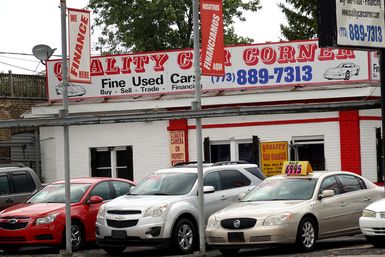
Does the dealer have the upper hand?
Scott Olson/Getty Images
- Also Known As:
- antiselection
Adverse selection is a term used in economics and insurance to describe a market process in which buyers or sellers of a product or service are able to use their private knowledge of the risk factors involved in the transaction to maximize their outcomes, at the expense of the other parties to the transaction. Adverse selection is most likely to occur in transactions in which there is an asymmetry of information—that is, where one party has more or better information than the other party. Asymmetry of information impacts both buyers and sellers:
- Asymmetry of information tends to favor the buyer in markets such as the insurance industry, where the buyer knows much more about their personal needs and risks than the insurance provider. For example, a person might lower the deductible on their health insurance policy, knowing that they expect to file a major claim within the next few months.
- The seller usually has better information than the buyer in markets such as used cars, stocks, and real estate, where they have more knowledge of the products. For example, a homeowner may know of a home’s history of basement flooding, but not fully disclose the information to a potential buyer.
Adverse selection in insurance
The concept of adverse selection was first used predominantly in the insurance industry to describe the likelihood that people who elect to purchase insurance policies will file claims that will, over the life of the policy, exceed the total dollar value of the premiums they pay.
Individuals who elect to purchase insurance may know they have higher risk factors than the population average and thus are more likely to file future claims. If insurers use the risk factors of the general population to set premiums, they could lose money if and when the number of individuals who file claims exceeds the population average. If insurers raise the cost of premiums to cover the increased claims, they also increase the likelihood that individuals who know they are less likely to file future claims will opt out of the plan, increasing the number of individuals remaining in the plan who will file claims. This unraveling, also known as a death spiral, is typical of adverse selection environments.
Insurers might try to cope with the challenges imposed by adverse selection by insuring only certain buyers, such as those with no history of disease or young people. If insurers have the ability to deny coverage to individuals who are deemed “high risk,” such as those with preexisting conditions, they will try to insure only those least likely to file future claims. Insurers do this to minimize the number of claims that individuals file, because an increase in claims drives up their costs.
This practice, known as “cherry-picking” or “cream-skimming,” may result in insurers providing coverage to a group of individuals who are less likely to file claims than the population average, thereby increasing the insurers’ profits. In those instances, the costs incurred by the higher-risk individuals are generally borne by society. To combat that practice, the government may forbid insurers to act on information about their population even if they are able to discover it. For example, some governments require health insurance providers to insure all who apply, at the same cost, regardless of their individual risk factors.
Sometimes, contractual agreements contain inherent bias or fail to prioritize the interest of society as a whole. Such agreements may incentivize cheating or other misbehavior in what’s known as moral hazard.
To learn more about different types of insurance, including life insurance, health insurance, home insurance, and even pet insurance, visit Britannica Money.
Carmen M. AlstonThis article was most recently revised and updated by The Editors of Encyclopaedia Britannica