Although many provisions of the new law took effect in 2010, some wouldn’t take full effect for several years. Provisions entering into force in 2010 included:
- Insurance plans could no longer deny coverage of preexisting conditions in children, nor could insurance providers put a lifetime limit on payouts. People who were uninsured because of preexisting conditions could get insurance through a temporary high-risk pool.
- Within six months of the bill’s signing, all existing health plans and any new ones were required to cover dependent children of policyholders until age 26.
- The “doughnut hole” gap in Medicare coverage for prescription drugs would begin closing in 2010 and be entirely wiped out by 2020. Medicare recipients who reached the gap in 2010 would receive a $250 rebate, and seniors were promised discounts on brand-name drugs in future years.
- Private insurance plans were required to offer minimum packages of benefits that would be determined by the federal government.
Several additional changes were slated to phase in starting in 2014, including:
- Most Americans would be required to carry a minimum level of health insurance or pay a penalty (the individual mandate).
- States would have until 2014 to create health insurance exchanges that would be open to people who did not have coverage through their jobs and to employers with 100 or fewer workers. A federal exchange would be created for use by people living in states that refused to set up their own exchanges. The federal government would provide advance premium tax credits and cost-sharing subsidies to reduce premiums and out-of-pocket expenses for low- and middle-income Americans.
- Eligibility requirements for Medicaid would be revised to cover anyone earning less than 133% of the poverty level, eventually resulting in an estimated 16 million new beneficiaries. From 2014 to 2016, as this provision took effect, the federal government would foot the entire bill for new beneficiaries, but the federal share would gradually decrease to about 90%.
- Businesses with 50 or more workers would be assessed a penalty starting in 2014 if they didn’t offer benefits and if any of their workers bought subsidized coverage through the new exchanges.
To finance the health care overhaul, several new fees and taxes would be levied. An excise tax would be imposed on the most expensive employer-sponsored health insurance plans, although Congress repealed the tax in 2019 before it took effect.
Beginning in 2013, the Medicare payroll tax would be increased for high-salaried employees, who also would have to pay a new tax on unearned income, including stock dividends and capital gains.
The Affordable Care Act imposed limitations on the use of federal money. Under the reform law, federal funds could not be used for abortions except in cases of rape or incest or when the mother’s life was endangered. Further, immigrants in the United States unlawfully would be unable to buy insurance through the health insurance exchanges even if they paid the full cost themselves.
At the time of the law’s passage, the Congressional Budget Office (CBO) projected the legislation would extend coverage to some 32 million additional Americans by 2019, leaving only about 6% of legal residents uninsured. The CBO estimated that the plan would cost $938 billion over the next 10 years but would reduce the budget deficit by $143 billion in that period and by another $1.2 trillion over the following decade.
Implementation and challenges to ACA subsidies
The federal health insurance exchange, which operated through a Web site called HealthCare.gov, was officially opened on October 1, 2013. However, severe technical problems with the site prevented many users from enrolling in health insurance plans during the first two months of the first open enrollment period, which ended on March 31, 2014; a special enrollment period, ending on April 19, 2014, was added for those who had been unable to complete their applications because of last-minute site failures on March 31.
In May the Obama administration announced that more than 8 million people had purchased health insurance on the federal and state exchanges.
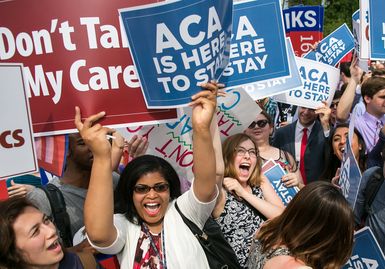
The Supreme Court ruled in 2015 that ACA subsidies were available to eligible consumers using the federal insurance exchange.
© Al Drago—CQ Roll Call/Getty Images
In July 2014 the Court of Appeals for the District of Columbia Circuit ruled in Halbig v. Burwell that the federal government could not subsidize individual health insurance policies purchased on the federal exchange, because a provision of the Affordable Care Act that determined the amount of such subsidies referred only to exchanges “established by the State.” Because most people who used the federal exchange would have been unable to afford and thus to purchase health insurance without the subsidies, the decision, had it been upheld by the Supreme Court, threatened to deprive millions of people of their insurance coverage. Only hours later, however, the Court of Appeals for the Fourth Circuit, in King v. Burwell, reached the opposite conclusion, holding that the federal subsidies were permissible because the relevant language of the Affordable Care Act was ambiguous. The Fourth Circuit’s decision was eventually affirmed by the Supreme Court on June 25, 2015.
The ACA during Trump’s first term
By 2016, the last full year of Obama’s second term, nearly 20 million formerly uninsured Americans had acquired health care coverage through the new exchanges or through the expansion of Medicaid in participating states, and the rate of increase in premiums for employer-based health insurance was considerably lower than it had been during the decade preceding implementation of the Affordable Care Act.
Notwithstanding those successes, Republicans in Congress repeatedly condemned the law throughout Obama’s presidency, voting more than 50 times in the House of Representatives to repeal or amend it after the party won control of the chamber in 2010. In 2014 the Republicans also gained a majority in the Senate, and in 2016 Republican Donald J. Trump was elected president of the United States, giving the party control of both the executive and legislative branches of the federal government.
Trump, who had long derided Obamacare as an expensive failure, had campaigned on a pledge to replace it with a plan that would provide all Americans with better coverage at lower premiums. Accordingly, in his first executive order (13765), Trump directed all relevant executive departments and agencies “to minimize the unwarranted economic and regulatory burdens” of the Affordable Care Act pending its repeal. Because he had not worked out a detailed alternative to the law, however, he was forced to rely on Republicans in the House to draft a bill.
That task proved to be politically difficult, as it soon became apparent that changes of the sort that Republicans were contemplating—including elimination of the individual mandate, cuts in Medicaid funding, and reductions in credits to offset insurance premiums—would disrupt the exchanges and cause several million Americans to lose their health insurance.
Divisions between moderate and more-conservative Republicans in the House, and the angry feedback of constituents who now supported some form of the Affordable Care Act, prevented passage of a replacement bill until May 2017. During the next four months, similar divisions doomed several versions of a Senate bill, three of which were dramatically voted down in July; a final version was withdrawn in September.
Sharply critical of Congress for having failed to replace the Affordable Care Act, Trump signed an executive order in October (13813) that permitted the sale of cheaper health insurance policies with fewer benefits than those that had been required under the law. He also said his administration would immediately end federal cost-sharing subsidies for low- and middle-income Americans.
In December 2017 Republicans in Congress adopted—and Trump signed into law—a comprehensive tax bill that, in one of its provisions, effectively repealed the individual mandate by reducing the penalty for failing to carry health insurance to $0 beginning in 2019.
After the COVID-19 outbreak in early 2020, the Trump administration declined to create a nationwide special enrollment period for the federal health insurance exchange, although people who lost job-based coverage could qualify for existing special enrollment periods.
Litigation over the individual mandate
In Texas v. United States, a suit brought by several Republican-led states and two individuals, a U.S. district court held in December 2018 that the individual mandate was unconstitutional (because it could no longer be enforced as a tax) and wasn’t “severable” from other provisions of the Affordable Care Act. On those grounds, it declared the entire act unconstitutional.
The ruling, which was widely criticized, was partly upheld in December 2019 by the Court of Appeals for the Fifth Circuit, which found the individual mandate to be unconstitutional but remanded the case for further consideration of the severability question.
In March 2020 the Supreme Court granted two petitions for review of the Fifth Circuit’s decision, which it consolidated as California v. Texas. In a 7–2 decision issued in June 2021, the Court declined to rule on the questions of the constitutionality of the individual mandate and the mandate’s severability from the Affordable Care Act, instead holding that the parties challenging the law lacked standing to sue.
The ACA under Biden and Trump’s second term
In January 2021, newly elected Democratic Pres. Joe Biden signed an executive order (14009) that revoked Trump’s orders 13765 and 13813; created a new open enrollment period for Obamacare, to last from February 15 to May 15 (the period was later extended to August 15); and mandated reviews of departmental and agency actions under the Trump administration that were inconsistent with Biden’s policy “to protect and strengthen Medicaid and the ACA.”
The American Rescue Plan Act, passed two months later, temporarily increased federal premium subsidies for ACA plans, part of a broader package of economic relief enacted in response to the COVID-19 pandemic. The enhanced subsidies included making benchmark coverage available without a premium to some lower-income enrollees. The Inflation Reduction Act of 2022 extended the enhanced subsidies through 2025.
Enrollment in ACA marketplace plans rose sharply during this period. By February 2026, an estimated 19.2 million people were enrolled, well above enrollment levels before the pandemic.
The enhanced subsidies expired at the end of 2025, leaving many enrollees with substantially higher premiums. By mid-2026, ACA enrollment had fallen by about 3 million, or 13%. Hospitals also reported increases in uninsured patients, unpaid medical bills, and charity care as some former ACA enrollees went without coverage.
After returning to office in 2025, Trump again sought changes to the ACA marketplaces, with his administration arguing that tighter eligibility checks were needed to prevent improper enrollment and fraud. Some of the administration’s regulatory changes, including stricter subsidy verification requirements and expanded access to catastrophic plans, were temporarily blocked by a federal court.
Other restrictions enacted by Congress were scheduled to take effect in later years, including changes to automatic reenrollment and income-verification requirements.
Michael LevyThis article was most recently revised and updated by The Editors of Encyclopaedia Britannica