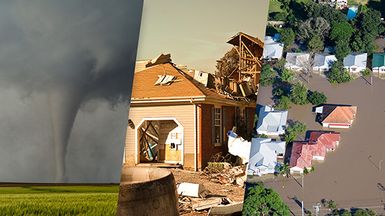
Is your insurance ready for Mother Nature?
© Matthew/stock.adobe.com, © Nando Azevedo/stock.adobe.com, © On-Air/stock.adobe.com; Photo composite Encyclopædia Britannica, Inc.
Over the past two decades, weather-related natural disasters and ensuing insurance claims have risen significantly. The Eastern Seaboard in the U.S. is experiencing more frequent and fiercer hurricanes, while wildfires in the West are becoming larger and more commonplace. Floods once projected to occur every 1,000 years now arrive with increasing regularity, devastating entire communities. And then there are earthquakes, which can strike unexpectedly even in places not prone to them.
Whether you blame climate change or not, these so-called acts of God—that is, unavoidable disasters outside human control—can be devastating to victims. And that devastation is often compounded when homeowners discover their insurance policies won’t cover the damage. But there are ways to ensure you’re not caught unaware and uncovered should a natural disaster strike.
Key Points
- A typical homeowner’s policy (property insurance) may not adequately protect you against acts of God, requiring additional coverage.
- Review your policy with your insurance agent or company and ask relevant questions, including what your options are if your policy gets canceled and how you can minimize risk.
- Coverage differs based on the type of dwelling you live in; costs vary accordingly.
Understand the coverage you have
To avoid Mother Nature getting the best of you financially, it pays to know what your comprehensive homeowner’s policy (known as an HO-3) covers. Home insurance policies are long and full of legal jargon, so even if you’ve read the entire document, you may be unclear about just what is covered. Your insurance agent (or company, if you buy direct) can help you identify the coverage for acts of God contained in your policy, such as:
Figuring out which homeowner’s policy is right for you
- Water. The insurance industry distinguishes between water damage caused by wind and water damage caused by flooding. For example, when a windstorm damages your roof and rain comes pouring into your house, insurance companies will typically consider it wind damage. But rising water that fills your basement is considered flood damage, even if the cause of the flooding is rain or storm surge associated with a wind event. Understanding the difference is important because flood damage isn’t covered under a typical homeowner’s policy; it must be purchased separately. (Victims of Hurricane Katrina without flood insurance learned this distinction firsthand after insurers refused to cover damage caused by the storm that resulted from breached levees.)
- Wind. Wind and hail damage is the number one cause of insurance claims, and most homeowner’s policies cover it, according to the Insurance Information Institute (III). You may be subject to a separate deductible for wind and hail coverage—or need an additional policy or a rider—if you live in a state at high risk for hurricanes or tornadoes.
In both cases, your deductible—the amount you’re responsible for paying toward the cost of repairs—is a percentage of your dwelling coverage instead of a fixed amount; it can range from 1% to 5%. For example, if your home is insured for $350,000, and your wind/hail deductible is 5%, $17,500 is deducted from the amount of your claim before insurance kicks in. In addition, a named storm or hurricane, as designated by the National Weather Service, may trigger a separate deductible in addition to or instead of your wind/hail deductible.
You can minimize risk before disaster strikes by identifying and mitigating potential hazards and making improvements to protect your property.
In the case of wildfires, for example, clearing vegetation near your home and installing a fire-resistant roof can reduce your susceptibility to loss. To avoid damage from windstorms, remove or trim substantial trees close to your house to help prevent limbs from falling on or into your home. Installing a sewer backflow valve as well as elevating furnaces, water heaters, and electrical components can help protect them from basement flooding.
Understanding who pays
A common point of confusion among many policyholders is who pays for what. If your neighbor’s tree falls on your house, for example, whose insurance policy covers it? And what if negligence is involved? Knowing who’s responsible is important because you may have to pay a deductible to repair any damage. Policies may also limit how much is paid for tree removal.
Taking these steps may entitle you to a discount on your insurance premium, so advise your insurance agent or company after you’ve made any improvements to lock in your savings.
Beyond standard homeowner’s insurance
Let’s look at several types of natural disaster coverage that aren’t included in a basic homeowner’s policy.
Flood insurance. Flood insurance must usually be purchased separately. The National Flood Insurance Program is managed by the Federal Emergency Management Agency (FEMA); insurance can be purchased directly from FEMA or through most insurance agencies.
Flood insurance isn’t just for beachfront homeowners. A significant portion of flood claims come from outside high-risk flood areas, and flooding has occurred in 99% of the counties in the United States, according to FEMA. Swollen rivers, saturated soils, and runoff caused by torrential rains and melting snow are typical sources of flooding.
Flood insurance coverage limits are low—the maximum amount for a house is $250,000 and $100,000 for its contents. Additional coverage may be available through a private flood insurance company. The National Flood Insurance Program features an online directory of flood insurance providers.
Renter’s or condo insurance. As a tenant or condominium owner, you aren’t responsible for insuring the building you live in, but purchasing renter’s insurance (an HO-4 policy) or a personal condo insurance policy (HO-6) ensures your belongings can be replaced in the event of a natural disaster.
Car insurance. Damage to your car from an act of God is typically covered if you have comprehensive auto coverage. Some drivers opt out of this policy as their cars age, or pay off their loans to save money on the premium. Knowing the value of your car and how much it would cost to replace it can help you determine whether it makes financial sense to maintain comprehensive coverage.
Earthquake insurance. Fault lines run throughout the United States, not just California, so you might live closer to one than you think. Typical homeowner’s policies don’t cover damage caused by earthquakes. In areas prone to tremors, earthquake policies can be quite expensive, while the cost may be reasonable in other locations. You may be able to purchase a separate policy or add a rider to your existing homeowner’s policy.
Areas where fracking is common have experienced tremors caused by wastewater being injected into the ground. Because such movements are technically caused by human activity and not an act of God, your earthquake insurance may not cover it, so ask your agent if these incidents are included or if you can add a rider.
My policy got canceled. What do I do now?
Although it’s important to understand which acts of God are covered by your homeowner’s policy, it doesn’t guarantee you’ll keep your coverage. The uptick in claims resulting from catastrophic natural disasters has prompted some insurers to cancel existing policies and refuse to write new ones in high-risk areas.
Florida (hurricanes) and California (wildfires) are good examples. Many homeowners in these states have been left scrambling to find new and often more expensive coverage with another insurer. If you can’t find coverage through an agent or insurance company, many states have established high-risk insurance pools to act as a market of last resort.
Two-thirds of U.S. states offer these pools, so check with your state insurance department for availability. Often called Fair Access to Insurance Requirements (FAIR) plans, the coverage these policies provide may be less comprehensive and have more stringent requirements than those offered by private insurance companies.
Consider insuring your home for an amount that will allow it to be rebuilt and help you replace your belongings in the event of an act of God (or other peril). Insuring your property is a fundamental financial building block—like establishing an emergency fund or saving for retirement.
It’s important to know what your homeowner’s policy covers, so read it carefully and ask questions if you don’t understand the language or think something is missing. Your insurance agent or company is a good resource, but there’s no substitute for your own due diligence.
Be aware of the natural disasters that are possible in your area, whether it’s hail, ice storms, windstorms, wildfires, tornadoes, earthquakes, hurricanes, or a neighbor’s tree. Having planned for the worst, you can take some comfort in knowing that you’re as prepared as you can be for whatever Mother Nature has in store.
This article was most recently revised and updated by Vera WilsonThis article was most recently revised and updated by David Schepp