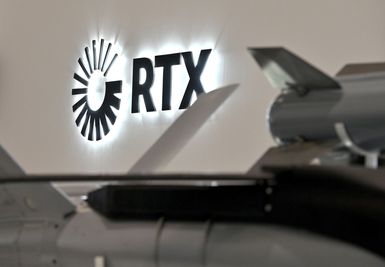
RTX ranks among the world’s largest aerospace and defense contractors.
© John Keeble/Getty Images
- Also Known As:
- Raytheon Manufacturing Company
- American Appliance Company
- Raytheon Company
- Raytheon Technologies
- Share price:
- $198.58 (mkt close, Nov. 13, 2026)
- Annual revenue:
- $95.99 bil.
- Earnings per share (prev. year):
- $6.15
- CEO:
- Mr. Christopher T. Calio J.D.
- Industry:
- Aerospace & Defense
RTX Corporation (RTX) is an American aerospace and defense company headquartered in Arlington, Virginia. It was created in 2020 when Raytheon Company combined with United Technologies Corporation. The combined company was renamed RTX Corporation in 2023. Its predecessor companies helped shape the modern aerospace and defense industry. RTX operates through three principal businesses: Collins Aerospace (aircraft systems and avionics); Pratt & Whitney (jet engines); and Raytheon (defense systems). Christopher T. Calio became chief executive officer (CEO) in May 2024, and was elected chairman in 2025.
Raytheon Company, one of the predecessors of RTX, was founded in 1922 in Cambridge, Massachusetts, as the American Appliance Company by three scientist-engineers: Laurence K. Marshall, Charles G. Smith, and Vannevar Bush. The company initially explored new refrigeration technology but soon shifted to electronics, developing a “gaseous rectifier,” an electron tube that converted alternating current to direct current for radios and eliminated the need for short-lived batteries. In 1925, it was renamed Raytheon Manufacturing Company and marketed the rectifier under the name Raytheon with great success.
The company was reincorporated in 1928 after merging with Q.R.S. Company, a producer of electron tubes and switches, and diversified further in 1933 by acquiring Acme-Delta Company, a manufacturer of transformers, power equipment, and electronic auto parts. Over the following decades Raytheon became a major supplier of radar, sonar, and missiles for the U.S. military and international markets and produced electronic and communications systems for satellite and navigation programs, including Global Positioning System (GPS). In 1959, it dropped Manufacturing from its name and became Raytheon Company.
By 2011, Raytheon employed about 70,000 workers worldwide and sold its defense and electronics products in more than 80 countries. Its headquarters were in Waltham, Massachusetts. In 2020, Raytheon merged with United Technologies Corporation in a merger of equals that created Raytheon Technologies, later renamed RTX Corporation.
World War II and radar development
Early in World War II, physicists in England invented the magnetron, a specialized microwave-generating electron tube that markedly improved the capability of radar to detect enemy planes. American companies were sought to perfect and mass-produce the magnetron for ground-based, airborne, and shipborne radar systems, and, with support from the Massachusetts Institute of Technology’s Radiation Laboratory (recently formed to investigate microwave radar), Raytheon received a contract to build the devices. At war’s end, the company was responsible for about 80% of all magnetrons manufactured. During the war Raytheon also pioneered the production of shipboard radar systems, particularly for submarine detection.
Development of the microwave oven
Discover how microwave technology, first refined by Raytheon for radar, led to the microwave oven.
© American Chemical Society
Raytheon’s research on the magnetron tube revealed the potential of microwaves to cook food. In 1947, the company demonstrated the Radarange microwave oven for commercial use. In 1965, it acquired Amana Refrigeration, Inc., a manufacturer of refrigerators and air conditioners. Using the Amana brand name and its distribution channels, Raytheon began selling the first countertop household microwave oven in 1967 and became a dominant manufacturer in the microwave oven business.
Expansion into defense and missile systems
In 1945, the company expanded its electronics capability through acquisitions that included the Submarine Signal Company (founded in 1901), a leading manufacturer of maritime safety equipment. With its broadened capabilities, Raytheon developed the first guidance system for a missile that could intercept a flying target. In 1950, its Lark missile became the first such weapon to destroy a target aircraft in flight.
Raytheon then received military contracts to develop the air-to-air Sparrow and ground-to-air Hawk missiles—projects that received impetus from the Korean War. In later decades, it remained a major producer of missiles, among them the Patriot antimissile missile and the air-to-air Phoenix missile. In 1959, Raytheon acquired Apelco-Applied Electronics, which significantly increased its strength in commercial marine electronics. In the same year, it changed its name to Raytheon Company.
Diversification into civil aviation
In 1980, Raytheon acquired Beech Aircraft Corporation, a leading manufacturer of general aviation aircraft founded in 1932 by Walter H. Beech. Raytheon expanded its aircraft activities by adding the Hawker line of business jets through the acquisition in 1993 of Corporate Jets Inc. from British Aerospace (now BAE Systems).
As part of the Raytheon aircraft subsidiary, Beech and Hawker produced business jets such as the Hawker 800XP and Horizon, the Beechjet 400A, and the Premier I; the popular Beech King Air series of twin turboprops; and single-engine piston aircraft such as the Beech Bonanza. Beech’s special-mission aircraft, the single-turboprop T-6A Texan II, was chosen to be the primary training aircraft for the U.S. Air Force and U.S. Navy.
Post–Cold War expansion and restructuring
In 1991, during the Persian Gulf War, Raytheon’s Patriot missile received great international exposure, resulting in a substantial increase in sales for the company outside the United States. In an effort to establish leadership in the defense business, in 1996 Raytheon purchased in quick succession Chrysler Corporation’s defense electronics and aircraft-modification businesses, and in 1997 it bought the defense electronics units of Texas Instruments as well as Hughes Electronics, maker of numerous missile systems. It also divested itself of several nondefense businesses in the 1990s, including Amana Refrigeration.
In 2007, it sold its aircraft subsidiary, with its Beech and Hawker product line, to investors that named the new company Hawker Beechcraft, Inc.
The merger between Raytheon Company and United Technologies Corporation was completed on April 3, 2020, following UTC’s spin-off of its Carrier and Otis divisions. The transaction created Raytheon Technologies Corporation, focused exclusively on aerospace and defense.
Initially headquartered in Waltham, Massachusetts, the company moved its corporate headquarters to Arlington, Virginia, in 2022. In July 2023, it changed its corporate name to RTX Corporation, reflecting a unified identity for the merged business.
Organization and operations
Following the merger, RTX operated through four business segments—Collins Aerospace, Pratt & Whitney, Raytheon Intelligence & Space, and Raytheon Missiles & Defense—before consolidating them in 2023 into three divisions: Collins Aerospace, Pratt & Whitney, and Raytheon. As of 2024, the company employed about 195,000 workers worldwide and reported $80.8 billion in annual sales, with roughly two-thirds of revenue derived from commercial aerospace and the remainder from defense products and services.
Gregory J. Hayes, former chairman and CEO of United Technologies, became the inaugural chief executive of Raytheon Technologies from 2020 to 2024. Thomas A. Kennedy, Raytheon’s longtime CEO, was named executive chairman during the merger integration. The post-merger board of directors, numbering 15 members, included representatives from both predecessor companies. Christopher T. Calio succeeded Hayes as CEO in May 2024 and was elected chairman in 2025.
Legal and business matters
In 2023, RTX’s Pratt & Whitney division initiated a global recall and inspection program for certain geared-turbofan engines after a powdered-metal manufacturing flaw was discovered, affecting hundreds of aircraft and prompting multiyear maintenance plans. In 2024 and 2025, RTX resolved multiple U.S. and international investigations involving legacy Raytheon and Rockwell Collins operations.
The company agreed to pay more than $950 million in combined criminal and civil penalties for alleged bribery and procurement-fraud violations, along with a separate $200 million settlement with the U.S. State Department under the Arms Export Control Act. RTX said most of the conduct occurred before the 2020 merger and that it had since made changes to improve oversight and prevent similar violations.
Amir R. AmirThis article was most recently revised and updated by David ScheppStanley I. Weiss