


- Key People:
- John Gorrie
- Related Topics:
- freezing
- chilling
- precooling
- refrigerant
- cold storage

refrigeration
-
What is refrigeration?
Refrigeration is the process of removing heat from an enclosed space or substance to lower the temperature. It is widely used for storing food at low temperatures, which prevents the growth of harmful bacteria, yeast, and mold. Refrigeration is also used for air conditioning, providing comfort cooling in buildings and vehicles.
Mechanical refrigeration, which cools using the rapid expansion of gases, was invented in the mid-19th century. Modern vapor-compression refrigeration systems use a compressor, condenser, expansion device, and evaporator to cool a space.
2 Britannica SourcesCreated from Britannica articles using AI. AI can make mistakes, so verify using Britannica articles. -
How does refrigeration keep things cold?
Refrigeration works by removing heat from an enclosed space or substance, lowering its temperature. This process relies on the principle of evaporative cooling, where rapid vaporization of a liquid draws heat from its surroundings.
Modern refrigeration systems use a gas coolant that is compressed and then cooled in a condenser. The cooled vapor expands, drawing energy from its surroundings and causing cooling. The evaporator then cools the space, and the gas returns to the compressor, repeating the cycle. This method inhibits bacteria, yeast, and mold, preserving food by slowing spoilage.
2 Britannica SourcesCreated from Britannica articles using AI. AI can make mistakes, so verify using Britannica articles. -
What are the main parts of a refrigerator?
A modern vapor-compression refrigeration system consists of four basic components compressor:, condenser, an expansion device, and an evaporator. The gas coolant is compressed and pushed into the condenser, where circulating air or water removes heat. The cooled vapor then passes through an expansion valve to an area of lower pressure, drawing energy from its surroundings as it expands. Evaporators cool a space directly or indirectly, and the hot gas is drawn back to the compressor.
1 Britannica SourceCreated from Britannica articles using AI. AI can make mistakes, so verify using Britannica articles. -
Why does refrigeration help preserve food?
Refrigeration helps preserve food by slowing down the growth of microorganisms and reducing the rate of chemical and physical reactions that cause food to decay. Low temperatures, typically below 40°F (4°C), extend the shelf life of many foods, including fruits, vegetables, eggs, dairy products, and meats.
Microorganisms like bacteria, yeasts, and molds can contaminate food and cause spoilage. Refrigeration inhibits the destructive actions of these microorganisms. Additionally, enzymes present in plant and animal tissues can cause food to degrade, but low temperatures can slow these processes, preserving food quality.
3 Britannica SourcesCreated from Britannica articles using AI. AI can make mistakes, so verify using Britannica articles. -
How do different types of refrigerators work (like home vs. industrial)?
Refrigeration, which is the process of removing heat from an enclosed space or substance to lower the temperature, is mainly used to store food at low temperatures, which prevents bacteria, yeast, and mold from causing damage.
The main parts of today’s vapor-compression refrigeration system are a compressor, a condenser, an expansion device, and an evaporator. The gas coolant is compressed, cooled in the condenser, and then passed through an expansion valve, which causes it to expand and draw energy from its surroundings. Finally, the hot gas is drawn toward the compressor.
In industrialized nations, refrigeration is mainly used to store food. Air conditioning, which uses refrigeration for comfort cooling, has also become widespread in more developed nations. Adsorption chillers offer an energy-efficient alternative to traditional refrigeration and air conditioning because the cooling system is powered by water warmed by waste heat.
3 Britannica SourcesCreated from Britannica articles using AI. AI can make mistakes, so verify using Britannica articles. -
What are some environmental concerns related to refrigeration?
Refrigeration has shifted from chlorofluorocarbons (CFCs) to hydrofluorocarbons (HFCs) because CFCs were found to be a major cause of ozone layer depletion. Though HFCs don't damage the ozone layer, they are potent greenhouse gases that contribute to global warming. The average global warming potential (GWP) of HFCs was estimated to be 3,770 times that of carbon dioxide in 2007. Because of their impact as human-generated sources of radiative forcing, HFC emissions are being targeted for reduction.
2 Britannica SourcesCreated from Britannica articles using AI. AI can make mistakes, so verify using Britannica articles.
refrigeration, the process of removing heat from an enclosed space or from a substance for the purpose of lowering the temperature.
In the industrialized nations and affluent regions in the developing world, refrigeration is chiefly used to store foodstuffs at low temperatures, thus inhibiting the destructive action of bacteria, yeast, and mold. Many perishable products can be frozen, permitting them to be kept for months and even years with little loss in nutrition or flavour or change in appearance. Air-conditioning, the use of refrigeration for comfort cooling, has also become widespread in more developed nations.
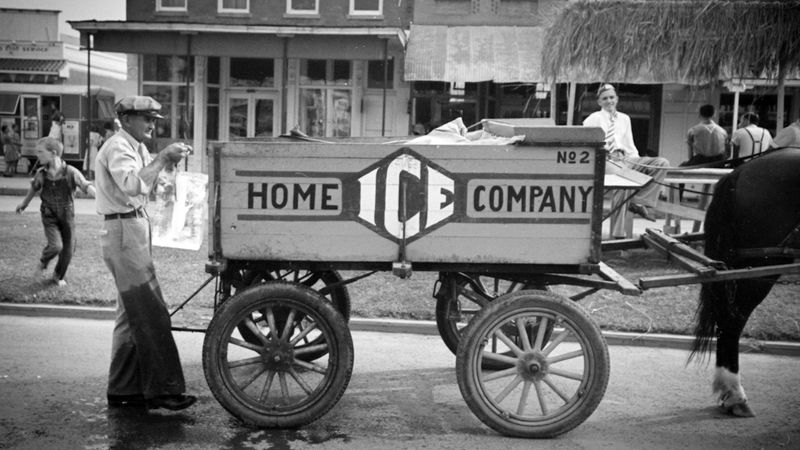
Before mechanical refrigeration systems were introduced, ancient peoples, including the Greeks and Romans, cooled their food with ice transported from the mountains. Wealthy families made use of snow cellars, pits that were dug into the ground and insulated with wood and straw, to store the ice. In this manner, packed snow and ice could be preserved for months. Stored ice was the principal means of refrigeration until the beginning of the 20th century, and it is still used in some areas.



 " height="20" alt="HEW Logo">

In India and Egypt evaporative cooling was employed. If a liquid is rapidly vaporized, it expands quickly. The rising molecules of vapour abruptly increase their kinetic energy. Much of this increase is drawn from the immediate surroundings of the vapour, which are therefore cooled. Thus, if water is placed in shallow trays during the cool tropical nights, its rapid evaporation can cause ice to form in the trays, even if the air does not fall below freezing temperatures. By controlling the conditions of evaporation, it is possible to form even large blocks of ice in this manner.
Cooling caused by the rapid expansion of gases is the primary means of refrigeration today. The technique of evaporative cooling, as described heretofore, has been known for centuries, but the fundamental methods of mechanical refrigeration were only discovered in the middle of the 19th century. The first known artificial refrigeration was demonstrated by William Cullen at the University of Glasgow in 1748. Cullen let ethyl ether boil into a partial vacuum; he did not, however, use the result to any practical purpose. In 1805 an American inventor, Oliver Evans, designed the first refrigeration machine that used vapour instead of liquid. Evans never constructed his machine, but one similar to it was built by an American physician, John Gorrie, in 1844.
Commercial refrigeration is believed to have been initiated by an American businessman, Alexander C. Twinning, in 1856. Shortly afterward, an Australian, James Harrison, examined the refrigerators used by Gorrie and Twinning and introduced vapour-compression refrigeration to the brewing and meat-packing industries. A somewhat more complex system was developed by Ferdinand Carré of France in 1859. Unlike earlier vapour-compression machines, which used air as a coolant, Carré’s equipment contained rapidly expanding ammonia. (Ammonia liquefies at a much lower temperature than water and is thus able to absorb more heat.) Carré’s refrigerators were widely used, and vapour-compression refrigeration became, and still is, the most widely used method of cooling.
In spite of the successful use of ammonia, that substance had a severe disadvantage: if it leaked, it was unpleasant as well as toxic. Refrigeration engineers searched for acceptable substitutes until the 1920s, when a number of synthetic refrigerants were developed. The best known of these substances was patented under the brand name of Freon. Chemically, Freon was created by the substitution of two chlorine and two fluorine atoms for the four hydrogen atoms in methane (CH4); the result, dichlorofluoromethane (CCl2F2), is odourless and is toxic only in extremely large doses.
The trusted destination for professionals, college students, and lifelong learners.
SUBSCRIBE


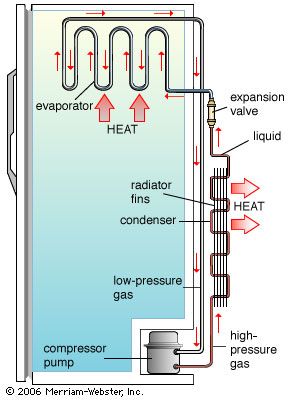
The basic components of a modern vapour-compression refrigeration system are a compressor; a condenser; an expansion device, which can be a valve, a capillary tube, an engine, or a turbine; and an evaporator. The gas coolant is first compressed, usually by a piston, and then pushed through a tube into the condenser. In the condenser, the winding tube containing the vapour is passed through either circulating air or a bath of water, which removes some of the heat energy of the compressed gas. The cooled vapour is passed through an expansion valve to an area of much lower pressure; as the vapour expands, it draws the energy of its expansion from its surroundings or the medium in contact with it. Evaporators may directly cool a space by letting the vapour come into contact with the area to be chilled, or they may act indirectly—i.e., by cooling a secondary medium such as water. In most domestic refrigerators, the coil containing the evaporator directly contacts the air in the food compartment. At the end of the process, the hot gas is drawn toward the compressor.
In the 1960s certain characteristics of semiconductors began to be utilized for commercial refrigeration. Chief among these was the Peltier effect, named after the French chemist Jean Peltier, who observed in 1834 that electric currents passing through the junction of two different metals sometimes caused the junction to cool. When the junction is made from semiconductors such as bismuth telluride, the Peltier effect is of magnitude sufficient to permit its commercial use.