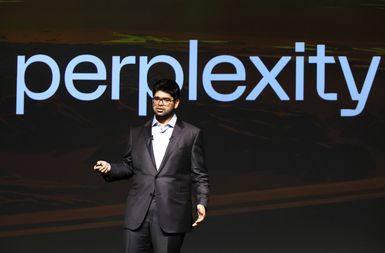
Perplexity is an answer engine.
© Pavlo Gonchar—SOPA Images/Shutterstock.com
Perplexity AI is a conversational search engine that uses large language models (LLMs) to provide direct answers to search queries, complete with source citations. Its development company, Perplexity AI, Inc., was founded in August 2022 and is headquartered in San Francisco, California.
Through its merging of online information retrieval (aka “search”), natural language processing, and machine learning, Perplexity AI is among the leading tech pioneers developing “answer engine” technologies. It aims to deliver direct, detailed answers to user queries.
Value and differentiation strategy
Perplexity AI differentiates its product through the following capabilities:
- Real-time search. Many search and AI technologies are developing ways to incorporate real-time data access, but Perplexity AI has made this feature central to its core functionality.
- Source transparency. Perplexity AI provides citations for its information, allowing users to verify answers for accuracy and further understand their context.
- Direct answers over listed search results. Positioned as an “answer engine” rather than a traditional search engine, Perplexity AI was designed to try to understand the nuanced context of a search query and to provide direct answers in a conversational tone.
Among its early users, Perplexity AI’s platform is viewed as a fusion between OpenAI’s ChatGPT AI chatbot and the Google search engine from Alphabet (GOOGL). Although each company’s proprietary technologies remain distinct and differentiated in their strengths and capabilities, Perplexity’s platform was seen as an early bridge between key functionalities of OpenAI and Google (advanced chatbot and search combined).
Despite Perplexity’s first-mover advantage in this hybrid space, the platform faces increasing competition from Google with its core search and Gemini chatbot; Microsoft (MSFT) with its Bing search engine and AI-powered Copilot; Open AI’s ChatGPT and SearchGPT; and the lesser-known You.com (a similar AI-powered search engine).
Perplexity offers a range of services categorized under a so-called “freemium” model—a free basic level of service and subscription-based, professional-level paid services.
AI & your money
Artificial intelligence is changing how we interact online, how we manage our finances, and even how we work. Learn more with Britannica Money.
Free services
- Perplexity AI Search Engine provides direct answers to user queries in a conversational tone by synthesizing real-time information from multiple online sources while citing each source’s origins.
Paid services
- Perplexity Pro is a paid subscription that offers a more extensive version of the freemium’s “quick search” functionalities; it is capable of deeper problem-solving, code interpretation, data analysis, and content generation. Pro also integrates with other AI models and allows developers to access an application programming interface (API).
- Enterprise Pro is designed for companies. It includes multiple-user licensing and compliance with SOC 2 data security and user privacy standards, which are required by many companies that handle customer data.
- Buy with Pro allows Pro subscribers in the U.S. to purchase products directly through the company’s search engine. It includes the Snap to Shop visual search tool for consumers and the Perplexity Merchant Program designed to help large retailers reach customers.
Founding years
Perplexity AI, Inc. was founded in 2022 in San Francisco by four engineers with backgrounds in artificial intelligence (AI) and machine learning:
- Aravind Srinivas, chief executive officer, was a key founder of Perplexity AI and a former AI researcher at OpenAI and Alphabet, Inc. subsidiaries DeepMind and Google Brain.
- Denis Yarats, chief technology officer, was a former AI research scientist at Meta (META).
- Johnny Ho, chief strategy officer, was previously an engineer at Quora and a quantitative trader with Tower Research Capital, a high-frequency trading firm.
- Andy Konwinski, president and board member, was a cofounder of Databricks, a cloud-based data analytics platform.
Perplexity AI CEO Aravind Srinivas speaking at a press conference in Tokyo announcing the strategic partnership agreement between Perplexity and Japan’s telecommunications giant SoftBank on June 17, 2024.
© Yoshio Tsunoda—AFLO/Shutterstock.com
The founding members’ shared vision for advancing search technology stemmed from a common frustration: search engines’ inability to provide direct answers in a way that understands the wider and nuanced context of queries.
By 2023, Perplexity achieved a milestone with 10 million monthly active users. The company raised $26 million in a Series A funding round, which helped launch Perplexity’s mobile application.
The following year marked several significant milestones for the company. It launched Perplexity Pages, which allows users to generate customizable Web pages using prompts. It announced plans to introduce advertising on its search platform in the fourth quarter of the year, diversifying Perplexity’s revenue streams and positioning it even more firmly as a Google competitor. The company also launched its Buy with Pro and Snap to Shop applications.
Perplexity completed a series of funding rounds that established the company as a Wall Street “unicorn” with a valuation of over $1 billion. Participating investors in both rounds included notable individuals and companies such as Jeff Bezos, NVIDIA (NVDA), Daniel Gross, and Stan Druckenmiller. In November 2024 the company underwent a final capital raising effort, after which its valuation reached an estimated $9 billion.
Plagiarism allegations and the future of intellectual property
The rapid growth of AI technology required platforms such as Perplexity to continuously feed vast quantities of data into its LLMs, not only to train new models, but also to deliver the most up-to-date information for user queries. But data collection and distribution practices came under fire in 2024, with publishers and content creators accusing the top AI platforms of plagiarism and misuse of copyrighted material without proper attribution.
In June 2024 the financial publication Forbes sent a cease and desist letter to Perplexity, accusing it of scraping and redistributing text and images without proper attribution. Soon after, Wired magazine published the results of an investigation alleging that Perplexity scraped content from websites that expressly forbid such data collection. By the end of June, Amazon Web Services (AMZN)—Perplexity’s cloud service partner—launched an investigation into whether the platform’s data collection practices violate its terms of use.
In October 2024 The New York Times issued a cease and desist letter to Perplexity, alleging the company infringed on its copyright by scraping content from its website. The same month, News Corp (NWS) publications including the Wall Street Journal and New York Post filed a lawsuit against Perplexity alleging copyright infringement. (Earlier that year, News Corp struck a five-year deal with Perplexity competitor OpenAI that allowed OpenAI to use its current and archived content in its LLMs.) On Sept. 10, 2025, Encyclopædia Britannica and Merriam-Webster filed a complaint against Perplexity alleging copyright and trademark infringement.
In November 2024, in response to claims of misuse of copyrighted material, Perplexity CEO Aravind Srinivas argued that no publisher should have the exclusive right to own reported facts, that such facts should be freely accessible to everyone, and that Perplexity simply surfaces and summarizes data from the Web, with full citations and a notation that it doesn’t claim ownership of any content.
Perplexity’s legal challenges—and the company’s response—are emblematic of a much broader and ongoing debate surrounding the boundaries of intellectual property as it pertains to AI-driven content aggregation and creation.
In a mere two years, Perplexity AI has established itself as a leading pioneer in the emerging “answer-engine” space. Integrating generative AI chatbot functionalities with real-time information retrieval technologies, Perplexity AI has effectively positioned itself at the intersection of these distinct yet overlapping industries.
This article was most recently revised and updated by Karl Montevirgen