Encyclopaedia Britannica's editors oversee subject areas in which they have extensive knowledge, whether from years of experience gained by working on that content or via study for an advanced degree. They write new content and verify and edit content received from contributors.
How did NVIDIA contribute to the development of OpenAI’s ChatGPT?
OpenAI trained the technology behind ChatGPT using a supercomputer powered by 10,000 NVIDIA GPUs, underscoring NVIDIA’s importance in the development of artificial intelligence.
What are some key products offered by NVIDIA?
NVIDIA’s major products include GeForce graphics cards for gaming, A and H series chips for artificial intelligence, Tegra processors for mobile and embedded devices, RTX Spark chips for AI-focused personal computers, and CUDA software for developers. Together, these products support applications ranging from video games and autonomous vehicles to AI training and data-center computing.
NVIDIA is a semiconductor company and a leading global manufacturer of high-end graphics processing units (GPUs). Based in Santa Clara, California, NVIDIA is the dominant supplier of high-end GPUs worldwide, with a 92% market share in the discrete graphics segment as of 2025. It shares trade on Nasdaq under the ticker symbol NVDA.
Open full sized image
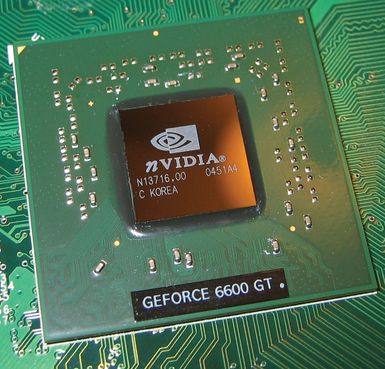
NVIDIA built its early success on graphics chips for video games before its GPUs became essential to artificial intelligence.
Berkut
Unlike general-purpose central processing unit (CPU) semiconductor chips, GPUs are built to speed up graphics-intensive applications such as video games, editing, and 3D rendering as well as artificial intelligence (AI) and machine learning (ML) applications. NVIDIA has played a central role in the development of GPU technology for more than 25 years and remains a key player in the industry.
Having established itself as one of the world’s leading chip producers specializing in GPU technology, NVIDIA also positioned itself as one of the main suppliers of both AI hardware and software. The company’s role in AI infrastructure drew global attention in 2022, when OpenAI’s ChatGPT generative AI chatbot became available to the general public. OpenAI developed its technology using a supercomputer powered by 10,000 NVIDIA GPUs.
Operational characteristics and key products
NVIDIA’s focus on GPU technology, in contrast to the prevailing CPU technology, was a key factor in establishing both its market differentiation and competitive advantages.
Whether by design or inherent capacity and improvement, GPU technology excels at parallel processing—utilizing more cores in order to allow multiple processes to run simultaneously. In comparison, CPUs utilize serial processing, which generally requires the completion of one process before the next one can begin.
By concentrating its research and production on GPUs, NVIDIA significantly advanced chip capacity within the semiconductor industry.
NVIDIA was also able to accelerate its own chip manufacturing process to produce a new chip every six months, as opposed to the historical industry average of 18 months. This process advantage gave NVIDIA an edge in its production cycle as well as its capacity to quickly improve and implement new technologies through significant R&D investments. Key products include:
GeForce GTX and RTX series. Used primarily in gaming and professional workstation applications.
NVIDIA A and H series and DGX systems. Supports artificial intelligence (AI) and data center applications.
NVIDIA Tegra series. Designed for small devices such as car components, smartphones, and handheld electronics.
NVIDIA Mellanox ConnectX SmartNICs and Quantum InfiniBand. GPUs utilized in cloud applications, data storage, and machine learning.
CUDA, AI Enterprise, and Drive. GPUs tailored for software developers, with Drive being specifically designed for self-driving car applications.
RTX Spark. Designed to run advanced AI applications on laptops and desktop computers.
The 1990s: Founding years to IPO
Open full sized image
Jensen Huang cofounded NVIDIA in 1993 and led the company until his resignation in 2026.
Courtesy, NVIDIA
NVIDIA Corporation was founded in April 1993 by three American computer scientists: Jen-Hsun (“Jensen”) Huang, previously a director at LSI Logic and microprocessor designer at Advanced Micro Devices (AMD); Chris Malachowsky, an engineer at Sun Microsystems; and Curtis Priem, a senior staff engineer and graphic chip designer at IBM and Sun Microsystems.
The name NVIDIA is an amalgamation of two terms: invidia, the Latin word for envy, and the abbreviation NV (short for next vision), which the company used early on to label its files. In the year of its founding, the company received an initial investment of $20 million in venture capital funding from firms such as Sequoia Capital, giving it the early financial support and market credibility that would lead to its initial public offering (IPO) six years later, in 1999.
The company’s initial focus was on graphics-based computing and video games, an area that would become a major differentiating factor and, in time, a competitive advantage for NVIDIA. The company would go on to pioneer GPU technology, capitalizing on its multicore and parallel processing speed—both lacking in standard CPU processes.
In 1997, NVIDIA gained a foothold in the computer gaming industry with the launch of the RIVA series of graphics processors. The following year, 1998, the company released the RIVA TNT, a PC graphics accelerator chip that helped expand NVIDIA’s reputation.
In 1999, the year the company held its initial public offering (IPO), NVIDIA released the GeForce 256, which introduced onboard transformation and lighting (T&L) to consumer-grade hardware. The success of these products won NVIDIA the contract to develop the hardware for the Xbox, Microsoft’s gaming console. NVIDIA received a $200 million advance for the project.
The 2000s: Gaming, real-world applications, and controversy
Over the next decade, NVIDIA would solidify its position as a formidable gaming console chip supplier. In the middle of the decade, Sony would select NVIDIA to assist in the design of the RSX Reality Synthesizer proprietary graphics processor for the SonyPlayStation 3.
The early 2000s also saw NVIDIA’s shift beyond the gaming industry, a move that the company would expand on throughout most of the decade. In 2003, NVIDIA worked with NASA to develop a photorealistic Mars simulation. NVIDIA also became a major graphics chip supplier for a number of Audi’s vehicles.
The company’s growth was publicly recognized when, in 2007, NVIDIA was named the Forbes “Company of the Year.” Soon after this crowning accolade, however, the company would face a series of setbacks that would mire the chipmaker in legal hurdles and lost business opportunities.
At the center were reports that certain mobile chips and GPUs had “abnormal failure rates” as a result of manufacturing defects. Despite the red flags, the company wouldn’t reveal which products were affected. As a consequence, NVIDIA found itself on the receiving end of a class-action lawsuit, which was settled in September 2010.
In January 2011, NVIDIA signed a $1.5 billion cross-licensing deal with IBM (IBM), which ended all pending litigation between the two companies.
The 2010s: Parallel computing and AI technology
Luckily, or perhaps with keen forward-leaning insight, the company’s development in parallel computing technology would not only help the chip manufacturer recover from its end-of-decade slump, but would also help launch the company’s leading position in a then-remote field: artificial intelligence.
Parallel computing is a computational paradigm that consists of breaking down a single problem into several sub-parts and then solving them simultaneously using multiple processors. Ultimately, it allows for faster execution. And it’s exactly the kind of computational speed and power that’s needed to develop and run sophisticated AI applications.
NVIDIA’s seminal step toward later AI and deep learning technology began back in 2006, when it released its Compute Unified Device Architecture (CUDA) platform and programming model, a major innovation in GPU-based parallel computing technology.
As the company continued to develop—and eventually monetize—AI technology, it added other revenue drivers to its core gaming enterprise.
Growth through acquisition. Strategic acquisition has been part of NVIDIA’s growth since its purchase in 2000 of graphics card maker 3Dfx Interactive. Its 2011 acquisition of mobile communications equipment maker Icera, followed by compiler tech maker PGI in 2013, kicked off a decade in which NVIDIA used its resources not only to fill technology gaps but also to enter new markets. By the end of the decade, NVIDIA had initiated more than a dozen acquisitions.
Mobile computing. In 2011, NVIDIA released its first-generation Tegra—its mobile processor for smartphones, tablets, entertainment systems, and vehicle navigation. Tegra is a system-on-a-chip (SoC) series.
Advanced vehicle technologies. In 2017, the company announced a partnership with automaker Toyota, which would use NVIDIA’s Drive PX artificial intelligence platform for its own self-driving cars. The NVIDIA Drive chip enables vehicles to analyze the surrounding environment via cameras and radar and lidar technologies. NVIDIA also partnered with Baidu, a Chinese multinational technology conglomerate, which uses the Drive PX series in its self-driving car initiative.
Metaverse. In 2020, NVIDIA released its beta version of Omniverse, which leveraged NVIDIA’s graphics leadership to develop 3D imaging, design, and engineering.
2020s: AI renaissance and regulatory scrutiny
Although mergers and acquisitions are common in the technology sector, NVIDIA’s dominant position in chipmaking drew scrutiny from antitrust regulators. In 2006, for example, NVIDIA received its first subpoena from the U.S. Department of Justice regarding possible antitrust violations.
Attempted acquisition of Arm Ltd.
Regulatory scrutiny of NVIDIA reached a fever pitch in 2020, however, after its attempted $40 billion purchase of Arm Ltd., which was then held by tech investing giant SoftBank. When combined with NVIDIA’s GPU dominance, Arm (whose chip technology powers hundreds of devices, including AppleiPhones and iPads, AmazonKindles, and many automobile makes and models) met resistance by regulators worldwide. The deal was ultimately scrapped in 2022.
AI-driven growth and market dominance
Who are Blackwell and Rubin?
NVIDIA often names its chip architectures after influential scientists and mathematicians.
Rubin is named for Vera Florence Cooper Rubin (1928–2016), an American astronomer whose research provided some of the earliest and strongest evidence for the existence of dark matter, fundamentally changing modern cosmology.
But it was also in 2022 that NVIDIA’s investment in AI paid off. By emphasizing processing performance, rapid product development, and sustained investment in deep learning applications, NVIDIA was able to expand GPU capabilities while contributing significantly to advances in artificial intelligence.
When word spread that OpenAI’s ChatGPT service, which helped trigger a global surge in interest in AI, was built using 10,000 NVIDIA GPUs, rivals sought access to NVIDIA GPUs, and investors clamored for NVIDIA shares.
During the mid-2020s, NVIDIA’s position was reinforced by successive generations of data-center GPUs, including the Blackwell architecture, introduced in 2024, and its successor, Rubin, unveiled in early 2026. These chips were designed to support large-scale AI training and inference and were widely adopted by major cloud providers and AI developers.
Antitrust investigations and global oversight
The move also triggered another round of regulatory oversight, not just because of NVIDIA’s dominance (as of 2023 NVIDIA claimed that 70% of the world’s fastest supercomputers worldwide were using its chips) but also because of uncertainty about AI and its impacts on society, culture, and employment.
In September 2023, for example, NVIDIA’s French offices were raided in a cloud computing antitrust inquiry. Regulatory bodies in the European Union and in China and other countries also initiated a close examination of NVIDIA’s practices and overall position in the AI industry.
Record valuation milestone
In July 2025, NVIDIA became the world’s first company to reach a $4 trillion market capitalization, a milestone driven by soaring demand for its AI chips and its central role in powering large language models and data centers worldwide.
Competition and collaboration with OpenAI
In September 2025, NVIDIA and OpenAI agreed to form a strategic partnership to build at least 10 gigawatts of computing capacity using NVIDIA hardware for OpenAI’s next-generation AI infrastructure.
Under the preliminary agreement, NVIDIA would provide up to $100 billion in hardware and data-center capacity as each phase of the project is completed, with the first gigawatt scheduled to come online in 2026. The partnership preceded a separate supply agreement OpenAI made with AMD to diversify chip sourcing.
Partnership with Synopsys
In November 2025, NVIDIA bought about $2 billion in Synopsys Inc. (SNPS) common stock, giving it a significant minority stake in the engineering software company. Along with the purchase, the two companies expanded their collaboration to make greater use of NVIDIA’s graphics processors in engineering and testing work, including detailed computer models that allow engineers to study semiconductor components and other complex hardware before they are built.
Expansion beyond GPUs
In December 2025, NVIDIA agreed to pay about $20 billion for most of the assets of Groq, an AI chip startup specializing in technology for quickly running AI models. The agreement also licensed Groq technology to NVIDIA and brought Groq founder Jonathan Ross and other employees to the company, although Groq remained an independent business. NVIDIA began putting the technology into its own AI computing systems in 2026.
In September 2026, NVIDIA agreed to acquire Hugging Face, a company whose website is widely used by developers to access, share, and develop artificial intelligence models, for $12.9 billion. The deal would expand NVIDIA further beyond the computer chips that fueled its growth in AI and into software and AI development. NVIDIA said Hugging Face would continue to operate as an open platform.
Jensen Huang resignation
On November 8, 2026, NVIDIA’s board of directors opened an investigation into Huang’s relationship with a business executive whom U.S. intelligence officials had determined was working for Chinese intelligence. Huang acknowledged that the relationship had been intimate. Days later, The New York Times reported that Huang had also had an extramarital relationship with Kimberly Powell, an NVIDIA executive who reported to him.
On November 12, Huang resigned as president and CEO and stepped down from NVIDIA’s board, ending a 33-year tenure leading the company. Chief Financial Officer Colette Kress was named interim CEO while continuing as CFO, and the board began a search for a permanent successor. NVIDIA also named Harvey C. Jones its first chair of the board.