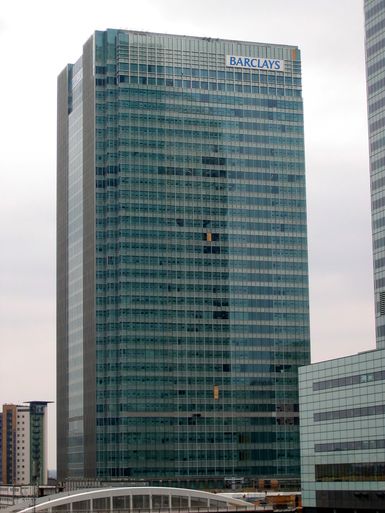
The headquarters of Barclays PLC, London.
C Ford
- Share price:
- $22.87 (mkt close, Nov. 13, 2026)
- Annual revenue:
- $28.46 bil.
- Earnings per share (prev. year):
- $2.68
- CEO:
- Mr. Coimbatore Sundararajan Venkatakrishnan Ph.D.
Barclays PLC is a multinational financial institution formed in England in 1896, with roots that date back to goldsmith banking in the late 1600s. A household name in many countries, London-based Barclays operates across retail banking, investment banking, wealth management, brokerage services, and lending. The enterprise is headquartered in London’s Canary Wharf district.
Barclays business structure
In February 2024 Barclays announced a major restructuring designed to make the bank “simpler, better, and more balanced.” The banking giant has five divisions:
- Barclays UK. Focused on serving individual customers in the United Kingdom, Barclays UK supports bank accounts, credit cards, and lending, among other retail banking services.
- Barclays UK Corporate Bank. Also focused on serving UK customers, this corporate banking division provides enterprise clients with lending, liquidity management, and other specialized offerings.
- Barclays Private Bank and Wealth Management. This Barclays division works with financial advisors and investors to provide private banking, wealth advisory, philanthropy enablement, lending solutions, and other specialized investment services.
- Barclays Investment Bank. The investment banking division of Barclays provides research, advisory, finance, and risk management services to international clients.
- Barclays US Consumer Bank. This retail banking operation serves United States customers, primarily with credit cards, loans, and savings solutions.
Expansion in the early years
Barclays, which originated from goldsmith banking, formally came into existence on July 20, 1896. The British banking and trust firm was created by merging the banking businesses of Barclay, Bevan, Tritton, Ransom, Bouverie & Co., Gurney & Co., and other private concerns. The enterprise first registered under the name Barclay & Co. Ltd. and assumed the name Barclays Bank Ltd. in 1917.
Barclays has a long history of mergers and acquisitions, having purchased 17 private banks in England in its first 20 years of existence. In 1918 Barclays merged with the London, Provincial and South Western Bank to further boost its presence and rank among the “big five” in the UK market.
Another notable merger occurred in 1925 with the international amalgamation of the Colonial Bank, the Anglo Egyptian Bank, and the National Bank of South Africa to form Barclays Bank (Dominion, Colonial and Overseas). This division of Barclays was renamed Barclays Bank DCO in 1954 and Barclay Bank International Ltd. in 1971.
Mid-20th century: Innovation and entry into the U.S. market
In the late 1950s Barclays earned the distinction of being Britain’s largest bank—and also its most innovative:
- Computers. In 1959 Barclays became the earliest British financial enterprise to use a computer at a branch location.
- Barclaycard. In 1966 Barclays introduced credit cards to the UK market with the launch of the Barclaycard.
- ATMs. The following year, 1967, Barclays introduced the world’s first automated teller machine (ATM) in London.
The late 1960s and early 1970s are also when Barclays established a U.S. presence (on both coasts), first with Barclays Bank of California in 1965, and then Barclays Bank of New York in 1971.
Late 20th century: Expansion, structural change, and a step backward
In 1979 Barclays purchased American Credit Corporation and changed the name of that institution to Barclays American Corporation. Through this subsidiary, the bank embarked on a program of significant expansion in the U.S. in the early 1980s, purchasing numerous consumer finance companies and trust company operations.
In 1981 Barclays was converted from a joint-stock bank into a public limited company. With further restructuring and name changes, Barclays became a holding company in 1985 after transferring all its assets to an operating subsidiary.
The traveler’s check business from Visa (V) was added to the Barclays family in 1986. The same year kicked off its investment banking operations when Barclays Merchant Bank merged with a partner. Barclays further expanded its investment banking practice in 1990 by acquiring Merck, Finck & Co. (a German investment bank) and L’Européenne de Banque (a French investment bank formerly part of the Rothschild dynasty).
The 1990s were a period of retrenchment for Barclays as it struggled with bad debt and management changes concurrent with the 1990–91 Persian Gulf War and deep economic recession. The institution exited U.S. retail banking starting in 1992; it sold bank branches, assets, and its lending and mortgage businesses.
During the latter part of the decade, the economy rebounded, and so did Barclays. In 1995 the bank acquired Wells Fargo Nikko Investment Advisors, in part to strengthen the organization’s presence in the Asia-Pacific region.
The 2000s: Modernization and navigating a financial crisis
In 2000 Barclays added to its domestic lending business with the acquisition of the UK mortgage bank Woolwich. When the financial crisis hit in 2008, Barclays made headlines for its purchase of Lehman Brothers’ North American operations. The banking institution raised £7.3 billion ($12.1 billion) from Middle Eastern investors, rather than accepting rescue funds from the UK government.
From the early 2000s, Barclays started proactively building and expanding its digital footprint. It was early to launch online banking and a mobile app, as well as support contactless payments and a digital literacy program.
Since the mid-2010s, Barclays has been slowly intensifying its focus on the UK and U.S. markets. In 2016 it divested from Barclays Africa Group.
No shortage of controversy
Barclays has been embroiled in its share of scandals and controversies over its long history. Some of the most recent or impactful include:
- The LIBOR bid-rigging scandal. In 2012 Barclays was fined £290 million ($450 million) for its part (along with other global banks) in the manipulation of the London InterBank Offered Rate (LIBOR), a key banking interest rate benchmark.
- Excessive fees scandal. In 2017 the bank was charged by the UK’s Serious Fraud Office, which alleged that Barclays provided improper financial assistance to Qatari investors as part of the 2008 investment deal. The SFO alleged that Barclays executives funneled £322 million ($418 million) in secret fees in order to secure the funding. The executives were later cleared of the charges.
- Client overbilling. Also in 2017, Barclays was fined $97 million by the U.S. Securities and Exchange Commission for overcharging individual clients by almost $50 million.
- The Epstein connection. In 2021 Barclays CEO Jes Staley was forced to step down from his role due to his links with convicted sex offender Jeffrey Epstein.
- Boycotts. In 2024, in the wake of the Israel-Hamas War, Barclays was targeted by pro-Palestinian activists. Users closed their accounts to protest the bank financing weapons companies with ties to Israel. The boycott was reminiscent of a long-running activist campaign in the 1970s and ’80s against the bank’s ties to the apartheid government in South Africa.
A greener future?
As a financial powerhouse, Barclays is doubling down on retail banking in the UK and corporate and investment banking in the U.S. But the institution is also making some bold commitments to combat climate change:
- In 2020 Barclays pledged to become a net-zero bank by 2050.
- Starting in 2024, Barclays is ceasing to provide financing to energy companies, new upstream oil and gas projects, or related infrastructure (with a few caveats).
- The bank plans to invest up to £500 million ($675 million) of its own capital into climate technology companies before 2028.
- Barclays says it will mobilize $1 trillion of financing by year-end 2030 to help fund the energy transition.
These projections may or may not come to pass, but forward-thinking ideas and innovation are part of what made Barclays the global institution it has become. Its deep roots in British banking, strategic acquisitions, and navigating regulatory and social challenges have helped Barclays remain a key player in the shaping of modern banking and finance.
This article was most recently revised and updated by The Editors of Encyclopaedia Britannica