

- Born:
- July 14, 1800, Alais [now Alès], France
- Died:
- April 10, 1884, Cannes (aged 83)
- Awards And Honors:
- Copley Medal (1843)

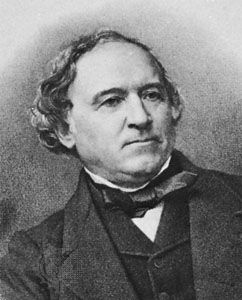
Jean-Baptiste-André Dumas
-
Who was Jean-Baptiste-André Dumas?
Jean-Baptiste-André Dumas (1800-1884) was a French chemist who made significant contributions to organic chemistry, particularly in organic analysis. He improved methods for determining vapor density and developed a combustion method for finding nitrogen in organic compounds. Dumas also revised atomic weights for about 30 elements and studied dyes and pharmaceuticals.
His "law of substitution" contradicted the electrochemical theory of his time, leading to disputes with German chemists. Despite this, Dumas became a respected figure, holding multiple academic positions and mentoring chemists such as Auguste Laurent and Louis Pasteur. He was also involved in politics, serving as minister of agriculture and commerce and later as a senator. Dumas contributed to urban planning in Paris and was recognized as "the founder of organic chemistry".
2 Britannica SourcesCreated from Britannica articles using AI. AI can make mistakes, so verify using Britannica articles. -
What field of science did Dumas work in?
Jean-Baptiste-André Dumas was a French chemist who made significant contributions to organic chemistry, particularly in organic analysis. He improved methods for determining the vapour density of substances to find their relative molecular masses and developed a combustion method for determining nitrogen in organic compounds. Wurtz called him "the founder of organic chemistry". Dumas also revised atomic weights for about 30 elements, studied the structure of dyes and pharmaceuticals, and wrote on inorganic chemistry, metallurgy, and physiology.
6 Britannica SourcesCreated from Britannica articles using AI. AI can make mistakes, so verify using Britannica articles. -
What is Dumas well known for discovering or developing in chemistry?
Jean-Baptiste-André Dumas was a French chemist who made significant contributions to organic chemistry, particularly in organic analysis.
Dumas is known for:
* Improving the method for determining the vapor density of substances to find their relative molecular masses.
* Developing a combustion method to determine the amount of nitrogen in organic compounds.
* Proposing a "Law of Substitution," stating that electronegative atoms can substitute electropositive hydrogen atoms in certain organic reactions without drastically altering the structure.
* Devising a method for determining the proportion of nitrogen combined with other elements in organic compounds.
* Isolating methyl alcohol (methanol) by distilling wood and preparing derivatives.2 Britannica SourcesCreated from Britannica articles using AI. AI can make mistakes, so verify using Britannica articles. -
How did Dumas help improve methods for finding the atomic mass of elements?
Jean-Baptiste-André Dumas significantly contributed to determining the atomic mass of elements. He enhanced the method for finding the vapor density of substances, which helped ascertain their relative molecular masses. Also, he created a combustion method to determine the amount of nitrogen in organic compounds. Moreover, between 1827 and 1858, Dumas expanded on J.W. Döbereiner’s observations, demonstrating relationships between triads of elements and classifying elements like oxygen, sulfur, selenium, and tellurium into families. He also produced revised atomic weights for about 30 elements, including carbon.
3 Britannica SourcesCreated from Britannica articles using AI. AI can make mistakes, so verify using Britannica articles. -
What other contributions did Dumas make to science or society?
Jean-Baptiste-André Dumas made significant contributions to both science and society. In science, he improved methods for determining vapor density and developed a combustion method for finding nitrogen in organic compounds. He also revised atomic weights for about 30 elements and studied dyes and pharmaceuticals.
Beyond science, Dumas served as the minister of agriculture and commerce in 1850–51 and later became a senator in the Second Empire. As president of the municipal council of Paris in 1859, he collaborated with Baron Haussmann on restructuring the city, enhancing drainage and lighting, and initiating a modern water-supply system. For this work, Emperor Napoleon III called him "the poet of hygiene".
1 Britannica SourceCreated from Britannica articles using AI. AI can make mistakes, so verify using Britannica articles. -
How has Dumas's work influenced modern chemistry?
Jean-Baptiste-André Dumas was a French chemist who made significant contributions to organic chemistry, particularly in organic analysis.
Dumas improved the method for determining the vapour density of substances and developed a combustion method for determining nitrogen in organic compounds. His work on the chlorination of oils and waxes led him to propose the Law of Substitution. Dumas's method for determining the proportion of nitrogen combined with other elements in organic compounds is an example of volumetric analysis.
Dumas's work led to the theory of types, which contradicted the electrochemical theory of structure. According to Wurtz, Dumas was the founder of organic chemistry.
2 Britannica SourcesCreated from Britannica articles using AI. AI can make mistakes, so verify using Britannica articles.
Jean-Baptiste-André Dumas (born July 14, 1800, Alais [now Alès], France—died April 10, 1884, Cannes) was a French chemist who pioneered in organic chemistry, particularly organic analysis.
Dumas’s father was the town clerk, and Dumas attended the local school. Although briefly apprenticed to an apothecary, in 1816 Dumas traveled to Geneva where he studied pharmacy, chemistry, and botany. His name appeared on journal articles in pharmacy and physiology before he was out of his teens.
In 1823, with assistance from the great German naturalist Alexander von Humboldt, Dumas returned to France and became assistant to the French chemist Louis-Jacques Thénard at the École Polytechnique in Paris. Dumas soon became professor of chemistry at the Athenaeum, only the first of many academic appointments he would hold—at the Sorbonne, the École Polytechnique, and the École de Médecine. As was common at the time, he held several of these positions simultaneously and spent many hours traveling from one school to the next. Dumas established a teaching laboratory, initially at his own expense. He was a masterful teacher, serving as mentor to many important French chemists, including Auguste Laurent, Charles-Adolphe Wurtz, and Louis Pasteur.




Dumas greatly improved the method of determining the vapour density of substances (and thus their relative molecular masses), and he developed a combustion method for determining nitrogen in organic compounds. He produced revised atomic weights for about 30 elements, including carbon, studied the structure of dyes and pharmaceuticals, and wrote on inorganic chemistry, metallurgy, and physiology. His greatest contributions, however, were to the new field of organic chemistry.
In the 1820s the accepted theory of molecular structure was the electrochemical dualism of the great Swedish chemist Jöns Jacob Berzelius. It assumed that atoms were either positive or negative and that chemical combinations resulted from the attraction of opposite charges. This worked well for inorganic compounds. In 1827–28, Dumas and Polydore Boullay (a pharmacist) published work on esters of ethyl alcohol and suggested that these might be understood as addition products of ethylene, just as ammonium compounds were addition products of ammonia. This was explained in Berzelian dualistic terms. In 1834 Dumas and French chemist Eugène Melchior Péligot isolated methyl alcohol (methanol) by distilling wood and prepared derivatives, which led them to propose the methyl radical (a molecule with at least one unpaired electron). However, the search for more hydrocarbon radicals soon led to difficulties.
As a result of his work on the chlorination of oils, waxes, and the like, Dumas proposed a “Law of Substitution,” stating that hydrogen atoms (electropositive) could be substituted by chlorine or oxygen atoms (electronegative) in certain organic reactions without any drastic alteration in the structure. This clearly did not fit the Berzelian theory and resulted in bitter attacks by many eminent German chemists, such as Justus Liebig and Friedrich Wöhler. Dumas at first retreated before the attacks, blaming his former coworker Laurent for the exaggeration of his theory. However, after replacing three hydrogens in acetic acid with chlorines to produce a compound with similar properties about 1839, Dumas boldly proposed a “theory of types,” based on his and Laurent’s previous ideas, which clearly contradicted the electrochemical theory of structure. This exacerbated the wide-ranging and often vituperative competition between German chemists, led by Liebig, and French chemists, led by Dumas. It also led to an irreconcilable dispute with Laurent over credit for the theory. In contrast, by 1850 Dumas and Liebig had mended their quarrels and ended up as friends.
Berzelius’s dualism eventually gave way to better theories of structure, but by the mid-1840s Dumas had completed most of his important scientific work and had become the undisputed dean of French chemists. He was a member of the prestigious French Academy and the Academy of Sciences, and he was not above using his status to impede the careers of younger chemists whom he saw as a threat to his reputation—Laurent and Charles Gerhardt being outstanding examples.
The trusted destination for professionals, college students, and lifelong learners.
SUBSCRIBE


Dumas’s politics had been moderately conservative, and he had prospered under the monarchy. Nevertheless, after the Revolutions of 1848, he was elected to the new National Assembly, along with a man who had just returned to France, Louis-Napoleon Bonaparte. Dumas served as both minister of agriculture and of commerce in 1850–51, and when Louis became Emperor Napoleon III, Dumas became a senator in the Second Empire. He was on the municipal council of Paris for many years and became its president (in effect, the mayor) in 1859. He worked with the great city planner Baron Haussmann on the restructuring of the city, including the improvement of drainage and lighting and the beginnings of the modern water-supply system. The emperor called him “the poet of hygiene.”
In 1868 Dumas was made permanent secretary of the Academy of Sciences and was also appointed master of the mint. The tumultuous birth of the Third Republic in 1870 led to his withdrawal from public life and his return to scientific work. He continued to demonstrate his wide-ranging interests, publishing on such topics as fermentation and the occlusion of oxygen on silver. He received many honours during his long and varied career; perhaps the highest tribute came from Wurtz, who called him “the founder of organic chemistry.”