

- In full:
- Charles-Frédéric Gerhardt
- Born:
- Aug. 21, 1816, Strasbourg, France
- Died:
- Aug. 19, 1856, Strasbourg (aged 39)

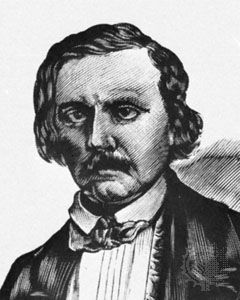
Charles Gerhardt
-
Who was Charles Gerhardt?
Charles Gerhardt (1816–1856) was a French chemist who significantly contributed to structural organic chemistry and was a precursor to August Kekulé.
Gerhardt's most important contribution was his 1853 theory of types, which classified organic compounds based on four fundamental types: hydrogen, hydrogen chloride, water, and ammonia. He also introduced the concept of homologous series in 1843, noting that the addition of methylene to a fundamental group yields related compounds.
Despite facing financial struggles and rejection from established chemists, Gerhardt's synthesis of acid anhydrides restored his reputation, leading to his appointment as a professor of chemistry at the University of Strasbourg and the local pharmacy school in 1855.
1 Britannica SourceCreated from Britannica articles using AI. AI can make mistakes, so verify using Britannica articles. -
What field of science did Charles Gerhardt work in?
Charles Gerhardt was a French chemist whose work significantly impacted the field of organic chemistry. He is known for bringing order to the field through reinterpreting the findings of other chemists. His 1843 concept of homologous series came from observing the consistent differences in boiling points between methyl and ethyl compounds, which led him to suggest that adding methylene (CH_2) to a base group would create related compounds like alcohols. Gerhardt's 1853 theory of types suggested that all organic compounds could be compared to fundamental types like hydrogen (H_2), hydrogen chloride (HCl), water (H_2O), and ammonia (NH_3), where hydrogen is replaced by complex residues.
3 Britannica SourcesCreated from Britannica articles using AI. AI can make mistakes, so verify using Britannica articles. -
What is Charles Gerhardt known for in chemistry?
Charles Gerhardt was a French chemist known for his contributions to organic chemistry. His most important contribution was bringing order to organic chemistry by reinterpreting the findings of others. In 1843, he developed the concept of homologous series, generalizing that successive additions of methylene (CH2) to a fundamental group yielded a series of related compounds.
Gerhardt's 1853 theory of types classified organic compounds based on four fundamental types: hydrogen (H2), hydrogen chloride (HCl), water (H2O), and ammonia (NH3), where hydrogen is replaced by complex residues. Additionally, he characterized organic substitutions as "double decompositions," using chemical equations consistently.
1 Britannica SourceCreated from Britannica articles using AI. AI can make mistakes, so verify using Britannica articles. -
What important concept did Charles Gerhardt introduce about acids and bases?
Charles Gerhardt, a French chemist, is known for his significant contributions to organic chemistry. One of his most important achievements was his theory of types, introduced in 1853, which was the culmination of attempts at organic classification by Gerhardt and Laurent.
Gerhardt suggested that all organic compounds could be compared to four fundamental types: hydrogen ((H_2)), hydrogen chloride ((HCl)), water ((H_2O)), and ammonia ((NH_3)), which are simple molecules where hydrogen is successively replaced by more-complex residues. Although Gerhardt insisted that his formulas were comparative and classificatory and gave no indication of the actual arrangement of atoms in the molecule, August Kekulé used Gerhardt's type theory as a foundation for his structure theory of 1858.
1 Britannica SourceCreated from Britannica articles using AI. AI can make mistakes, so verify using Britannica articles. -
How did Charles Gerhardt help organize and classify chemical compounds?
Charles Gerhardt brought order to organic chemistry through his reinterpretation of others' findings. In 1843, he developed the concept of homologous series, generalizing that adding methylene (CH_2) to a fundamental group creates related compounds like alcohols.
Gerhardt simplified organic chemistry formulas by halving them, which implied that inaccurate analysis occurred when an odd number of atoms appeared in a published organic formula. His efforts to improve conventional weights encouraged a younger generation to correct them, leading to the Karlsruhe Congress of chemists in 1860. His work culminated in the 1853 theory of types, where he suggested comparing all organic compounds to fundamental types like hydrogen, hydrogen chloride, water, and ammonia.
1 Britannica SourceCreated from Britannica articles using AI. AI can make mistakes, so verify using Britannica articles. -
How have Charles Gerhardt’s discoveries influenced modern chemistry?
Charles Gerhardt significantly influenced modern chemistry by bringing order to organic chemistry through reinterpreting existing findings.
Gerhardt's theory of types (1853) suggested all organic compounds could be compared to fundamental types like hydrogen, hydrogen chloride, water, and ammonia, where hydrogen is replaced by complex residues. August Kekulé's structure theory of 1858 was built on Gerhardt's type theory.
His concept of homologous series (1843) came from observing the constant boiling point difference between methyl and ethyl compounds. Gerhardt proposed that adding methylene (CH_2) to a fundamental group creates related compounds, like alcohols, which undergo similar changes. Also, Gerhardt prepared acetic anhydride, which refuted Jöns Jacob Berzelius’s view of organic acids. Acetic anhydride is heated with salicylic acid to produce acetylsalicylic acid (aspirin).
Gerhardt also characterized organic substitutions as "double decompositions," where a simple inorganic byproduct is eliminated, followed by the combination of two residues. He also promoted the use of chemical equations.
4 Britannica SourcesCreated from Britannica articles using AI. AI can make mistakes, so verify using Britannica articles.
Charles Gerhardt (born Aug. 21, 1816, Strasbourg, France—died Aug. 19, 1856, Strasbourg) was a French chemist who was an important precursor of the German chemist August Kekule and his structural organic chemistry.
Early life and education
Gerhardt’s Swiss-born father, Samuel Gerhardt, initially worked in a bank. In 1825 Samuel Gerhardt became a manufacturer of white lead but had little understanding of the technical side of his factory, so in 1831 young Gerhardt was sent to learn chemistry at Karlsruhe Polytechnic in Germany. Afterward he went to a business school in Leipzig, where, however, he preferred to continue his chemical studies. After an unsuccessful attempt to work for his father, he resumed chemical studies with Justus Liebig at the University of Giessen in Germany from 1836 to 1837. A final attempt at reconciliation with his father failed, and Gerhardt left in 1838 to study chemistry under Jean-Baptiste-André Dumas at the University of Paris, from which he received a doctorate in 1841. Gerhardt’s chemical training provided perhaps the best that both Germany and France had to offer, and it put him in an almost unique intermediary position in an age of strong rivalries between their national schools of chemistry. His own strength of character (or, as critics would say, his argumentativeness) determined that he would make up his own mind on the questions of the day.
Academic career
During the 1840s, Gerhardt alienated most European chemists as he accused them of analytical inaccuracies, bad faith, or false claims of priority. Before this, though, Dumas was keen to advance the career of his star pupil, and in 1841 he recommended Gerhardt for appointment to the University of Montpellier in France, initially as a temporary professor of chemistry; only in 1844 was the post confirmed. At Montpellier, Gerhardt found no expectation that professors would conduct research and therefore no facilities or research funds. The frustrations of his academic life closely paralleled those of chemist Auguste Laurent at the University of Bordeaux, whom he met in 1842. They became close friends, collaborators, and partners in provincial “exile.” When Laurent was appointed to a post in Paris in 1848, Gerhardt took leave from Montpellier to be near him, and when this leave was not renewed, he resigned in 1851 and attempted to support himself by private teaching.




Classification of organic compounds
Though Gerhardt was a skilled analyst, his most important contributions lay in bringing order to the seeming chaos of organic chemistry by reinterpreting the findings of others. Thus, his conception in 1843 of homologous series originated in a generalization of German chemist Hermann Kopp’s observation that the boiling points of methyl and ethyl compounds show an almost constant difference. Gerhardt suggested that successive additions of methylene (CH2) to a fundamental group yielded a series of related compounds, such as the alcohols. As he asserted, “These substances undergo changes according to the same equations, and we need only know the reactions of one to predict those of the others.”
Theory of residues
Turning his attention to organic substitutions, Gerhardt characterized them as “double decompositions” to describe the general path of substitution involving two reagents—a simple inorganic by-product such as water or hydrogen chloride would be eliminated, followed by the combination of the two residues. For example: C6H6 (benzene) + HONO2 (nitric acid) = H2O (water) + C6H5NO2 (nitrobenzene). It is worth noting that Gerhardt was one of the first to make significant and consistent use of chemical equations.
Two particular points had theoretical implications. First, Gerhardt denied that his residues carried any electrochemical charge or that they existed as preformed radicals in the reagents. His “unitary chemistry” was thus a further attack on the once-orthodox dualistic electrochemical view of organic combination, which already had been undermined by Dumas’s and Laurent’s substitution studies.
Second, Gerhardt was appalled by the inconsistent weights and differing formulas employed in chemistry. Most chemists used “four-volume” formulas, in which benzene was given as C24H10H2, but there were also “two-volume” formulas (C12H5H) and Gerhardt’s own unitary formulas (C6H6). How was a classifier to make sense of this chaos? Noting that under the four-volume system water was always eliminated as a double molecule, H4O2, Gerhardt proposed—on the grounds of economy, consistency with inorganic chemistry, and comparison of like with like—to halve all of these formulas. This carried the implication that when an odd number of atoms appeared in a published organic formula, the analysis was inaccurate. Gerhardt did not hesitate to criticize the analyses of Liebig, Dumas, and others.
The trusted destination for professionals, college students, and lifelong learners.
SUBSCRIBE


Unfortunately, Gerhardt’s attempt to simplify formulas used in organic and inorganic chemistry was made harder by the fact that he (unlike his friend Laurent) was unable to accept Avogadro’s law; his own view that “atoms, volumes, and equivalents are synonyms” was no substitute. His efforts to improve on conventional weights did, however, encourage a younger generation to try to get them right, which eventually led to the Karlsruhe Congress of chemists in 1860, called to consider these problems.
Gerhardt’s theory of types
The culmination of Gerhardt’s work lay in his 1853 theory of types, the last of the ongoing attempts at organic classification by Laurent and Gerhardt. In 1846 Laurent had suggested that alcohol and ether could be seen as water in which hydrogen was replaced by ethyl residues.
Following the development of techniques of targeted double decomposition, English chemist Alexander Williamson prepared common ether from sodium ethylate and ethyl iodide: C2H5ONa (sodium ethylate) + IC2H5 (ethyl iodide) = NaI (sodium iodide) + (C2H5)2O (ether). Gerhardt used an analogous reaction to prepare acetic anhydride, (C2H3O)2O. (This finally killed off Swedish chemist Jöns Jacob Berzelius’s conception of organic acids as containing preformed anhydride plus water.) Meanwhile, French chemist Charles-Adolphe Wurtz and German chemist August von Hofmann had been preparing the amines. Gerhardt suggested that all organic compounds could be compared to four fundamental types—hydrogen (H2), hydrogen chloride (HCl), water (H2O), and ammonia (NH3)—simple molecules in which the hydrogen was successively replaced by more-complex residues.
Although Gerhardt insisted that his formulas were merely comparative and classificatory and gave no indication of the actual arrangement of atoms in the molecule, Kekule erected his structure theory of 1858 on the foundation of Gerhardt’s type theory.
Later life
In 1844 Gerhardt married Jane Megget Sanders of Edinburgh, whose brother was studying in Montpellier; through her he learned English and became trilingual. They had two sons and a daughter; the elder son, Charles, was an engineer and cowrote his father’s biography. When Gerhardt was struggling financially in Paris in the early 1850s, his wife’s family provided essential support. Much to the surprise and horror of visiting foreign admirers, he and Laurent were treated as outcasts by the established chemists, led by Dumas. However, Gerhardt’s synthesis of acid anhydrides reestablished his reputation, and in 1855 he was appointed professor of chemistry at both the university and the pharmacy school in his native Strasbourg. Less than a year later, he was taken suddenly ill and died two days short of his 40th birthday.