
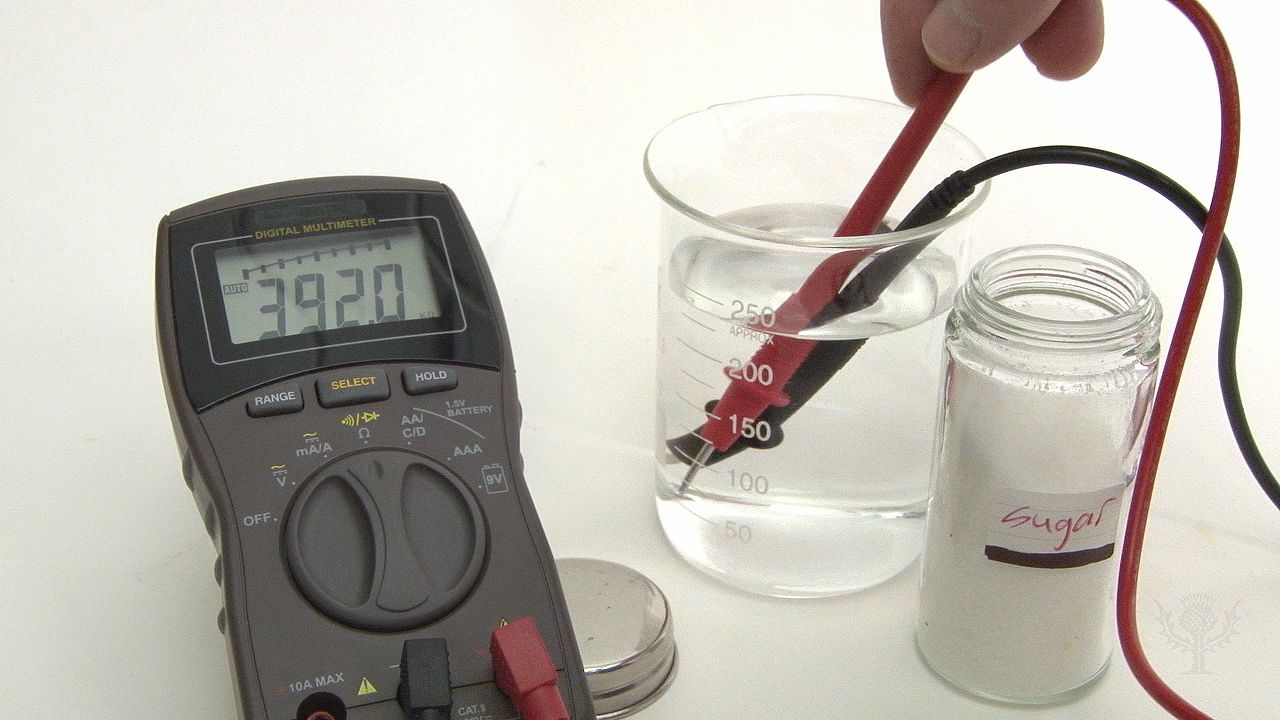
How different solutions conduct electricity
Conducting electric current in a solution of electrolytes.
Encyclopædia Britannica, Inc.
-
Encyclopædia Britannica, Inc.We asked NASA.
-
Encyclopædia Britannica, Inc.Learn about the transmission of P waves (primary waves), which alternately squeeze and stretch the transmitting medium, causing it to move back and forth in the direction of propagation.
-
Encyclopædia Britannica, Inc.An overview of biodiversity in East Africa's Lake Nyasa (also called Lake Malawi or Lago Niassa), particularly with respect to cichlid fishes.
-
Encyclopædia Britannica, Inc.The movement of impulses through the nerve cell, involving both chemical and biological changes.
-
© American Chemical Society (A Britannica Publishing Partner)An explanation of how salt is used in the winter to melt ice on roadways.
-
Contunico © ZDF Studios GmbH, MainzVisit a potash mine in Germany.
-
© American Chemical Society (A Britannica Publishing Partner)An overview of the chemical structure of water molecules.




Transcript
It's easy to tell whether a solution has ions. All we need for this test are: a volt-ohm meter, two glass beakers, pure water, sugar and salt.
Let's set the meter to read resistance in ohms. When electricity passes between the two wire probes, the circuit is complete and the meter records a low resistance. When the circuit is open, the meter says the resistance is very high.
Next, we'll pour pure water into both beakers. When the probes go into one of the beakers, the resistance is still quite high. Here we see over 900,000 ohms of resistance in this small sample of water. Pure water is not a good conductor.
Now let's add common salt to the water. Salt is sodium chloride. In salt, each atom of sodium is bonded to an atom of chlorine. But here's how it works: the sodium atom donates an electron to the chlorine atom, so that the sodium atom has a slight positive charge and the chlorine has a slight negative charge. This is called an ionic bond.
When the sodium chloride dissolves in water, the sodium atoms and chlorine atoms separate under the influence of the water molecules. They're free to move around in the water as positively and negatively charged ions.
This separation of charge allows the solution to conduct electricity. In this sample of salt water, the meter reads less than 80,000 ohms of resistance. Salt water is much more conductive than pure water.
But is this true of every water solution?
Let's try dissolving sugar in the other beaker. Sugar is made of carbon, hydrogen, and oxygen held together by covalent bonds: the atoms share electrons among each other within the molecule. They don't donate electrons, so they don't acquire positive and negative charges. So when this substance dissolves, it won't break apart into ions.
Sure enough, when we dip the probes into the sugar water, the meter shows a relatively high resistance. This solution is not a good conductor of electric current.
It's clear to see, if substances with covalent bonds are dissolved in water, the solution conducts electricity poorly.
But if the solution contains ions like sodium and chlorine, current flows much more freely. Scientists call these conductive materials electrolytes.
Last Modification: