




blue cheese
News •
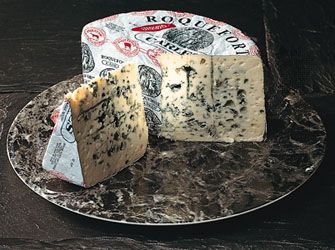
blue cheese, any of several cheeses marbled with bluish or greenish veins of mold. Important trademarked varieties include English Stilton, French Roquefort, and Italian Gorgonzola.

Most blue cheeses are made from cow’s milk, but Roquefort is made from the milk of the ewe. Spores of species Penicillium roqueforti are mixed with either the milk or the curd. The mold, during the three to six months of ripening, grows both in small, irregular, natural openings in the cheese and in machine-made perforations. Roquefort and some Gorgonzolas are ripened in caves, the stable, moist atmosphere of which imparts a distinctive character to the cheeses.
Blue cheeses may be soft and creamy or crumbly in texture, with a characteristically sharp, piquant flavour. They are often quite salty but should not be overly so, nor bitter. Well-known blue cheeses in addition to those mentioned above include Bleu de Bresse and Bleu d’Auvergne (France), Danablu (Denmark), Blue Cheshire (England), and several produced in the United States.


 " height="20" alt="HEW Logo">