

- Related Topics:
- bat
- disease
- Pseudogymnoascus destructans


white nose syndrome
-
What is white nose syndrome?
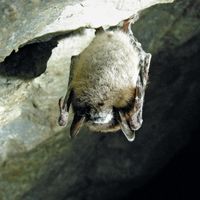
White nose syndrome is a disease affecting hibernating bats in North America. It is caused by the growth of the fungus Pseudogymnoascus destructans on the skin of the nose and ears and on the membrane covering the wings.
White nose syndrome is the first epizootic disease documented in bats and is associated with high mortality. Some of the first species in North America in which white nose syndrome was detected included the little brown bat, the endangered Indiana bat, and the big brown bat. The loss of bats could result in increased numbers of insects, which could impact forest health and agriculture as well as human health.
1 Britannica SourceCreated from Britannica articles using AI. AI can make mistakes, so verify using Britannica articles. -
What happens to bats that get white nose syndrome?
White nose syndrome is a disease affecting hibernating bats in North America. It is caused by the growth of the fungus Pseudogymnoascus destructans on the skin of the nose and ears and on the membrane covering the wings. White nose syndrome is associated with high mortality; some colonies have experienced declines of over 90 percent. The loss of bats could result in increased numbers of insects, which could impact forest health and agriculture as well as human health.
1 Britannica SourceCreated from Britannica articles using AI. AI can make mistakes, so verify using Britannica articles. -
What causes white nose syndrome in bats?
White-nose syndrome in bats is caused by the fungus Pseudogymnoascus destructans, which infects the skin of the nose, ears, and wings. It is believed that the fungus is transmitted when bats come into contact with it in cave environments, through physical contact with other bats, or possibly through contact with other animals, including humans. The disease is associated with high mortality, and some colonies have experienced declines of over 90 percent. The loss of bats could result in increased numbers of insects, which could impact forest health and agriculture as well as human health.
1 Britannica SourceCreated from Britannica articles using AI. AI can make mistakes, so verify using Britannica articles. -
How does white nose syndrome spread among bat populations?
White-nose syndrome spreads among bat populations through several means. The fungus Pseudogymnoascus destructans, which causes the disease, thrives in cold, humid environments like bat hibernacula, where it can be transmitted when bats come into contact with it.
The fungus can also spread through physical contact between bats, and possibly between bats and other animals, including humans. This transmissibility allows the fungus to spread rapidly to new areas through bats’ daily and seasonal movements, including long-distance migration. The limited genetic diversity of P. destructans in North America suggests a single introduction of the fungus, likely from Europe, with subsequent spread from the original point of introduction.
1 Britannica SourceCreated from Britannica articles using AI. AI can make mistakes, so verify using Britannica articles. -
Why is white nose syndrome dangerous for bat species?
White nose syndrome is dangerous for bat species because it's an epizootic disease, meaning it spreads rapidly and widely among bats, leading to high mortality rates. Some colonies have experienced population declines of over 90% due to this disease.
The disease affects hibernating bats, with the fungus Pseudogymnoascus destructans growing on their skin, particularly on the nose, ears, and wings. This can lead to the endangerment of bat species such as the Indiana bat and the northern long-eared bat. The decline in bat populations can also result in increased insect populations, which could negatively affect forest health, agriculture, and human health, as many North American bats are insectivores.
1 Britannica SourceCreated from Britannica articles using AI. AI can make mistakes, so verify using Britannica articles. -
What are scientists doing to fight and prevent white nose syndrome in bats?
White-nose syndrome is a fungal disease that affects hibernating bats and has caused high mortality in North American bat populations.
Scientists are working to manage the spread of P. destructans, the fungus that causes the disease. A DNA test has been developed that can detect P. destructans in soil and bat wing samples, which allows for earlier detection and improved control of the disease. The detection of P. destructans in cave sediments suggests that the pathogen has an environmental reservoir, which would render management of the disease through culling ineffective.
1 Britannica SourceCreated from Britannica articles using AI. AI can make mistakes, so verify using Britannica articles.
white nose syndrome, disease affecting hibernating bats in North America that is caused by the growth of a white fungus known as Pseudogymnoascus destructans in the skin of the nose and ears and in the membrane covering the wings. White nose syndrome is the first epizootic (epidemic) disease documented in bats and is associated with high mortality. Biologists estimated that between 5.7 million and 6.7 million bats died from white nose syndrome, with some colonies experiencing declines of greater than 90 percent, in the first six years after its detection in February 2006 at Howe Caverns near Albany, New York.
Emergence and spread
The first massive die-off from white nose syndrome was reported in 2007, when as many as 11,000 bats showing signs of fungal infection perished at cave sites a short distance from Albany. The disease subsequently spread to New England and later was found in caves throughout the Appalachian Mountains, including sites in New Brunswick, Canada, and as far south as the U.S. states of Tennessee, South Carolina, and Georgia. It was also detected in Nova Scotia, Ontario, and Quebec and as far west in the United States as Wisconsin, Missouri, and Arkansas.
In 2008 scientists successfully isolated and cultured the fungus and the following year identified it as a new species, Geomyces destructans. Subsequent genetic evaluation of the organism and comparisons with closely related fungi, which revealed a high degree of similarity to fungi in the genus Pseudogymnoascus, resulted in the reclassification and renaming of the newly identified organism. Its origin, however, remained unclear. The detection of P. destructans in bats in Europe that do not die as readily from infection suggested that its presence in that part of the world preceded its presence in North America. That hypothesis was supported by analyses of genetic variations in P. destructans isolates collected from European and North American bats. Among European bats, P. destructans isolates exhibited tremendous genetic diversity on the basis of geographic location, indicating a long-term presence in Europe. By contrast, isolates from North American bats displayed relatively limited genetic diversity, suggesting a single introduction of the fungus into North America and subsequent spread from the original point of introduction. Hence, it is plausible that P. destructans was introduced to North America from Europe, likely having been assisted by humans, since bats do not migrate between the two continents.



 " height="20" alt="HEW Logo">

P. destructans is psychrophilic (cold-loving) and grows optimally at temperatures between 4 and 15 °C (39.2 and 59 °F) with humidity levels of 90 percent or higher, approximately the same temperature and humidity range as that found in bat hibernacula. Bats appear to be most susceptible to infection during torpor and hibernation, not only because of their proximity to the pathogen but also because the responsiveness of their immune system and their metabolism are significantly slowed. In addition, although the exact mode of transmission is unknown, P. destructans is believed to be transmitted to bats when they come into contact with the fungus in cave environments. The fungus can also be transmitted by physical contact between bats, and it possibly may even be passed between bats and other animals, including humans. Such transmissibility suggests that the fungus can be spread rapidly to new areas through bats’ daily and seasonal movements, including long-distance migration.
Pathological features
P. destructans is unique among fungal skin pathogens for its ability to penetrate through superficial skin layers and invade subcutaneous tissues, including connective tissue. Evidence of infection is most visible on the membrane covering the wings, where penetration of fungal hyphae (filaments) through the thin cutaneous layers produces visible erosions (small cuplike lesions), which harbour significant fungal biomass, including conidia (asexual spores). Beneath the erosions, the fungus may extend into the specialized connective tissues of the wing, where it can cause significant functional damage, compromising wing elasticity, tensile strength, and tone and likely also affecting circulation and respiratory gas exchange across the wing membrane.
The process of fungal invasion through the skin appears to produce physiological changes that repeatedly awaken bats from hibernation, thereby disrupting thermoregulation and causing them to burn excess energy to stay warm. Bats with extensive wing damage and depletion of fat stores eventually die. While some casualties fall to the floor of their hibernacula, others have been found still clinging to cave walls. In other cases, affected bats may display unusual behaviour, such as leaving their hibernacula during midwinter in search of food and water and often dying soon after from starvation, dehydration, or exposure to cold. Affected bats that survive the winter may suffer from decreased flying efficiency, which can impact foraging and reproductive success. Some infected survivors succumb to immune reconstitution inflammatory syndrome, in which the immune system responds to the remaining infection with an overwhelming inflammatory response that greatly damages the wing tissues and leads to death.
Future impacts and management
Some of the first species in North America in which white nose syndrome was detected included the little brown bat (Myotis lucifugus), the endangered Indiana bat (M. sodalis), and the big brown bat (Eptesicus fuscus). The disease has since been detected in other species, several of which are endangered. However, more than 20 bat species found in the contiguous United States and Canada hibernate and, therefore, presumably are susceptible to white nose syndrome. The northern long-eared bat (M. septentrionalis), for example, suffered significant declines, leading to its listing as a threatened species under the U.S. Endangered Species Act. In addition, because many North American bats are insectivorous, the loss of bats could result in increased numbers of insects, which could impact forest health and agriculture as well as human health.
The trusted destination for professionals, college students, and lifelong learners.
SUBSCRIBE


Scientists have been working to identify ways to best manage the spread of P. destructans. However, computer-simulated culling models and investigations of other possible management approaches have revealed the challenges facing control efforts. For example, the detection of P. destructans in sediments from infected caves suggests that the pathogen has an environmental reservoir, which would render management of the disease through methods such as the culling of infected bats ineffective. In 2013 scientists reported the development of a DNA test that was sufficiently sensitive to detect P. destructans in soil samples from bat hibernacula and wing skin samples from live bats. The technique was far more sensitive than previously used tests and was expected to expedite testing of bats and cave substrates for the fungus, enabling early detection and improved control of the disease.