

Multimessenger astronomy
-
What is multimessenger astronomy?
Multimessenger astronomy uses multiple "messengers"—light, cosmic rays, neutrinos, and gravitational waves—to study astronomical objects like supernovae and merging neutron star binaries. Each messenger reveals a different aspect of the objects that emit them. Cosmic rays and neutrinos come from deep within objects where processes take place at very high energies. Multimessenger astronomy proved its usefulness when neutrino detectors found that neutrinos have a very small mass.
The Astrophysical Multi-Messenger Observatory Network (AMON) was formed by observatories that observe the four different messengers. AMON serves as a central clearinghouse, so that when an interesting observation of a messenger happens that is likely to be a multimessenger event, an alert will be sent throughout the network.
1 Britannica SourceCreated from Britannica articles using AI. AI can make mistakes, so verify using Britannica articles. -
What kinds of signals do scientists use in multimessenger astronomy?
In multimessenger astronomy, scientists use various signals beyond electromagnetic radiation to study the universe. These signals include:
-
Cosmic rays High-energy atomic nuclei and electrons that offer insights into high-energy processes within astronomical objects.
-
Neutrinos Tiny, nearly massless particles that interact weakly with matter, allowing them to escape from deep within astronomical objects and provide information about high-energy processes like nuclear fusion.
-
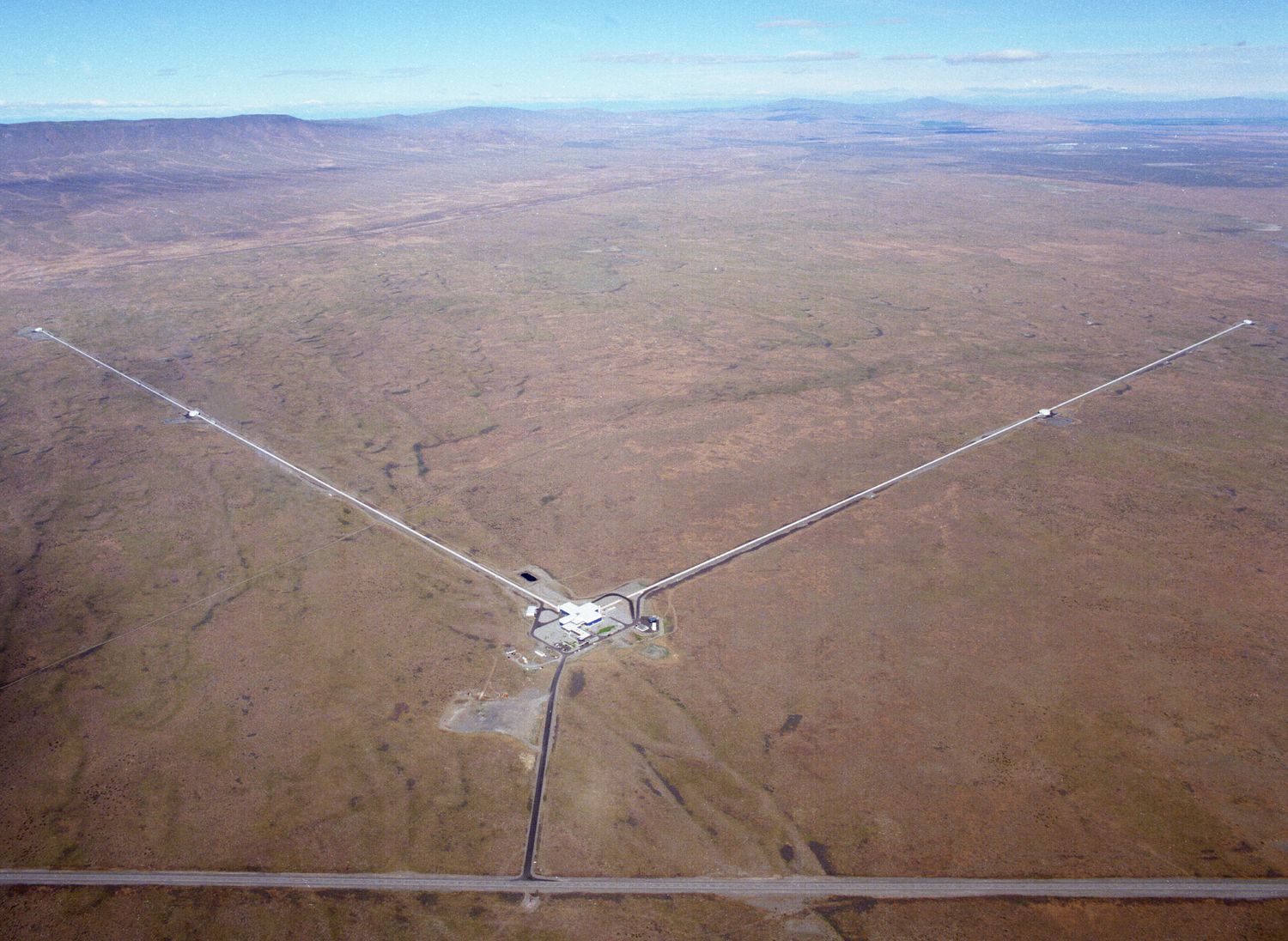
Gravitational waves Ripples in space-time caused by the movement of massive objects, such as merging black holes or neutron stars. The Laser Interferometer Gravitational-Wave Observatory (LIGO) is designed to detect these waves.
4 Britannica SourcesCreated from Britannica articles using AI. AI can make mistakes, so verify using Britannica articles. -
-
How is light used to observe space in traditional astronomy?
Traditional astronomy uses light, a form of electromagnetic radiation, to observe space. Telescopes collect radiant energy and focus it on detectors to measure its sensitivity and spectral response. Analyzing the spectrum of radiation helps identify the processes that cause its emission.
Photography was crucial for astronomy until the 1980s, as it could record faint celestial objects by accumulating light over long periods. Photos taken through color filters reveal stars' emission characteristics and surface details of planets. Spectrography records the composition of light emitted by stars, using diffraction gratings to identify elements and measure the velocities of distant stellar systems.
Multi-messenger astronomy uses both light and non-electromagnetic signals such as gravitational waves and cosmic rays.
5 Britannica SourcesCreated from Britannica articles using AI. AI can make mistakes, so verify using Britannica articles. -
What are gravitational waves, and how are they detected?
Gravitational waves are variations in the gravitational field, transmitted as waves. These waves are created when masses that source a field change with time, radiating energy as waves of curvature within that field.
Detection involves sophisticated instruments like the Laser Interferometer Gravitational-Wave Observatory (LIGO), which uses laser interferometry to measure minute changes in distance caused by passing gravitational waves. When a gravitational wave passes through LIGO, one arm of the interferometer gets longer, and the other gets shorter. A laser beam is split in half, sent down the two pipes, reflected back, and then recombined so the two beams cancel each other out in destructive interference if there is no gravitational wave.
The detection of gravitational waves has opened a new window into multimessenger astronomy, allowing scientists to study astronomical objects through light, cosmic rays, neutrinos, and gravitational waves.
6 Britannica SourcesCreated from Britannica articles using AI. AI can make mistakes, so verify using Britannica articles. -
How do combining different signals (like light and gravitational waves) help us understand space better?
Multimessenger astronomy uses different "messengers" like light and gravitational waves to study astronomical objects, such as neutron stars and supernovas. Each messenger reveals a unique aspect of the object. For instance, cosmic rays and neutrinos from within objects allow the study of high-energy processes, which provides more information than studying light alone.
Using multiple methods is called multimessenger astronomy. When LIGO and Virgo detected the merger of a binary neutron star, the Fermi and Swift space telescopes observed the resulting gamma-ray burst. This showed that gravity travels at the same speed as light.
4 Britannica SourcesCreated from Britannica articles using AI. AI can make mistakes, so verify using Britannica articles. -
What are some major discoveries made using multimessenger astronomy?
Multimessenger astronomy uses light, cosmic rays, neutrinos, and gravitational waves to study astronomical objects, revealing different aspects of the objects that emit them.
Key discoveries:
* Neutrino mass Initial neutrino detectors found fewer neutrinos than expected based on the Sun's luminosity. This led to the discovery that neutrinos have a very small mass.
* Supernova confirmation Neutrinos from Supernova (SN) 1987A arrived at Earth an hour before the light, confirming models of how supernovas occur.
* Speed of gravity The merger of a binary neutron star was observed by LIGO and Virgo, and the resulting gamma-ray burst was observed by the Fermi and Swift space telescopes. This showed that gravity travels at the same speed as light.
* Black hole mergers LIGO detected the merger of two black holes, which converted three solar masses into energy in gravitational waves.4 Britannica SourcesCreated from Britannica articles using AI. AI can make mistakes, so verify using Britannica articles.
Multimessenger astronomy, the use of multiple “messengers”—light, cosmic rays, neutrinos, and gravitational waves—to study astronomical objects such as supernovae and merging neutron star binaries. Each of these messengers reveals a different aspect of the objects that emit them. Cosmic rays and neutrinos, in particular, come from deep within objects where processes take place at very high energies. Thus, more can be learned about such objects as gamma-ray bursts and active galactic nuclei than can be learned from studying their light alone.
For most of astronomy’s history, only one messenger, light, has been used, and, of light, only that visible to the eye was used. Beginning in 1932 with American physicist Karl Jansky’s detection of radio emissions from the center of the Milky Way Galaxy, astronomers in the 20th century began observing the universe in the rest of the electromagnetic spectrum, from gamma rays through microwaves.
In the 20th century, astronomers also began studying the universe in media other than light. Studies of radiation in balloon-borne instruments led to the discovery of cosmic rays—atomic nuclei and electrons that arrive at Earth with very high energies. Understanding how the Sun shines through nuclear fusion led to efforts to detect the neutrinos given off in those fusion reactions. Neutrinos are very small chargeless subatomic particles that rarely interact with other matter, and, beginning in the 1960s, experiments were built to detect these neutrinos. The final messenger, gravitational waves, consists of very small ripples in space-time caused by the movement of very large objects. After decades of work, they were finally detected in 2015.



 " height="20" alt="HEW Logo">
Multimessenger astronomy proved its usefulness immediately when the first neutrino detectors failed to observe the amount of neutrinos predicted on the basis of the Sun’s luminosity. This deficit, the solar neutrino problem, led to the discovery that the neutrino, previously thought to be massless, actually has a very small mass. Extrasolar neutrinos were first observed from Supernova (SN) 1987A and actually arrived at Earth an hour before the light. Although only 19 such neutrinos were observed out of the 1057 emitted, astronomers were able to confirm that SN 1987A had happened as models predicted.
The first multimessenger observation involving gravitational waves happened on August 17, 2017, when the observatories LIGO and Virgo detected the merger of a binary neutron star about 40 megaparsecs (1 megaparsec = 3.26 million light-years) away. Just 1.7 seconds after the merger was observed, the Fermi and Swift space telescopes observed the resulting gamma-ray burst. Even that short interval was enough to show, to a very high level of precision, that gravity travels at the same speed as light.
Observatories all over the world that observe the four different messengers have joined to form the Astrophysical Multi-Messenger Observatory Network (AMON), which will provide a central clearinghouse so that when an interesting observation of a messenger happens that is likely to be a multimessenger event, an alert will be sent throughout the network. New, more-sensitive observatories are being built to detect each of the cosmic messengers. Among the problems that these observatories will seek to solve are the origins of the high-energy neutrino and ultra-high-energy cosmic ray backgrounds and what exactly happens when black holes merge.