

- Key People:
- Arthur B. McDonald
- Related Topics:
- Sun
- neutrino
- Astrophysics

Solar neutrino problem
-
What are neutrinos?
Neutrinos are elementary subatomic particles that are electrically neutral, possess very little mass, and have a spin of 1/2. They belong to the lepton family and are subject to the weak force. There are three types of neutrinos: electron-neutrinos, muon-neutrinos, and tau-neutrinos; each has an antimatter component called an antineutrino.
The solar neutrino problem was an astrophysics issue where the observed number of neutrinos originating from the Sun was much less than expected. The Sudbury Neutrino Observatory (SNO) demonstrated in 2002 that solar neutrinos change their type, implying that neutrinos have a small mass. This discovery resolved the solar neutrino problem.
The cosmic neutrino background consists of low-energy neutrinos that permeate the universe. These neutrinos ceased interacting with ordinary matter when the universe was one second old and have since formed the cosmic neutrino background.
4 Britannica SourcesCreated from Britannica articles using AI. AI can make mistakes, so verify using Britannica articles. -
How are neutrinos produced in the Sun?
In the Sun, neutrinos are produced through nuclear fusion reactions, primarily via the proton-proton chain. This process involves converting hydrogen nuclei into helium, releasing energy and neutrinos. For every two hydrogen atoms converted, one neutrino is produced.
These neutrinos, initially electron neutrinos, can change types as they travel from the Sun's core, a phenomenon known as neutrino oscillation. This transformation was key to solving the solar neutrino problem, which was the observed deficit of electron neutrinos compared to theoretical predictions.
5 Britannica SourcesCreated from Britannica articles using AI. AI can make mistakes, so verify using Britannica articles. -
What is the solar neutrino problem?
The solar neutrino problem is a long-standing issue in astrophysics. It describes the difference between the amount of neutrinos observed as coming from the Sun and the amount that scientists expected to find.
In the Sun, energy generation results from the immense pressure and density at its center. This allows nuclei to overcome electrostatic repulsion and for hydrogen atoms to fuse into helium atoms, releasing energy carried off by gamma-ray photons and neutrinos.
Experiments designed to detect solar neutrinos found fewer neutrinos than expected. One explanation was that the electron-neutrinos changed to another type on their way through the sun, such as muon-neutrinos. In 2002, the Sudbury Neutrino Observatory (SNO) found direct evidence for neutrino oscillations in solar neutrinos, implying that the "missing" electron-neutrinos had changed to one of the other types.
5 Britannica SourcesCreated from Britannica articles using AI. AI can make mistakes, so verify using Britannica articles. -
How did scientists detect neutrinos from the Sun?
Scientists detected neutrinos from the Sun using underground experiments like the Homestake mine experiment by Raymond Davis in the 1960s. This experiment, located deep underground, aimed to detect higher-energy neutrinos produced in the Sun.
Later, the Sudbury Neutrino Observatory (SNO) in Ontario, Canada, provided direct evidence of neutrino oscillations. SNO used heavy water to detect electron-neutrinos and all types of neutrinos, finding that the number of electron-neutrinos was only a third of what was expected. This indicated that the "missing" electron-neutrinos had changed into other types, proving that neutrinos have mass and solving the solar neutrino problem.
4 Britannica SourcesCreated from Britannica articles using AI. AI can make mistakes, so verify using Britannica articles. -
Why was there a difference between the predicted and observed number of solar neutrinos?
The solar neutrino problem arose because the observed number of neutrinos originating from the Sun was much lower than predicted.
One explanation was that the rates of the subordinate processes in the Sun's core were incorrect. Another possibility was that the neutrinos produced in the Sun's core changed to a different type that was unobservable as they interacted with the solar mass. This would mean that neutrinos have a small mass, which would have major implications for nuclear theory.
In 2002, the Sudbury Neutrino Observatory (SNO) demonstrated that solar neutrinos change their type, meaning that neutrinos have a small mass. These findings resolved the solar neutrino problem.
3 Britannica SourcesCreated from Britannica articles using AI. AI can make mistakes, so verify using Britannica articles. -
How was the solar neutrino problem finally solved?
The solar neutrino problem arose because the observed number of neutrinos from the Sun was much lower than expected. The solution came in 2002, when the Sudbury Neutrino Observatory (SNO) in Ontario, Canada, discovered that solar neutrinos change types as they travel from the Sun.
These neutrino oscillations are possible only if neutrinos have mass. Experiments showed that the number of electron-neutrinos was only one-third of what was expected, implying that the missing electron-neutrinos had changed into other types. This discovery that neutrinos have a small mass provided the definitive solution to the solar neutrino problem.
4 Britannica SourcesCreated from Britannica articles using AI. AI can make mistakes, so verify using Britannica articles.
Solar neutrino problem, long-standing astrophysics problem in which the amount of observed neutrinos originating from the Sun was much less than expected.
In the Sun, the process of energy generation results from the enormous pressure and density at its centre, which makes it possible for nuclei to overcome electrostatic repulsion. (Nuclei are positive and thus repel each other.) Once in some billions of years, a given proton (1H, in which the superscript represents the mass of the isotope) is close enough to another to undergo a process called inverse beta-decay, in which one proton becomes a neutron and combines with the second to form a deuteron (2D). This is shown symbolically on the first line of equation (1), in which e− is an electron and ν is a subatomic particle known as a neutrino.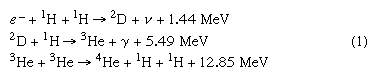
While this is a rare event, hydrogen atoms are so numerous that it is the main solar energy source. Subsequent encounters (listed on the second and third lines) proceed much faster: the deuteron encounters one of the ubiquitous protons to produce helium-3 (3He), and these in turn form helium-4 (4He). The net result is that four hydrogen atoms are fused into one helium atom. The energy is carried off by gamma-ray photons (γ) and neutrinos (ν). Because the nuclei must have enough energy to overcome the electrostatic barrier, the rate of energy production varies as the fourth power of the temperature.



 " height="20" alt="HEW Logo">

Equation (1) shows that for every two hydrogen atoms converted, one neutrino of average energy 0.26 MeV carrying 1.3 percent of the total energy released is produced. This produces a flux of 8 1010 neutrinos per square centimetre per second at Earth. In the 1960s the first experiment designed to detect solar neutrinos was built by the American scientist Raymond Davis (for which he won the Nobel Prize for Physics in 2002) and carried out deep underground in the Homestake gold mine in Lead, S.D. The solar neutrinos in equation (1) had an energy (less than 0.42 MeV) that was too low to be detected by this experiment; however, subsequent processes produced higher-energy neutrinos that Davis’s experiment could detect. The number of these higher-energy neutrinos observed was far smaller than would be expected from the known energy-generation rate, but experiments established that these neutrinos did in fact come from the Sun. One possible reason for the small number detected was that the presumed rates of the subordinate process are not correct. Another more intriguing possibility was that the neutrinos produced in the core of the Sun interact with the vast solar mass and change to a different kind of neutrino that cannot be observed. The existence of such a process would have great significance for nuclear theory, for it requires a small mass for the neutrino. In 2002, results from the Sudbury Neutrino Observatory, nearly 2,100 metres (6,900 feet) underground in the Creighton nickel mine near Sudbury, Ont., showed that the solar neutrinos did change their type and thus that the neutrino had a small mass. These results solved the solar neutrino problem.