

- Related Topics:
- Why are gymnasts so short?
- radius of gyration
- rotational inertia
- On the Web:
- Physics LibreTexts - Moment of Inertia (Oct. 22, 2026)

moment of inertia
-
What is moment of inertia?
The moment of inertia, represented as ( I ), measures a body's resistance to changes in its rotation around an axis, whether internal or external. It is the sum of the products of each particle's mass in the body and the square of its distance from the axis.
The formula for calculating the moment of inertia is:
[ I = \Sigma m_i R_i^2 ]
Where ( m_i ) is the mass of each particle and ( R_i ) is the distance from the axis of rotation.The moment of inertia is analogous to mass in linear momentum. The unit of measure for the moment of inertia in the International System (SI) is kilogram-meter squared.
2 Britannica SourcesCreated from Britannica articles using AI. AI can make mistakes, so verify using Britannica articles. -
How is moment of inertia related to rotational motion?
Moment of inertia is a measure of an object's resistance to changes in its rotational motion. It is analogous to mass in linear motion, where greater mass means greater resistance to changes in velocity. For rotational motion, the greater the moment of inertia, the more torque (twisting force) must be applied to alter its angular velocity.
The moment of inertia ( I ) relates to angular momentum ( L ) and angular velocity ( \omega ) as ( L = I\omega ), and to torque ( \tau ) and angular acceleration ( \alpha ) as ( \tau = I\alpha ). The moment of inertia depends not only on the mass of the object but also on how that mass is distributed relative to the axis of rotation; mass further from the axis contributes more to the moment of inertia.
3 Britannica SourcesCreated from Britannica articles using AI. AI can make mistakes, so verify using Britannica articles. -
How does the shape of an object affect its moment of inertia?
The moment of inertia, a measure of an object's resistance to changes in its rotation, is significantly influenced by the object's shape. The distribution of mass relative to the axis of rotation is key: mass farther from the axis contributes more to the moment of inertia than mass closer to it because of the (R_i^2) factor, where (R_i) is the distance from the axis.
For mathematically definable shapes, the moment of inertia can be calculated using integral calculus. The moment of inertia depends on the axis of rotation and, for an axis not through the center of mass, involves the moment of inertia about a parallel axis through the center of mass, plus a term accounting for the mass concentrated at the center of mass rotating about the axis of rotation.
2 Britannica SourcesCreated from Britannica articles using AI. AI can make mistakes, so verify using Britannica articles. -
Why does the axis of rotation matter for moment of inertia?
The axis of rotation is crucial for determining the moment of inertia because it affects how mass is distributed relative to the axis. The moment of inertia, denoted as ( I ), quantifies an object's resistance to changes in its rotation.
The effect of a mass on the moment of inertia depends on its distance from the axis. Mass farther from the axis contributes more to the moment of inertia due to the ( R_i^2 ) factor, where ( R_i ) is the distance from the axis. Therefore, the moment of inertia varies depending on the chosen axis of rotation.
For an axis that does not pass through the center of mass, the moment of inertia equals the moment of inertia for rotation about an axis through the center of mass (( I_c )) plus a contribution that acts as if the mass were concentrated at the center of mass, which then rotates about the axis of rotation.
2 Britannica SourcesCreated from Britannica articles using AI. AI can make mistakes, so verify using Britannica articles. -
How do you calculate the moment of inertia for a simple object like a rod or a disk?
The moment of inertia, represented by ( I ), measures a body's resistance to changes in its rotation. It depends on the mass distribution relative to the axis of rotation.
To calculate the moment of inertia, you sum the products of each particle's mass (( m )) and the square of its distance (( r )) from the axis of rotation: ( I = \Sigma mr^2 ). For continuous objects, integral calculus is used.
For a disk, the moment of inertia about an axis through its center and perpendicular to its face is ( I = \frac{1}{2}mR^2 ), where ( m ) is the mass and ( R ) is the radius. The moments of inertia of some other uniform bodies are given in the table in the mechanics article.
2 Britannica SourcesCreated from Britannica articles using AI. AI can make mistakes, so verify using Britannica articles. -
Why is understanding moment of inertia important in physics and engineering?
The moment of inertia, crucial in physics and engineering, is a body's resistance to changes in its rotation rate around an axis. Understanding it is vital because it relates torque (turning force) to angular acceleration.
Inertia depends on mass and its distribution relative to the axis: mass further from the axis contributes more to the moment of inertia because it is proportional to the square of the distance from the axis. This is why, for a rigid body, the angular momentum (L) equals the moment of inertia (I) times the angular velocity (\omega), or (L = I\omega).
3 Britannica SourcesCreated from Britannica articles using AI. AI can make mistakes, so verify using Britannica articles.
moment of inertia, in physics, quantitative measure of the rotational inertia of a body—i.e., the opposition that the body exhibits to having its speed of rotation about an axis altered by the application of a torque (turning force). The axis may be internal or external and may or may not be fixed. The moment of inertia (I), however, is always specified with respect to that axis and is defined as the sum of the products obtained by multiplying the mass of each particle of matter in a given body by the square of its distance from the axis. In calculating angular momentum for a rigid body, the moment of inertia is analogous to mass in linear momentum. For linear momentum, the momentum p is equal to the mass m times the velocity v; whereas for angular momentum, the angular momentum L is equal to the moment of inertia I times the angular velocity ω.
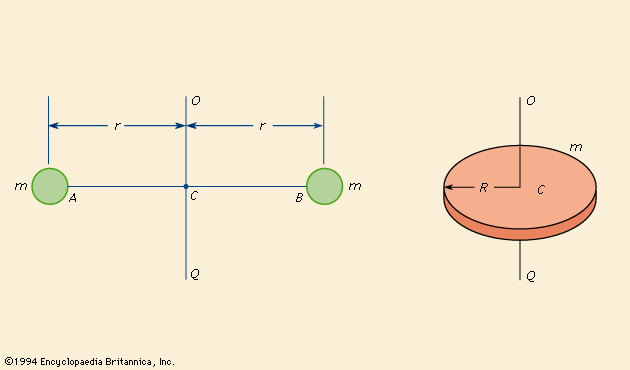
The shows two steel balls that are welded to a rod AB that is attached to a bar OQ at C. Neglecting the mass of AB and assuming that all particles of the mass m of each ball are concentrated at a distance r from OQ, the moment of inertia is given by I = 2mr2.
The unit of moment of inertia is a composite unit of measure. In the International System (SI), m is expressed in kilograms and r in metres, with I (moment of inertia) having the dimension kilogram-metre square. In the U.S. customary system, m is in slugs (1 slug = 32.2 pounds) and r in feet, with I expressed in terms of slug-foot square.



 " height="20" alt="HEW Logo">
The moment of inertia of any body having a shape that can be described by a mathematical formula is commonly calculated by the integral calculus. The moment of inertia of the disk in the about OQ could be approximated by cutting it into a number of thin concentric rings, finding their masses, multiplying the masses by the squares of their distances from OQ, and adding up these products. Using the integral calculus, the summation process is carried out automatically; the answer is I = (mR2)/2. (See mechanics; torque.)
For a body with a mathematically indescribable shape, the moment of inertia can be obtained by experiment. One of the experimental procedures employs the relation between the period (time) of oscillation of a torsion pendulum and the moment of inertia of the suspended mass. If the disk in the were suspended by a wire OC fixed at O, it would oscillate about OC if twisted and released. The time for one complete oscillation would depend on the stiffness of the wire and the moment of inertia of the disk; the larger the inertia, the longer the time.