rotational inertia
Quick Summary
Rotational inertia, also known as moment of inertia, is a measure of an object's resistance to changes in its rotational motion. Just as mass resists changes in linear motion, rotational inertia resists changes in rotational motion.12
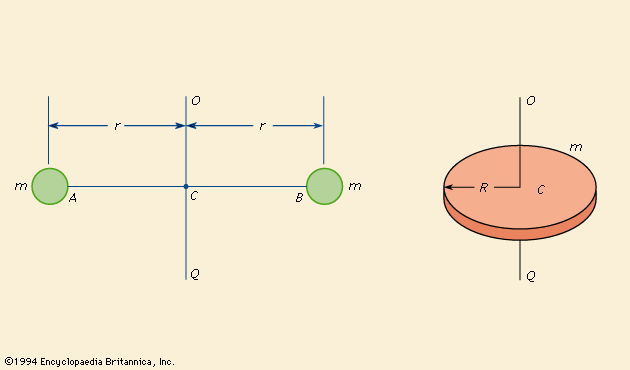
This resistance depends on both the object's mass and how that mass is distributed relative to the axis of rotation. Mass located farther from the axis contributes more to the rotational inertia than mass closer to the axis. The formula for rotational inertia ((I)) is derived from the sum of the products of each mass element ((m_i)) and the square of its distance ((R_i)) from the axis of rotation: (I = \sum m_i R_i^2).2
Rotational inertia is a fundamental concept in understanding the dynamics of rigid bodies rotating about a fixed axis, influencing angular momentum and the torque required to change rotational speed.2
Ask Britannica AI about this topic
Britannica doesn't have a full article on this topic, so we've curated a list of our relevant coverage.