- Related Topics:
- pseudoionone
- methyl ethyl ketone
- ketoxime
- keto acid
- thujone
- On the Web:
- National Center for Biotechnology Information - Biochemistry, Ketone Metabolism (Nov. 07, 2026)


ketone
-
What is a ketone?
A ketone is an organic compound with a carbonyl group (a carbon atom double-bonded to an oxygen atom) connected to two other carbon atoms or hydrocarbon radicals. Ketones are highly reactive and are used to synthesize many complex organic compounds.
The most important ketone is acetone (CH3COCH3), a liquid solvent with a sweet odor that is infinitely soluble in water and dissolves many organic compounds.
Ketones are named by selecting the longest carbon atom chain containing the carbonyl group and changing the parent alkane's suffix from -e to -one.
4 Britannica SourcesCreated from Britannica articles using AI. AI can make mistakes, so verify using Britannica articles. -
How do ketones differ from other types of organic compounds?
Ketones are a class of organic compounds characterized by a carbonyl group (a carbon atom double-bonded to an oxygen atom) with the carbon atom also bonded to two other carbon atoms or hydrocarbon radicals.
Key differences:
* Functional Group While many organic compounds contain different functional groups, ketones specifically feature a carbonyl group (C=O) bonded to two carbon atoms.
* Reactivity Ketones are less reactive than aldehydes due to the carbonyl group's nature.
* Polarity The carbonyl group in ketones is polar because the electrons in the C=O bond are drawn closer to the oxygen than to the carbon, giving the oxygen a partial negative charge and the carbon a partial positive charge.
* Nomenclature Ketones are named by identifying the longest carbon chain containing the carbonyl group and changing the parent alkane's suffix from -e to -one.3 Britannica SourcesCreated from Britannica articles using AI. AI can make mistakes, so verify using Britannica articles. -
What is the basic structure of a ketone molecule?
Ketones are a class of organic compounds distinguished by a carbonyl group ((\text{C=O})), where the carbon atom is double-bonded to an oxygen atom. The remaining two bonds on the carbonyl carbon are to other carbon atoms or hydrocarbon radicals (R), which can be the same or different. The general formula for a ketone is (R_1(\text{CO})R_2).
Because the oxygen atom is more electronegative than the carbon atom, the carbonyl group is polar. This polarity makes the carbon atom partially positive, rendering it susceptible to nucleophilic attack.
Acetone ((\text{CH}_3\text{COCH}_3)) is a widely used industrial solvent and the most important ketone.
3 Britannica SourcesCreated from Britannica articles using AI. AI can make mistakes, so verify using Britannica articles. -
Where can ketones be found in everyday life or nature?
Ketones are organic compounds that contain a carbonyl group with a carbon atom covalently bonded to an oxygen atom.
Ketones can be found in:
- Sugars Ketones are present in several types of sugars.
- Steroid hormones They are found in both natural and synthetic steroid hormones and medicinal compounds. For example, cortisone, an anti-inflammatory agent, contains three ketone groups.
- Industrial solvents Ketones are widely utilized as solvents in industries that manufacture explosives, lacquers, paints, and textiles. They are also used in tanning, as preservatives, and in hydraulic fluids.
- Acetone The most important ketone, acetone, is infinitely soluble in water and dissolves many organic compounds. It is a common ingredient in products like paints, varnishes, resins, coatings, and nail-polish removers.
- Ketone bodies These include acetoacetic acid, acetone, and beta-hydroxybutyric acid, which are intermediates in lipid metabolism.
2 Britannica SourcesCreated from Britannica articles using AI. AI can make mistakes, so verify using Britannica articles. -
How are ketones used in industry or medicine?
Ketones are organic compounds with a carbonyl group, crucial in various physiological processes and medicinal applications. They appear in several sugars and medicinal compounds, such as natural and synthetic steroid hormones; cortisone, an anti-inflammatory agent, contains three ketone groups.
Industrially, ketones serve as solvents in manufacturing explosives, lacquers, paints, and textiles. They are also useful in tanning, as preservatives, and in hydraulic fluids. Acetone is a very important ketone, used as an industrial solvent in paints, varnishes, resins, coatings, and nail-polish removers. Ketone bodies, such as acetoacetic acid, acetone, and beta-hydroxybutyric acid, are intermediates in lipid metabolism.
2 Britannica SourcesCreated from Britannica articles using AI. AI can make mistakes, so verify using Britannica articles. -
What makes ketones chemically reactive or important in chemistry?
Ketones are reactive because of their carbonyl group (carbon atom double-bonded to an oxygen atom), which is highly polar due to an uneven distribution of electrons. This polarity makes the carbon atom partially positive, attracting nucleophiles.
Ketones are essential as solvents in manufacturing explosives, lacquers, paints, and textiles, and as building blocks for synthesizing complex organic compounds because they are relatively stable, easily prepared, and highly reactive. Common reactions that ketones undergo include nucleophilic addition and oxidation-reduction. They can be produced through the oxidation of secondary alcohols, Friedel-Crafts acylation, or the reaction of nitriles with Grignard reagents.
2 Britannica SourcesCreated from Britannica articles using AI. AI can make mistakes, so verify using Britannica articles.
ketone, any of a class of organic compounds characterized by the presence of a carbonyl group in which the carbon atom is covalently bonded to an oxygen atom. The remaining two bonds are to other carbon atoms or hydrocarbon radicals (R):
Ketone compounds have important physiological properties. They are found in several sugars and in compounds for medicinal use, including natural and synthetic steroid hormones. Molecules of the anti-inflammatory agent cortisone contain three ketone groups.
Only a small number of ketones are manufactured on a large scale in industry. They can be synthesized by a wide variety of methods, and because of their ease of preparation, relative stability, and high reactivity, they are nearly ideal chemical intermediates. Many complex organic compounds are synthesized using ketones as building blocks. They are most widely used as solvents, especially in industries manufacturing explosives, lacquers, paints, and textiles. Ketones are also used in tanning, as preservatives, and in hydraulic fluids.



 " height="20" alt="HEW Logo">

The most important ketone is acetone (CH3COCH3), a liquid with a sweetish odour. Acetone is one of the few organic compounds that is infinitely soluble in water (i.e., soluble in all proportions); it also dissolves many organic compounds. For this reason—and because of its low boiling point (56 °C [132.8 °F]), which makes it easy to remove by evaporation when no longer wanted—it is one of the most important industrial solvents, being used in such products as paints, varnishes, resins, coatings, and nail-polish removers.
Nomenclature of ketones
The International Union of Pure and Applied Chemistry (IUPAC) name of a ketone is derived by selecting as the parent the longest chain of carbon atoms that contains the carbonyl group. The parent chain is numbered from the end that gives the carbonyl carbon the smaller number. The suffix -e of the parent alkane is changed to -one to show that the compound is a ketone. For example, CH3CH2COCH2CH(CH3)2 is named 5-methyl-3-hexanone. The longest chain contains six carbon atoms and numbering of the carbon must begin at the end that gives the smaller number to the carbonyl carbon. The carbonyl group is on carbon 3, and the methyl group is on carbon 5. In cyclic ketones, numbering of the atoms of the ring begins with the carbonyl carbon as number 1. Common names for ketones are derived by naming each carbon group bonded to carbon as a separate word followed by the word “ketone.”
The simplest ketone, CH3COCH3, whose IUPAC name is 2-propanone, is almost always called by its common name, acetone, which is derived from the fact that it was first prepared by heating the calcium salt of acetic acid.
Reactions of ketones
Ketones are highly reactive, although less so than aldehydes, to which they are closely related. Much of their chemical activity results from the nature of the carbonyl group. Ketones readily undergo a wide variety of chemical reactions. A major reason is that the carbonyl group is highly polar; i.e., it has an uneven distribution of electrons. This gives the carbon atom a partial positive charge, making it susceptible to attack by nucleophiles, which are species attracted to positively charged centres. Typical reactions include oxidation-reduction and nucleophilic addition. The polarity of the carbonyl group affects the physical properties of ketones as well.
The trusted destination for professionals, college students, and lifelong learners.
SUBSCRIBE


Secondary alcohols are easily oxidized to ketones (R2CHOH → R2CO). The reaction can be halted at the ketone stage because ketones are generally resistant to further oxidation. Oxidation of a secondary alcohol to a ketone can be accomplished by many oxidizing agents, most often chromic acid (H2CrO4), pyridinium chlorochromate (PCC), potassium permanganate (KMnO4), or manganese dioxide (MnO2). With a few exceptions (such as oxidative cleavage of cyclohexanone, C6H10O, to adipic acid, HO2C[CH2]4CO2H, a compound used to make nylon-6,6), the oxidation of ketones is not synthetically useful.
The treatment of an aromatic hydrocarbon with an acyl halide or anhydride in the presence of a catalyst composed of a Lewis acid (i.e., a compound capable of accepting an electron pair), most often aluminum chloride (AlCl3), gives an aryl alkyl or diaryl ketone (ArH → ArCOR or ArCOAr′), where Ar represents an aromatic ring. This reaction is known as Friedel-Crafts acylation.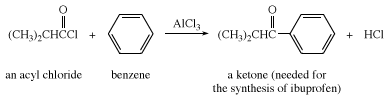
Nitriles (RCN) react with Grignard reagents to produce ketones, following hydrolysis (RCN + R′MgX → RCOR′).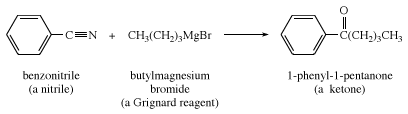
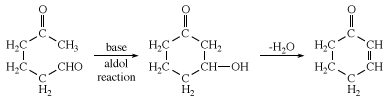
Ketones possessing α-hydrogens can often be made to undergo aldol reactions (also called aldol condensation) by the use of certain techniques. The reaction is often used to close rings, in which case one carbon provides the carbonyl group and another provides the carbon with an α-hydrogen. An example is the synthesis of 2-cyclohexenone. In this example, the aldol product undergoes loss of H2O to give an α, β-unsaturated ketone.