
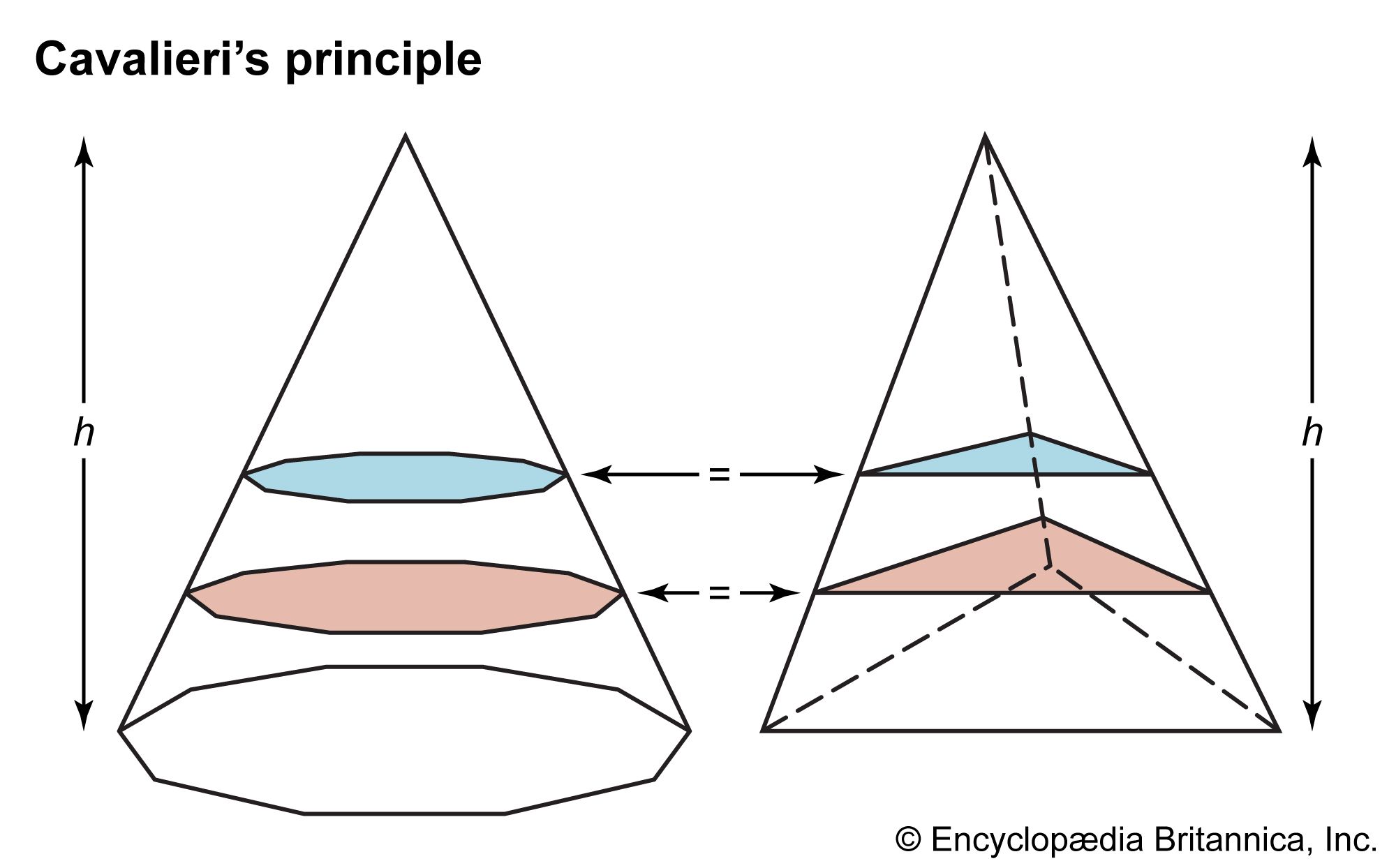


Cavalieri’s principle
Quick Summary
Cavalieri's principle, developed by mathematician Bonaventura Cavalieri, is a precursor to integral calculus. It provides a method for determining the size of geometric figures by considering them as sums of infinitesimally thin slices, or "indivisibles".12
The principle states that if two solids can be sliced by a family of parallel planes, and each plane cuts both solids into cross sections of equal area, then the two solids have equal volume. This concept was crucial in geometry and helped mathematicians calculate areas and volumes more efficiently before the full development of calculus. Cavalieri's work, particularly his book Geometria Indivisibilibus Continuorum Nova Quadam Ratione Promota, introduced this method, though it initially faced criticism before being refined into a more widely accepted form.21
Ask Britannica AI about this topic
Britannica doesn't have a full article on this topic, so we've curated a list of our relevant coverage.
- Archimedes’ Lost Method
…a method later known as Cavalieri’s principle, which involves slicing solids (whose volumes are to be compared) with a family of parallel planes. In particular, if each plane in the family cuts two solids into cross sections of equal area, then the two solids must have equal volume (see figure).…
Read More…a method later known as Cavalieri’s principle, which involves slicing solids (whose volumes are to be compared) with a family of parallel planes. In particular, if each plane in the family cuts two solids into cross sections of equal area, then the two solids must have equal volume (see figure).…
Read More  East Asian mathematicsThe commentary of Liu Hui
…later in the West as Cavalieri’s principle, which states that, if two solids of the same height are such that their corresponding sections at any level have the same areas, then they have the same volume. (See the figure.) More precisely, Liu deduced the volume of a solid whose cross…
Read More…later in the West as Cavalieri’s principle, which states that, if two solids of the same height are such that their corresponding sections at any level have the same areas, then they have the same volume. (See the figure.) More precisely, Liu deduced the volume of a solid whose cross…
Read More