

- Born:
- 1598, Milan [Italy]
- Died:
- Nov. 30, 1647, Bologna, Papal States (aged 49)
- Subjects Of Study:
- method of indivisibles


Bonaventura Cavalieri
Bonaventura Cavalieri (born 1598, Milan [Italy]—died Nov. 30, 1647, Bologna, Papal States) was an Italian mathematician who made developments in geometry that were precursors to integral calculus.
As a boy Cavalieri joined the Jesuati, a religious order (sometimes called “Apostolic Clerics of St. Jerome”) that followed the rule of St. Augustine and was suppressed in 1668 by Pope Clement IX. Euclid’s works stimulated his interest in mathematics, and, after he met Galileo, Cavalieri considered himself a disciple of that great astronomer.
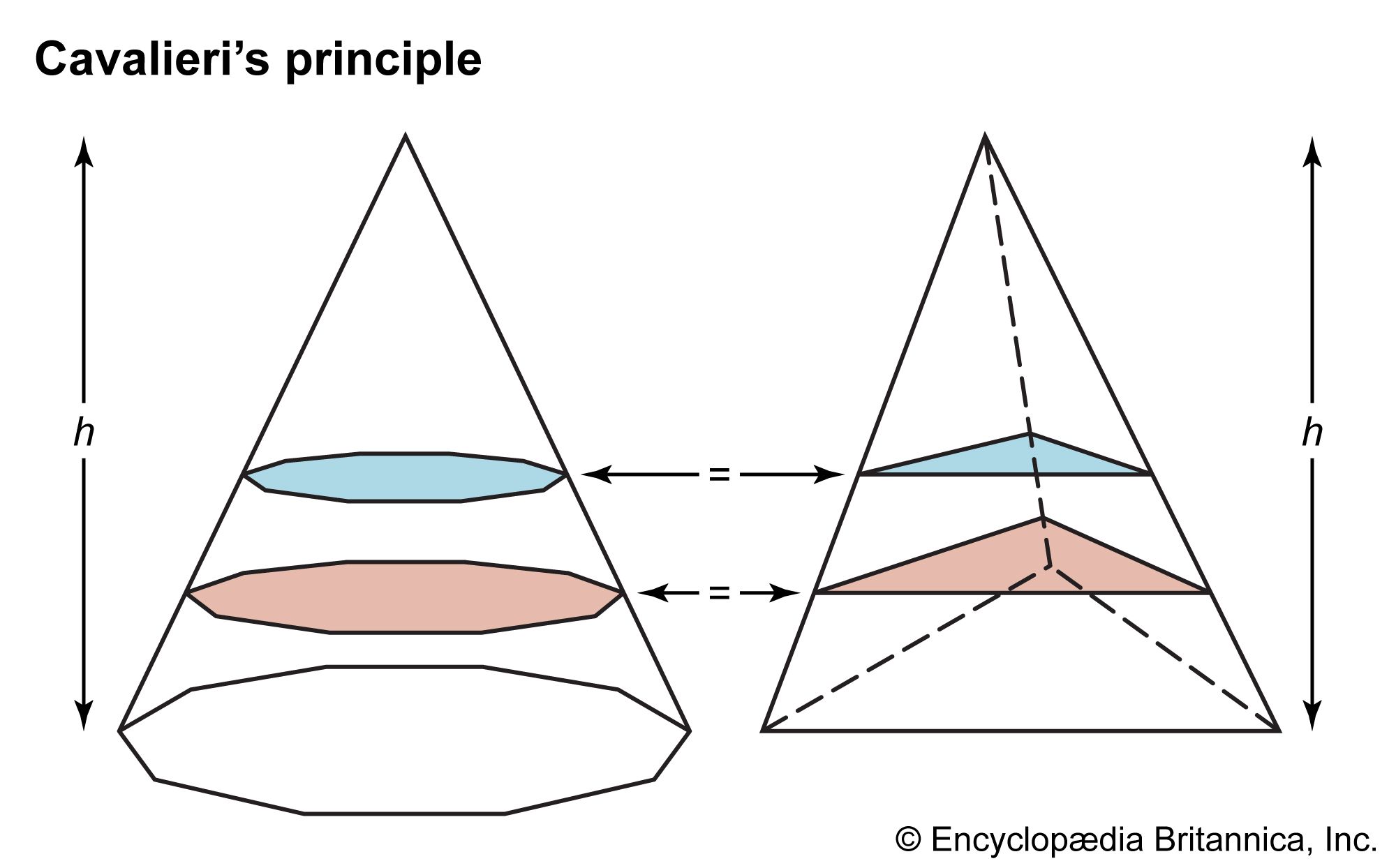
By 1629, when he was appointed professor of mathematics of the University of Bologna, Cavalieri had completely developed his method of indivisibles, a means of determining the size of geometric figures similar to the methods of integral calculus. He delayed publishing his results for six years out of deference to Galileo, who planned a similar work. Cavalieri’s work appeared in 1635 and was entitled Geometria Indivisibilibus Continuorum Nova Quadam Ratione Promota (“A Certain Method for the Development of a New Geometry of Continuous Indivisibles”). As stated in his Geometria, the method of indivisibles was unsatisfactory and fell under heavy criticism, notably from the contemporary Swiss mathematician Paul Guldin. In reply to this criticism, Cavalieri wrote Exercitationes Geometricae Sex (1647; “Six Geometrical Exercises”), stating the principle in the more satisfactory form that was widely employed by mathematicians during the 17th century.




Cavalieri was largely responsible for introducing the use of logarithms as a computational tool in Italy through his book Directorium Generale Uranometricum (1632; “A General Directory of Uranometry”). His other works include Lo specchio ustorio ouero trattato delle settioni coniche (1632; “The Burning Glass; or, A Treatise on Conic Sections”) and Trigonometria plana et sphaerica, linearis et logarithmica (1643; “Plane, Spherical, Linear, and Logarithmic Trigonometry”).