




Byron Bay
News •
-
What is Byron Bay?
Byron Bay is a well-known beach town and major tourist destination located in northeastern New South Wales, Australia. Situated on Cape Byron, it is the easternmost point of the Australian mainland.
The Bundjalung nation of the Arakwal Australian Aboriginal people inhabited the coast for over 20,000 years before Captain James Cook named the cape in 1770. Byron Bay was established in 1860 as a timber port and officially became a town in 1896.
Tourism now drives the local economy. Visitors enjoy beaches, surfing, diving, and exploring nearby villages. The Cape Byron Lighthouse and Arakwal National Park are popular attractions, with the latter being co-managed by the Bundjalung people.
1 Britannica SourceCreated from Britannica articles using AI. AI can make mistakes, so verify using Britannica articles. -
Where is Byron Bay located in Australia?
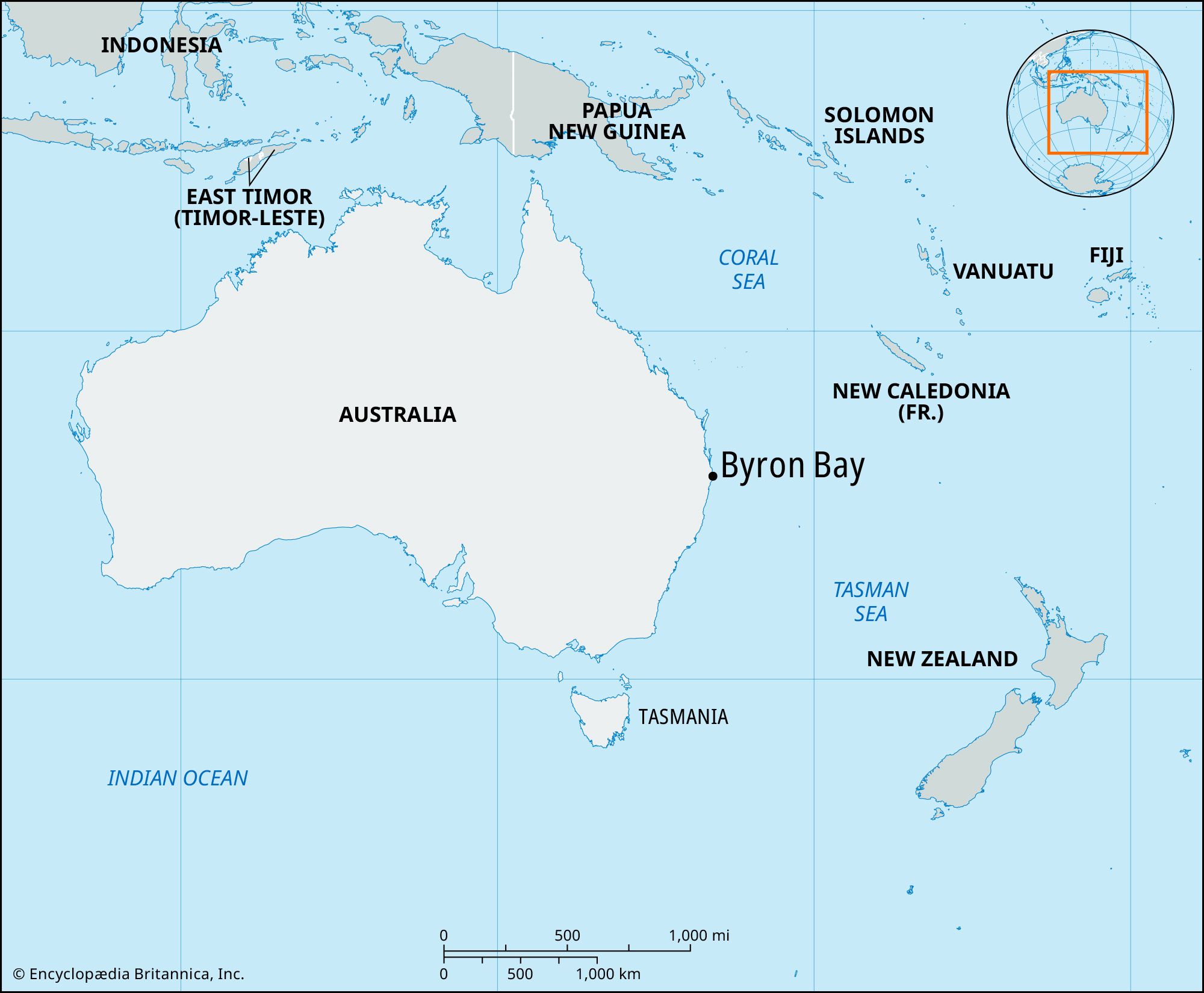
Byron Bay is a town in northeastern New South Wales, Australia, situated on Cape Byron, which shelters the bay and marks the easternmost point on Australia's mainland. The Bundjalung nation of the Arakwal Australian Aboriginal people have lived along the coast of Byron Bay for over 20,000 years. Today, tourism drives the local economy, with visitors coming to enjoy beaches, surfing, and marine activities.
1 Britannica SourceCreated from Britannica articles using AI. AI can make mistakes, so verify using Britannica articles. -
What is Byron Bay known for?
Byron Bay, situated on Cape Byron in northeastern New South Wales, Australia, is renowned as one of Australia’s best-known beach towns and a major tourist destination. Originally inhabited by the Bundjalung nation, Captain James Cook named the cape in 1770.
Byron Bay has evolved from a timber port in 1860 to a town in 1896 and a shire in 1906. Gold was discovered in 1870, followed by sand mining for rutile and zircon. Today, tourism drives the economy, with attractions like beaches, surfing, Cape Byron Marine Park, and the Cape Byron Lighthouse. Arakwal National Park, managed with the Bundjalung people, protects cultural heritage and allows traditional practices. The town also hosts open-air markets and the annual Byron Bay Bluesfest.
1 Britannica SourceCreated from Britannica articles using AI. AI can make mistakes, so verify using Britannica articles. -
What types of outdoor activities can people do in Byron Bay?
Byron Bay, situated on Cape Byron in northeastern New South Wales, Australia, is known for its diverse outdoor activities. Visitors can enjoy surfing and strolling its beaches, as well as scuba diving and snorkeling in the Cape Byron Marine Park. Eco-cruising and kayaking are also popular. The Cape Byron State Conservation Area features a walking track that passes through rainforest and cliff tops, while the Arakwal National Park offers jointly managed cultural heritage areas for traditional activities.
1 Britannica SourceCreated from Britannica articles using AI. AI can make mistakes, so verify using Britannica articles. -
How does Byron Bay’s climate affect its tourism?
Byron Bay is one of Australia’s best-known beach towns and a major tourist destination. Visitors come to stroll its beaches and surf. They also scuba dive and snorkel in the protected habitat of Cape Byron Marine Park, go eco cruising and kayaking, and visit nearby villages.
1 Britannica SourceCreated from Britannica articles using AI. AI can make mistakes, so verify using Britannica articles. -
What are some ways Byron Bay’s history and culture make it unique?
Byron Bay's uniqueness arises from its blend of history and culture. Originally inhabited by the Bundjalung nation for over 20,000 years, the area was named by Captain James Cook in 1770. Founded as a timber port in 1860, Byron Bay has seen economic shifts from gold and sand mining to commercial fishing and agriculture.
Today, tourism drives its economy, attracting visitors to its beaches, marine park, and the Cape Byron Lighthouse. Arakwal National Park is co-managed by the Bundjalung people, preserving cultural heritage and traditional practices. The town also hosts open-air markets and festivals like the Byron Bay Bluesfest, adding to its distinctive appeal.
1 Britannica SourceCreated from Britannica articles using AI. AI can make mistakes, so verify using Britannica articles.
Byron Bay, town, northeastern New South Wales, Australia. The town is situated on Cape Byron, which shelters Byron Bay and is the easternmost point of the Australian mainland, Byron Bay is one of Australia’s best-known beach towns and is a major tourist destination.
The Bundjalung nation of the Arakwal Australian Aboriginal people had been living along the coast of Byron Bay for more than 20,000 years when the cape was encountered in 1770 by Capt. James Cook, who named it for Commodore (later Admiral) John Byron, grandfather of the poet Lord Byron. Byron Bay was founded in 1860 as a timber port. It was declared a town in 1896 and a shire in 1906. Before coastal shipping declined, Byron Bay was the principal port between Newcastle (about 390 miles [630 km] south) and Brisbane (90 miles [140 km] north-northwest).
Over the years, Byron Bay’s local economy underwent a dramatic evolution. Gold was discovered on the beach in 1870 and for roughly 20 years was painstakingly extracted from the black sand as “poor man’s diggings,” which yielded a measure of profit for most who undertook its mining but did not bestow a fortune on anyone. In the mid-1930s it was learned that the sand that had been discarded by the prospectors contained the valuable minerals rutile and zircon, which became the focus of a sand-mining industry that flourished until the early 1970s. From 1950 to 1961 Byron Bay’s Zircon Rutile Limited (ZRL) was the world’s largest producer of rutile and zircon.




Commercial fishing was locally important until 1954, when a powerful cyclone decimated Byron Bay’s jetty and most of the local fishing fleet. The decline of fishing in the 1950s was offset by the emergence of Byron Bay as a whaling port, though massive overfishing resulted in the virtual extinction of Australia and New Zealand’s humpback whale population by the mid-1960s; the population has since rebounded.
Largely because of the raising of beef and dairy cattle in the surrounding area, for some 90 years (the mid-1890s to the mid-1980s) Byron Bay was the centre of a vibrant agricultural processing industry based on the production of beef, butter, and bacon. The cultivation of bananas, pineapples, and avocados was also important. In the 21st century the local production of bananas and avocados remained significant, along with that of flowers, coffee, and macadamia nuts.
Today tourism drives the local economy. Visitors flock to Byron Bay to stroll its beaches and surf, to scuba dive and snorkel in the protected habitat of Cape Byron Marine Park (2002), for eco cruising and kayaking, and to visit nearby quaint villages. Located about 1.2 miles (2 km) northeast of town is the historic Cape Byron Lighthouse (1901), which is within Cape Byron State Conservation Area and accessible via a 2.3-mile- (3.7-km-) loop walking track that passes through rainforest and along cliff tops. About 2 miles (3.2 km) east and southeast of Byron Bay, along the coast, is Arakwal National Park, which is jointly managed by the Bundjalung people of Byron Bay (Arakwal) and the New South Wales National Parks and Wildlife Service under the terms of a landmark indigenous land use agreement. That agreement protects areas of cultural heritage and guarantees access for the Bundjalung to conduct traditional ceremonies and to hunt and fish.
A number of open-air markets are regularly staged in Byron Bay. Prominent among several festivals held annually in or near town is the Byron Bay Bluesfest, which began in 1990. Connected to Brisbane by bus and just off the Pacific Highway, the town is also served by the Ballina Byron Gateway Airport Pop. (2011) urban centre, 8,424; (2016) urban centre, 9,246.
The trusted destination for professionals, college students, and lifelong learners.
SUBSCRIBE

