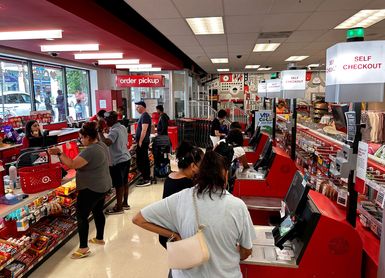
Tracking the cash registers, and the e-commerce clicks and taps.
© Lindsey Nicholson—UCG/Universal Images Group/Getty Images
Did you buy anything last month, like groceries, clothing, or a knickknack for the shelf in the corner? How about a new smartphone or perhaps even a car?
Congratulations. You and your stuff are part of a key monthly statistic: The monthly retail sales report.
Each month, the U.S. Census Bureau delivers a detailed report on the economic health of consumers, as measured by sales of goods and services at the retail level. It’s a key gauge—used by government policymakers, Wall Street analysts, and everyday investors—of how and where we all spent our money the month before. Because consumer spending represents some 70% of the country’s gross domestic product (GDP), the results are considered a harbinger of what might be ahead on the economic front.
Key Points
- The U.S. Census Bureau collects data each month from retailers across the economy and releases it around the middle of the following month.
- Retail sales data is used by the Federal Reserve and several government agencies to help inform their policy decisions.
- Everyday investors can use retail sales data to gauge the strength of the economy and perhaps future employment trends.
The Advanced Monthly Retail Trade and Food Services Survey (“MARTS”) is released at 8:30 a.m. ET around the middle of each month. It can also be used to detect inflationary pressures, and it’s one of the key metrics the Federal Reserve takes into account as it contemplates U.S. monetary policy.
Investors and traders often watch for the retail report to catch a glimpse of what’s ahead for sales and profits of the nation’s publicly held retailers, as well as the manufacturers that make their products. Sales trends—and expectations of future trends—can have an outsize effect on retailers and the broader market (see figure 1).
Figure 1: RETAIL AND ECONOMIC VOLATILITY. In the 10-year period from 2013 to 2023, the S&P Retail SPDR ETF (XRT, candlestick chart) saw periods of stagnation and underperformance versus the broad-based S&P 500 Index (SPX, blue line) before and after the COVID-19 pandemic. They were particularly volatile—first way down, then way up—in 2020 and 2021.
Source: Barchart.com; Annotations by Encyclopædia Britannica, Inc.
How is retail sales data gathered?
Although the advanced retail sales survey (MARTS) is the one that gets the headlines each month, MARTS is actually a randomized sample of a larger Monthly Retail Trade Survey (“MRTS”) data set. To calculate the MARTS data set each month, the Census Bureau pulls a random sample set of roughly 4,800 retail companies (and company business units) from the MRTS pool and asks them to respond to a questionnaire. The results are weighted by category and seasonally adjusted to account for holidays and other annual trends.
Responses are voluntary and confidential. The report aggregates total receipts at retail and food services stores that sell merchandise and related services to consumers, all considered finished goods. The retailers supply data on the dollar value of retail sales; some also give data on the value of end-of-month inventories.
Retail sales are divided into 13 categories:
- Auto dealers (the largest category), which includes new and used vehicle sales as well as auto parts sold at retailers.
- Building and garden supply stores.
- Apparel, including specialty clothing stores.
- Department store sales.
- Electronics and appliance stores.
- Food and beverage stores.
- Furniture stores.
- Gas stations.
- Health and beauty shops, including drug stores.
- Hospitality and leisure outlets, including hotels, restaurants, and bars.
- Miscellaneous retailers.
- Non-store retailers, or online sales.
- Sporting goods and hobby shops.
You’ll often hear about retail sales minus autos, gas, and/or food. But why strip food and gas out when they’re among the main products consumers purchase daily—and the ones we can least go without?
It’s because in these categories, price changes can happen much more frequently—and often without warning—compared to other categories. Gas prices, for example, aren’t always just a function of consumer demand, but also world supply. Food prices can jump or drop based on weather issues or animal diseases. Because these volatile categories can skew the data, it’s best to look at overall retail trends both with and without the volatile food, energy, and auto categories.
Why does the monthly retail sales report matter?
The MARTS report is valuable for its wide-ranging collection of data and its timeliness. Although some have argued it acts more as a lagging indicator than a forward one, the monthly retail sales report offers the clearest pulse of consumer spending, and, in effect, consumer confidence in spending.
Boom and bust? Expansion and contraction?
If consumers are buying a lot of big-ticket items such as cars, appliances, and furniture, it typically means they feel financially flush and the economy is booming. If they are tightening their purse strings, it can indicate potential tough times ahead, including a recessionary period.
If the Federal Reserve sees that consumers are overspending, creating more demand for supplies and driving up prices, it might opt to raise interest rates to slow the economy down. On the flip side, if consumers are not purchasing discretionary items and are seeking cheaper alternatives for everyday household products, that’s usually a recessionary signal. It could prompt the Fed to lower interest rates to induce spending.
Ideally, economic inflation shouldn’t be too hot or too cold.
Encyclopædia Britannica, Inc.
Most months, the numbers get readjusted up or down, depending on when final reports roll in. Sometimes a limited number of companies fail to respond to the surveys. If a company that hasn’t responded has what the Census Bureau calls “influential effects on the estimates,” the bureau will pull numbers based on the historical performance of the company.
The report’s biggest impact is on the GDP, which measures production capacity and economic growth (the size and strength of the economy). When the monthly retail sales reports are consecutively on the rise, it means the economy—and the people who work in it and fuel its growth—is robust. When the reverse is true, it could be time to brace for unemployment and business closings if a deep recessionary period ensues.
How is the retail sales report used?
Considering the MARTS report offers the government’s most current and accurate data on spending activity, it’s a valuable tool for setting monetary policy and a bevy of other government statistics, plus business and industry forecasts. In addition to the Fed:
- The Council of Economic Advisers uses the estimates to help with economic policy analysis.
- The Bureau of Economic Analysis draws on this data to develop the nation’s GDP estimates as well as its input-output tables, which show how industries react with each other and the rest of the economy.
- The Bureau of Labor Statistics drops this data into its input for the Producer Price Index, which measures the average change in selling prices over time, and uses it to help develop productivity measurements.
- Trade and professional organizations refer to the data to analyze industry trends and benchmark their statistical programs, develop forecasts, and evaluate regulatory requirements.
- Media often refer to the data in news reports and background information on any number of stories.
- Businesses, analysts, and investors use the data to measure market share, analyze business potential, and plan investments. It’s also used as a tool to help forecast sales.
The bottom line
The monthly retail sales report offers deep and timely insight into how the economy is functioning. Tracking those numbers and the rise and fall in each category over short and long periods provides key metrics that help the government, the Federal Reserve, businesses, and consumers forecast how the economy will move forward and how to prepare accordingly.
Specific companies and funds are mentioned in this article for educational purposes only and not as an endorsement.
This article was most recently revised and updated by Jennifer WatersThis article was most recently revised and updated by Doug Ashburn