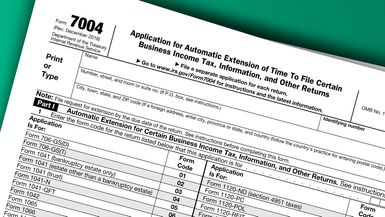
Can you buy a little more time?
© dmitriy/stock.adobe.com
Everyone knows that “scary” date of April 15—the day taxes are due each year. But you may have heard of a friend or neighbor who “filed an extension,” implying they got a bunch of extra time. Did they? And should you?
Here’s a look at the pros and cons of filing tax extensions, and the conditions and instances where you might consider one. Spoiler alert: Filing an extension does not give you more time to pay the taxes you owe. It’s merely an extension on submitting the paperwork.
Key Points
- An extension gives a taxpayer six extra months to file a tax return.
- If you owe money to the IRS, you’re required to pay it by April 15—even if you file an extension—or owe penalties and interest.
- If you’re active military, a U.S. citizen living abroad, or were impacted by a natural disaster, you may be eligible for an automatic extension.
Any taxpayer who feels they need more time to file their federal income taxes can request an extension. The extension gives you six extra months to file your return. The important thing to know is that although an extension gives you extra time to file your taxes, all tax payments are required to be paid on time by April 15.
Why is April 15 not always April 15?
Tax returns are due each year on April 15, but if that day falls on a weekend or holiday, the next business day is the due date. In 2023, taxes were due on April 18, since April 15 was a Saturday and April 17 was a recognized holiday. Similarly, the extension date of October 15 (a Sunday) is actually October 16 in 2023.
How do you qualify for a tax extension?
Extensions are available to all taxpayers, but a specific process is required:
- Estimate. You must properly estimate your tax liability—what you owe for the tax year.
- Report. You must report the amount of tax you owe—and it’s recommended that you pay it—in order to avoid interest and penalties.
- Apply. You must apply for the extension by the regular April 15 due date.
If you don’t follow the steps properly—for example, if you underestimate the taxes you owe—you’ll be subject to interest and penalties (more below).
How do you actually file a tax extension?
There are three ways to file an extension:
- IRS Direct Pay. If you use IRS Direct Pay either online or by phone, you can make an estimated payment and indicate to the IRS that you want an extension.
- Approved tax software. You can e-file your request through your (or your tax preparer’s) tax software. IRS Free File is one tax software option; it’s free for taxpayers with an adjusted gross income (AGI) of less than $73,000, but all taxpayers regardless of income can use it to file an extension.
- Snail mail. You can file a paper IRS Form 4868.
Pros of filing a tax extension
- You get six more months to collect your paperwork and file your return.
- If you pay a tax preparer to do your taxes, that person won’t be as busy during the typical tax season since they won’t have to do your return until later.
Cons of filing a tax extension
- You still have to pay all taxes due by April 15, so you need a very good estimate of your taxes due by that date.
- If your estimate is not correct and you owe taxes when you file your return on October 15, you will owe penalty and interest charges. According to the IRS, as of 2023, the interest rate is currently 7% compounded daily. Plus, the late payment penalty is 0.5% per month, which maxes out at 25%. So if you owe $100 when you file your return on October 15, you’ll have to pay 7% of $100 compounded daily over 183 days (from April 15 to October 15), which is $3.56, plus a penalty of 3% since you paid six months late, which is $3. So your $100 mistake will cost you $106.56 in total.
- If you’re due a tax refund when you file your return on October 15, you’ll have loaned the government your money for free for an additional six months.
Can you avoid the interest or penalty?
If you owe additional taxes when you file your late return, you’ll have to pay interest no matter what. But if you pay the remaining balance with your return on October 15, and you had paid at least 90% of your total taxes before April 15, you can write an appeal to the IRS to avoid the penalty.
Automatic extensions are given to certain taxpayers
No extra paperwork is needed to file an extension for the following eligible taxpayers:
- If you’re a U.S. citizen (or resident alien) and you live or work outside of the U.S. and Puerto Rico, you get an automatic two-month extension to file your return (until June 15). Tax payments are still due on April 15, though, or else interest will be charged.
- If you’re in the military on duty outside the U.S. or Puerto Rico, you also get until June 15 to file. If you are in a combat zone, you have up to 180 days after leaving the combat zone to file and pay. There’s a special tax guide provided by the IRS to help you if you’re in the military: Armed Forces’ Tax Guide.
- The IRS can delay tax deadlines if the U.S. president declares a disaster area. In 2023, according to the IRS, most of California and parts of Alabama and Georgia were given until October 16, 2023, to file and make tax payments. This deadline is applied automatically based on your address, which must fall in the disaster area.
The bottom line
If you’re someone who gets an automatic extension, especially one that allows an extension of tax payments, there’s no reason to rush the tax preparation process before the extension date of October 15. Just know that the next year’s tax deadline (the following April) will only be six months away at that point.
If you’re preparing a final tax return for a family member who passed away right at the end of the tax year, you might need some time to gather documents. Or if you have a serious illness or other emergency that precludes your ability to get those taxes done, you may wish to estimate and pay what you think you owe and complete your return by the extension date.
Just remember you need to pay those taxes on time to avoid penalties and interest. And if you’re getting a refund, you might want it sooner than later.
This article was most recently revised and updated by Nancy AshburnThis article was most recently revised and updated by Jennifer Agee