Balancing the economy.
Source: Board of Governors of the Federal Reserve System (US), Assets: Total Assets: Total Assets (Less Eliminations from Consolidation): Wednesday Level [WALCL], retrieved from FRED, Federal Reserve Bank of St. Louis; https://fred.stlouisfed.org/series/
If you’re an investor who happens to be a “Fedwatcher” type, then you’re likely to hear about two key topics: First, whether the central bank is going to raise, lower, or maintain its Fed funds interest rate target; and second, whether it’s planning on shrinking or expanding its balance sheet.
Investors typically understand the interest rate part pretty well, as the stock market tends to react (up or down) to the Fed’s interest rate decisions. But when it comes to the balance sheet stuff, many still get stumped. The inner workings of this tool seem a bit murky, perhaps even mysterious.
If you take a closer look, though, it’s not a mystery. The Fed publishes its balance sheet every Thursday at around 4:30 p.m. If you’re more than a passive investor, it’s something you should understand—at least the basics. The Fed balance sheet is a potent tool wielded by the central bank, and its impact on the markets and the broader economy can be significant.
Key Points
- The Fed funds rate affects short-term interest rates; the Fed balance sheet influences longer-term interest rates.
- Until the 2007–08 financial crisis, the Fed kept its asset base low, but during the COVID-19 pandemic, it ballooned to nearly $9 trillion.
- The stock and bond markets tend to react to changes in the Fed’s balance sheet plans.
What is the Federal Reserve’s balance sheet?
Much like any other balance sheet, it’s a financial statement that lists the Fed’s assets and liabilities—what it “owns” and what it “owes.” That’s the simple description.
What kinds of assets are on the Fed’s balance sheet?
As far as what the Fed owns (its assets), the bulk typically consists of Treasury securities (U.S. Treasury bills, notes, and bonds), followed by mortgage-backed securities (MBS). The rest includes different types of lending arrangements to banks in the U.S., such as repurchase agreements (“repos”), emergency loan facilities, and liquidity swaps.
What kinds of liabilities are on the Fed’s balance sheet?
As far as liabilities are concerned, typically they consist of U.S. paper currency in circulation and deposits from commercial banks held at the Fed.
You’re probably wondering how currency in circulation is a liability. U.S. dollars are promissory notes, like IOUs. For what, exactly? Well, it used to be gold. But now, currency “promises” or ensures purchasing power backed by the “full faith and credit” of the U.S. government.
The commercial bank funds parked at the Fed are a liability because the central bank is responsible for paying the entirety of the deposit, plus interest.
How does the Fed use its balance sheet to implement monetary policy?
The Fed uses its balance sheet to influence longer-term interest rates, which generally fall outside the scope of its Fed funds rate.
When the Fed wants to stimulate economic growth, it purchases more assets, adding to its balance sheet. Conversely, when the Fed wants to slow down economic growth (typically when inflation starts getting a bit high), it shrinks its balance sheet by selling its previously purchased assets or allowing them to mature and then not buying other securities to replace them (what they refer to as “balance sheet roll-off”).
By purchasing Treasury and mortgage-backed securities, the Fed can help lower interest rates on a much wider scope while increasing the money supply (i.e., pumping more money into the economy).
When the Fed aggressively buys Treasury and other fixed-income securities, their yields fall, as the price of these securities and the interest they yield have an inverse relationship.
What about the money supply? To purchase these securities, the Fed will often “create” money to make the purchase (yes, out of thin air, so to speak). Naturally, this increases the money supply.
But there’s a second part to this. Once these assets are off banks’ hands, the banks now have more cash and fewer debt liabilities, giving them even more reserves to issue more loans. When a bank issues a loan, it lends out more than what it has in deposits. This essentially “creates” more money injected into the economy.
How long has the Fed been using its balance sheet to conduct monetary policy?
The short answer is that the Fed has been using its balance sheet to influence the economy since its founding in 1913. However, the way it uses its balance sheet changed after the 2007–08 financial crisis.
Before that crisis, the Federal Reserve engaged in buying and selling short-term Treasury securities to maintain short-term interest rates within its targeted range. When the market crashed in 2008, this strategy wasn’t sufficient to kick-start economic growth. The Fed needed to do more.
At that point, the Fed drastically expanded its balance sheet by purchasing long-term Treasury securities, various government agency debts, and mortgage-backed securities. The Fed’s balance sheet was larger than at any time in its history. Taken together, these extraordinary actions are called quantitative easing (QE).
How did the Fed employ its balance sheet during the COVID-19 pandemic?
If the 2008 QE response was historically unprecedented in size (about $3.5 trillion), the COVID pandemic response was even bigger.
After slashing rates to zero in March 2020, the Fed immediately bought $500 billion in Treasury securities and $200 billion in mortgage-backed securities.
It didn’t end there. The Fed also started purchasing municipal bonds and corporate debt, adding new assets to the mix as part of a new set of emergency lending programs to keep the economy afloat during the wide-scale shutdowns. In just two years, the Fed’s balance sheet ballooned from $4.3 trillion to a whopping $8.9 trillion.
How does the Fed’s balance sheet affect the markets?
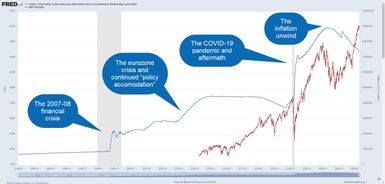
The correlation between the Fed’s balance sheet and the broader stock market is compelling (see figure 1).
Figure 1: BALANCING ACT. Before the 2007–08 financial crisis, the Fed balance sheet was quite stable at around $800 billion. Starting with the 2007–08 financial crisis, each global economic challenge meant a higher Fed balance sheet, and each taper in the balance sheet spooked the market (initially, anyway).
Source: Board of Governors of the Federal Reserve System (US), Assets: Total Assets: Total Assets (Less Eliminations from Consolidation): Wednesday Level [WALCL], retrieved from FRED, Federal Reserve Bank of St. Louis; https://fred.stlouisfed.org/series/
Notice how the Fed’s balance sheet expansion “led” the market. When the Fed started shrinking its balance sheet in 2018, the market crashed the following year before it began expanding again. When the COVID crash hit in 2020, the balance sheet ballooned to nearly $9 trillion, once again leading the market higher.
With an abundance of money sloshing around in the economy—plus low interest rates to encourage spending and borrowing—the engines of economic growth start revving up and the stock market, often leading the action, advances on strong Fed-induced tailwinds.
But for every action, there’s a reaction. And in this case, the reaction was a 40-year high in inflation. Whether it was a direct cause is up for debate, but when inflation spiked, the Fed decided it was time to both hike the Fed funds rate and shrink the balance sheet.
If you’re the type of investor who follows the coverage of Fed meetings, listens for small changes in Fed statements, and looks at the dots in the policy path chart (the “dot plot”), you probably understand the ins and outs of the Fed funds rate. But do you pay equally close attention to the ebbs and flows of the balance sheet? If not, you’re missing a big piece of the economic puzzle.
The balance sheet affects the entire yield curve, which can affect mortgage and auto loan rates, as well as the interest you earn on fixed-income investments.
It’s more than a financial statement. The Fed balance sheet is a powerful tool for influencing longer-term interest rates and the money supply, both of which can significantly move the markets and, ultimately, shape the economy.
This article was most recently revised and updated by Karl MontevirgenThis article was most recently revised and updated by Doug Ashburn