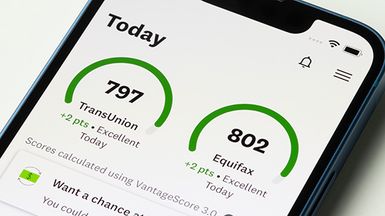
The three major credit reporting agencies influence many financial decisions.
© Tada Images/stock.adobe.com
Credit reporting agencies exert a major influence on consumers’ lives in the United States. The big three credit bureaus—Experian, TransUnion, and Equifax—and the credit reports and scores derived from their data can affect many financial decisions, including which loans and credit cards you can get, and possibly even where you’ll live and work.
Most of the information used to calculate your credit score comes from data collected by one or more of these three behemoths. But how did Experian, TransUnion, and Equifax become so influential, and how do they differ from each other?
Key Points
- Differences among the major credit reporting agencies usually come down to which factors they emphasize when calculating your credit score.
- The information the credit bureaus gather about you depends on which lenders and other businesses provide data to the agencies.
- The big three credit bureaus gained prominence mainly through consolidation by buying up smaller regional agencies.
The top 3 credit reporting agencies: The lowdown
Experian, TransUnion, and Equifax were founded decades ago to provide information about your financial reputation to banks, loan companies, and others. At first, most credit reporting agencies were small-time operations, often collecting and sharing information on a regional level.
Your credit history creates a “story” of you.
Encyclopædia Britannica, Inc.
Over time, these three credit bureaus gained size and influence through consolidation—usually by acquiring smaller agencies. With the development of computer technology and digital data collection and processing techniques, it became increasingly easy to compile reported information into histories that could be used to create credit scores.
Many financial services providers—not just lenders—started using information about potential customers in their decision-making. Some employers review modified versions of credit reports during background checks for certain positions.
Other entities that use credit reports include apartment rental managers and, in some states, auto insurers, which may be trying to determine if you have a good payment history as a measure of risk.
What the 3 credit bureaus do
Experian, TransUnion, and Equifax collect information about borrowers. They also offer a variety of credit monitoring and identity protection services that you can purchase to track your credit and be alerted to any changes that might signal potential fraud.
Credit scores are a relatively recent development
Even though credit bureaus have been around for decades, the first commercial credit score wasn’t developed until 1989, when it was introduced by Fair, Isaac and Company (FICO). Credit scores are typically generated using scoring models such as FICO or VantageScore that rely on data from the major credit reporting agencies.
The big three develop relationships with different creditors, who choose which bureau to send information to. Common information sent to the major credit reporting agencies includes:
Your credit report contains the information that’s reported to and compiled by the bureaus. As a result, the information in each report might vary. For example, your auto loan lender might report information to Experian and Equifax, but not TransUnion. At the same time, a credit card issuer may send your information to TransUnion and Experian, but not Equifax, while another lender might send your information to all three bureaus.
Buy now, pay later loans and credit reports
“Buy now, pay later” plans have proliferated in recent years. The loans allow you to pay for purchases in installments rather than paying the full price upfront, often with no interest. If you’re trying to build your credit profile, BNPL purchases may not always help. Historically, most BNPL providers didn’t report payment activity to the major credit bureaus. Some companies now report certain loans or payment histories, but reporting practices vary widely.
Each credit bureau uses its own formula to calculate your credit score. Depending on who’s reporting to whom, and what calculation is being used, you could end up with different scores from each bureau.
Equifax
- Founded in 1899, when the Retail Credit Company—later renamed Equifax—was established in Atlanta.
- Provides information on more than 245 million U.S. consumers.
- Offers consumer credit scores and reports based on Equifax data. Lenders may also obtain credit scores—such as FICO scores—calculated using information from Equifax credit reports.
VantageScore vs. FICO
The three major credit reporting bureaus created VantageScore through a joint venture in 2006 as a competitor to the FICO score. VantageScore and FICO use different proprietary formulas to evaluate the information in your credit report, and each model may produce slightly different scores.
Equifax sells a suite of credit and identity monitoring services, including family plans. Equifax includes three-bureau reports with its three-bureau scores based on VantageScore data, instead of FICO scoring.
For financial services providers, Equifax uses different data that can provide insight into potential habits, creating a scoring system for those who might not be scorable using traditional models. With data from utility payments, telecommunications companies, and other information, providers that use Equifax’s OneScore might be more willing to approve you.
Experian
- Traces its roots to 1826 in London, but has been bought and sold many times. Its current iteration dates from 2006, when it was listed on the London Stock Exchange.
- Has information on more than 300 million consumers in the United States and even more worldwide.
- Credit scores—such as FICO scores—can be generated using information from Experian credit reports, typically on a scale of 300 to 850.
One characteristic that sets Experian apart from other credit reporting agencies is that it collects information from landlords and incorporates on-time rent payments into its score through its Boost scoring program.
When you enroll in Boost, you can add information from accounts such as utilities, streaming services, or other recurring payments. Adding this information may improve your credit score when lenders use a score calculated from Experian data, but it doesn’t affect scores based on TransUnion or Equifax reports.
TransUnion
- Founded in 1968 as the parent company of a railcar-leasing business.
- Acquired its first regional credit bureau in 1969 and expanded over the decades, achieving full coverage in the United States by 1988.
- Listed on the New York Stock Exchange (NYSE) since 2015.
- Keeps records on more than 200 million U.S. consumers.
- Credit scores—such as FICO or VantageScore—can be generated using information from TransUnion credit reports, typically on a scale of 300 to 850.
TransUnion has acquired various identity companies over the years, including those focused on consumers’ digital identities (your Internet presence). TransUnion is also known for using nontraditional factors in its calculations to provide more qualitative data to financial services providers.
Staying secure—maybe for free
Each of the major credit bureaus sells products that monitor your credit and help detect possible identity theft. If your personal data is exposed in a corporate data breach, you may be offered one of these services for free as part of a breach notification or legal settlement.
Like other credit bureaus, TransUnion provides a variety of scoring and analytics models designed for different uses. Some models are used by collection agencies to estimate the likelihood of recovering unpaid debts. TransUnion also provides data and analytical tools that financial institutions may use to estimate factors such as income and debt-to-income ratios.
Credit reporting agencies compile information about consumers’ credit activity and provide reports and analytics to lenders and other businesses that request them. Using data from these reports, credit scoring models—such as FICO or VantageScore—generate the three-digit scores lenders often rely on when evaluating applications for loans, credit cards, apartments, or other services.
Although the three major credit bureaus operate in similar ways, each maintains its own database and relationships with lenders, which is why the information in your credit reports may differ slightly from one bureau to another. Monitoring your credit reports and maintaining responsible borrowing habits can help you keep your credit profile in good shape.
This article was most recently revised and updated by Miranda MarquitThis article was most recently revised and updated by David Schepp