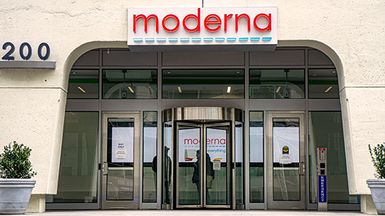
Moderna develops mRNA vaccines and therapies for infectious diseases, cancer, and rare genetic disorders.
© Plexi Images/GHI/UCG—Universal Images Group/Getty Images
- Share price:
- $231.35 (mkt close, Nov. 12, 2026)
- Annual revenue:
- $2.52 bil.
- Earnings per share (prev. year):
- $-6.98
- CEO:
- Mr. Stéphane Bancel M.B.A.
Moderna, Inc. is a biotechnology company specializing in messenger RNA (mRNA) medicines and is known for developing one of the first COVID-19 vaccines authorized for emergency use. The drugmaker focuses on infectious diseases, cancer, and rare genetic disorders, and collaborates with drugmakers and government agencies worldwide to advance its research efforts. Founded in 2010 and headquartered in Cambridge, Massachusetts, Moderna became a publicly traded company in 2018. As of December 31, 2025, it had about 4,700 employees.
What’s in a name?
The name Moderna is a portmanteau of “modified” and “RNA,” reflecting the company’s focus on developing uses for messenger ribonucleic acid (mRNA) technology. MRNA also serves as the company’s ticker symbol on the Nasdaq.
Moderna’s messenger ribonucleic acid (mRNA) medicines work by instructing cells to produce proteins that help fight or prevent disease. Its COVID-19 vaccine, authorized by the U.S. Food and Drug Administration (FDA) for emergency use in late 2020, demonstrated mRNA’s potential at scale.
The company has since expanded its vaccine portfolio with mRESVIA for respiratory syncytial virus (RSV), mNEXSPIKE for COVID-19, and mFLUSIVA for influenza. Approved by the FDA in August 2026, mFLUSIVA became the first mRNA flu vaccine.
How mRNA works
Messenger ribonucleic acid, or mRNA, is a molecule that carries genetic instructions from DNA to cells, telling them how to produce specific proteins. Scientists can engineer mRNA to direct cells to create proteins that help fight or prevent diseases.
Unlike traditional vaccines, which often use weakened or inactivated viruses to trigger an immune response, mRNA vaccines teach the human body to recognize and defend against specific pathogens by producing harmless protein fragments found on the surface of those pathogens. The approach is highly adaptable and allows for faster vaccine development.
History and growth
Founding and early patents
Moderna was founded in 2010 when biotechnology entrepreneur Noubar Afeyan teamed up with Robert Langer, a professor of chemical engineering at the Massachusetts Institute of Technology (MIT). The fledgling company began as part of Flagship Pioneering, a venture capital firm focused on developing medical and biological technologies. Several months later, Moderna filed two provisional patents based on its early research.
First proof of concept for mRNA
By 2011 and 2012, Moderna’s research and development team demonstrated the first proof of concept for engineered mRNA. Experiments on mice, rats, and chimpanzees showed that mRNA could direct cells to produce therapeutic proteins that would not naturally occur.
In 2013, Moderna entered its first major partnership with AstraZeneca (AZN), a biotechnology company, to develop mRNA treatments for cardiometabolic diseases and cancer. The collaboration received support from the Defense Advanced Research Projects Agency (DARPA), the research arm of the U.S. Department of Defense, further validating the promise of mRNA technology.
In 2014, Moderna partnered with Alexion Pharmaceuticals (which was acquired by AstraZeneca in 2021) to develop mRNA-based treatments for rare diseases. The collaboration ended in 2017 when Alexion shifted its research priorities, although Moderna continued its efforts to apply mRNA technology to rare diseases. That same year, the company launched Onkaido Therapeutics, a subsidiary dedicated to advancing mRNA applications in oncology, the study and treatment of cancer.
Antiviral vaccines and passive immunity
In 2015, Moderna partnered with Merck & Co. (MRK) to develop mRNA-based antiviral vaccines and passive immunity therapies, which deliver antibodies directly into the human body to protect against disease.
Personalized cancer vaccines
In 2016, Moderna and Merck began collaborating on personalized mRNA cancer vaccines, eventually developing intismeran.
In 2016, Moderna began clinical testing of its drug candidates. That same year, the company partnered with Vertex Pharmaceuticals (VRTX) to develop mRNA-based treatments for cystic fibrosis, a genetic disorder that affects the lungs and other organs.
In 2018, Moderna became a publicly traded company on the Nasdaq. Its IPO raised more than $600 million, making it one of the largest biotech IPOs in history at the time.
The COVID-19 pandemic in 2020 marked a significant turning point for Moderna. Although it had no marketable products, Moderna drew on its mRNA technology to rapidly develop a COVID-19 vaccine. It initially received $483 million from the Biomedical Advanced Research and Development Authority (BARDA) to accelerate vaccine development; the agreement was later expanded to provide up to about $1.8 billion.
In December 2020, Moderna secured FDA emergency use authorization for its COVID-19 vaccine. By the end of 2021, the company had delivered more than 800 million doses worldwide.
Vaccine rivals
Moderna wasn’t the only drugmaker to develop a COVID-19 vaccine during the pandemic. Pfizer (PFE), in partnership with the German company BioNTech, and Johnson & Johnson (JNJ) also received U.S. emergency use authorization.
The competition among drugmakers has since extended to RSV vaccines. In May 2023, GlaxoSmithKline (GSK) and Pfizer received FDA approval for Arexvy and Abrysvo as the first RSV vaccines for older adults. About a year later, Moderna’s RSV vaccine entered the market.
Moderna, like Pfizer (PFE) and Novavax (NVAX), has continued to update its COVID-19 vaccines to address emerging variants. The FDA fully approved Moderna’s original vaccine, marketed as Spikevax, in January 2022. In May 2025, the agency approved mNEXSPIKE, Moderna’s second COVID-19 vaccine.
Moderna completed its first company acquisition in 2023 with its purchase of OriCiro Genomics, a Tokyo-based biotech company focused on cell-free DNA synthesis and amplification technologies, for $85 million. The technologies are used to produce DNA for mRNA manufacturing.
In August 2026, the FDA approved Moderna’s mFLUSIVA for adults age 50 and older, making it the first mRNA vaccine for influenza. The vaccine received full approval for adults 50 to 64 and accelerated approval for adults 65 and older. Moderna planned to make mFLUSIVA available for the 2026–27 flu season.
Cancer vaccine breakthrough
In August 2026, a late-stage trial of Moderna and Merck’s intismeran found that patients receiving the personalized cancer vaccine with Keytruda were less likely to have their melanoma return or spread than those receiving Keytruda alone. The study involved 1,137 patients with high-risk melanoma who had undergone surgery.
Challenges and controversies
Moderna’s rapid growth during the COVID-19 pandemic brought scrutiny involving patent disputes, stock sales by executives, and scrutiny over its use of publicly funded research.
Stock sales during the COVID-19 pandemic
In 2020, Moderna reported positive Phase I test results for its coronavirus vaccine, leading to a roughly 30% increase in the company’s share price. In the days following the announcement, Moderna’s chief executive officer, Stéphane Bancel, and other executives sold company shares worth about $90 million. Although legal, the timing of the transactions, during a global health crisis, drew criticism.
Patent disputes and legal battles
- Arbutus Biopharma (ABUS) and Genevant Sciences sued Moderna in 2022, alleging that its COVID-19 vaccines infringed patents covering lipid nanoparticle (LNP) technology used to deliver mRNA into cells. In March 2026, Moderna agreed to pay the companies up to $2.25 billion to settle the litigation worldwide, including $950 million upfront and another $1.3 billion contingent on the outcome of an appeal.
- In August 2022, Moderna sued Pfizer and BioNTech (BNTX), alleging that their Comirnaty COVID-19 vaccine infringed Moderna’s mRNA patents. The dispute expanded to several countries, producing mixed rulings. In the United Kingdom, courts upheld the validity of one Moderna patent and found that Pfizer and BioNTech had infringed it. In December 2025, the U.K. Supreme Court refused permission for a further appeal.
- In February 2026, BioNTech separately sued Moderna, alleging that mNEXSPIKE infringed one of BioNTech’s mRNA vaccine patents.
- GlaxoSmithKline (GSK) sued Moderna in 2024, alleging that its COVID-19 vaccine Spikevax and RSV vaccine mRESVIA infringed patents involving mRNA and lipid nanoparticle technology. The litigation remained ongoing in mid-2026.
NIH dispute over COVID-19 vaccine
In February 2023, Moderna agreed to pay $400 million to the National Institutes of Health (NIH) to settle a dispute involving the use of publicly funded research in its COVID-19 vaccine. The agreement resolved claims that Moderna had incorporated a chemical modification developed by NIH scientists into its vaccine without proper licensing.
Since 2023, Moderna has worked with IBM (IBM) and OpenAI to expand its use of artificial intelligence (AI) and other advanced technologies. Its collaboration with IBM focuses on AI and quantum computing, while its work with OpenAI has included the companywide adoption of ChatGPT Enterprise and customized GPTs. Moderna uses AI in areas including drug design, clinical trials, and manufacturing.
This article was most recently revised and updated by Allie Grace Garnett