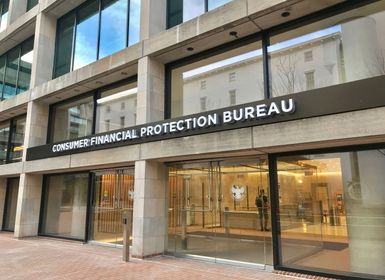
The former headquarters of the Consumer Financial Protection Bureau in Washington, D.C. The Trump administration closed the building in February 2025.
© DCStockPhotography/Shutterstock.com
The Consumer Financial Protection Bureau (CFPB) is a U.S. government agency created in the wake of the 2007–08 financial crisis to protect consumers from unfair, deceptive, and abusive practices in the financial services industry. Established by the Dodd-Frank Wall Street Reform and Consumer Protection Act of 2010, the bureau oversees financial institutions, enforces consumer protection laws, and handles complaints about financial products and services.
The CFPB’s future became uncertain after President Donald Trump returned to office in January 2025. His administration moved to sharply curtail the agency’s operations, reduce its workforce, and restrict its funding, prompting legal challenges. Although the bureau resumed some regulatory and supervisory activities in 2026, it has adopted a less aggressive approach to overseeing financial institutions and enforcing consumer protection laws.
Core functions of the CFPB
The CFPB is responsible for overseeing consumer financial products and services, including mortgages, credit cards, and loans. Its principal functions include:
- Rulemaking: Establishing regulations to protect consumers from unfair, deceptive, and abusive financial practices.
- Enforcement: Investigating potential violations of federal consumer financial protection laws and taking action against companies that break them.
- Consumer complaints: Receiving complaints about financial products and services and forwarding them to companies for a response.
- Market monitoring: Studying financial markets and identifying emerging risks to consumers.
- Financial education: Providing information and resources to help consumers understand financial products and make informed decisions.
Although these responsibilities remain established by law, the CFPB has scaled back its supervisory and enforcement activities under the Trump administration.
Where the CFPB fits in the U.S. government
The CFPB is an independent bureau within the Federal Reserve System, but the Fed doesn’t oversee its regulatory decisions. Unlike most federal agencies, which are funded through annual congressional appropriations, the CFPB receives its funding from the Fed.
The CFPB is led by a director nominated by the president and confirmed by the Senate. The director oversees the bureau’s regulatory, enforcement, supervisory, and administrative operations, with support from senior officials and specialized divisions.
The CFPB also has an independent Office of the Ombudsman, which helps consumers, financial institutions, and others address concerns about their interactions with the bureau.
CFPB history and leadership, 2011–2026
Elizabeth Warren, then a Harvard Law School professor, was instrumental in developing the CFPB and served as an adviser to the Obama administration before the agency officially opened in July 2011. President Barack Obama nominated Richard Cordray as its first director in 2011 and appointed him during a Senate recess in January 2012. The Senate confirmed him in 2013.
Trump’s effort to dismantle the CFPB
Within days of becoming acting director of the CFPB in February 2025, Russell Vought ordered the agency to suspend virtually all regulatory, supervisory, and enforcement activities. He also declined to request additional funding from the Federal Reserve, closed the bureau’s Washington headquarters, and directed employees to stop working.
The CFPB’s home page was temporarily disabled, although its consumer complaint portal remained accessible. The moves prompted lawsuits challenging the administration’s efforts to dismantle an agency established by Congress.
Cordray resigned in November 2017, eight months before his term expired, amid mounting criticism from Republican lawmakers and officials in the Trump administration about the bureau’s aggressive regulatory approach. Trump appointed Mick Mulvaney, a longtime critic of the CFPB, as acting director. Kathy Kraninger succeeded Mulvaney in December 2018 and remained director until January 2021. President Joe Biden subsequently appointed Rohit Chopra, who took office in October 2021 and led the agency until February 2025, when Trump, having returned to the White House, dismissed him.
Trump initially named Treasury Secretary Scott Bessent acting director before replacing him with Russell Vought, director of the Office of Management and Budget (OMB). Vought moved to sharply curtail the CFPB’s operations, triggering legal challenges that prevented much of the administration’s proposed restructuring. Mark Paoletta succeeded Vought as acting director in August 2026, as the agency continued operating under a narrower regulatory and enforcement agenda.
CFPB controversies and challenges
The CFPB has faced criticism over its independence, funding, and enforcement practices since its creation. Financial industry groups and Republican lawmakers have argued that the bureau exercises too much regulatory authority with insufficient congressional oversight. Consumer advocates, meanwhile, have defended its independence as necessary to protect borrowers from unfair and deceptive financial practices.
Consumer protections against unfair billing and debt collection
In May 2024, the U.S. Supreme Court upheld the constitutionality of the CFPB’s funding arrangement in a 7–2 decision, rejecting a challenge brought by payday lending industry groups. The ruling allowed the bureau to continue receiving funding from the Federal Reserve without annual congressional appropriations.
The debate over the CFPB’s authority intensified during Trump’s second administration. In 2025, Congress reduced the maximum amount the CFPB could receive annually from the Fed by nearly half to $446 million. The administration also sought substantial staffing cuts and scaled back enforcement and supervision. Examinations resumed in 2026, but the bureau adopted a less aggressive approach to oversight, selecting fewer companies for examination and conducting more reviews under expedited procedures. The changes extended beyond regulatory oversight. A June 2026 investigation by The Guardian newspaper found that more than 2,200 pages had been removed from the CFPB’s website, including consumer advisories and information about financial products.
In a separate dispute over the bureau’s funding, a federal district court ruled in September 2026 that the administration’s refusal to request money from the Fed was unlawful. The court ordered the CFPB to seek the funding needed to carry out its statutory responsibilities. The ruling remains subject to appeal.
This article was most recently revised and updated by Miranda Marquit