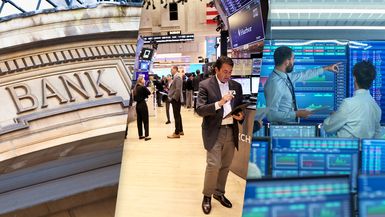
Many players participate in the financial markets.
© lightkey––E+/Getty Images, © Michael M. Santiago/Getty Images, © Gorodenkoff/stock.adobe.com; Photo composite Encyclopædia Britannica, Inc.
Consider these market interactions:
- You’re about to pull the trigger and buy 100 shares of a stock you’ve had your eye on.
- Each month, you contribute to your 401(k), spreading the money among several funds.
- Your parents are retired. Each month, one receives a pension check, while the other sells part of their portfolio and takes a distribution check from an IRA.
Each of these transactions feels seamless, immediate, and carries no (or very little) cost. How does it all work? It’s a lot to unpack.
First off, to make a market, at least two parties are needed to complete a trade. But to make markets competitive, three or more parties are needed. Competition helps to discover the best price, at any given time, where market participants are willing to buy or sell an asset.
Key Points
- Vibrant markets include all types of traders, from individuals to big institutions, and they all have a role to play.
- Markets need liquidity to be viable; market makers, specialists, and other professional traders help fill that role.
- Arbitrage—the simultaneous buying and selling of the same or similar securities to exploit small price discrepancies—is what keeps markets in line.
There are many types of investors in the financial markets. Some are individual traders, some are big institutional and commercial investors, and some are intermediaries who buy when others are selling and sell when others are buying.
Some markets have lots of these big institutional and commercial entities buying and selling all the time, while others rely on professional traders to ensure trading is liquid and efficient. Markets bring together different entities for different reasons, and they all help to set values for many different types of assets.
What are the market participant groups?
Markets evolved from ancient times as a way for a producer—such as a farmer, smith, or weaver—and a consumer to trade goods for barter, money, or other legal tender. Modern markets have a host of participants, including producers and consumers, but also ranging from individuals to investment managers.
- Individuals. Sometimes called retail investors, individual traders can buy single stocks and bonds, as well as mutual funds and exchange-traded funds (ETFs)—pooled investments made up of a diverse mix of stocks, bonds, and/or other assets.
- Raw materials producers. Just like in ancient times, producers still come to markets to trade. Producers can vary from individual farmers looking to hedge or sell crops to companies that mine metal or pump crude oil.
- Producers of goods and services. The entities that make the products we consume also come to markets, often to hedge their input costs and other risks. This group includes bread and cereal makers, auto manufacturers, and airlines.
- Fund managers. The portfolio managers of those mutual funds and ETFs that many of us hold in our retirement savings accounts are buying and selling fund holdings every day as we add to or draw from our accounts.
- Banks. Banks have many reasons to be in markets. They trade on behalf of retail and institutional clients, make loans, issue debt for clients, exchange currencies, and engage in a host of other activities.
- Insurers. Insurers invest the premiums they receive from customers and generally line up the money from premiums they receive with the asset that best reflects the type of insurance policy they sell. For example, premiums from a life insurance policy would be invested in a long-term asset.
- Endowments. Large charities and university endowments invest their assets in markets to generate long-term investment income to support their goals. Many invest not only in stocks and bonds, but also in alternative investments.
- Pension funds. The fund managers for both corporate and public pensions invest in markets on behalf of their retirees to ensure they can pay benefits over the long run. Like endowments, pension funds invest in different types of markets with long-term horizons.
- Hedge funds. Hedge funds are limited partnerships and can invest in both public and private securities using a range of strategies.
Why do we need market makers and professional traders?
Some markets, such as the crude oil market or U.S. Treasury bond markets, are deep, liquid markets that see active trading and modest bid/ask spreads. In other markets, some participants are there to provide liquidity on a short-term basis. If every party in a market were a long-term investor, then parties who only need to make short-term trades would have a hard time finding an opposite entity. That’s why a diverse range of participants makes markets efficient.
Some exchanges appoint market makers and specialists to facilitate trade in markets that may be lightly traded. Their role is to help the market function by making sure there is enough volume so trading is efficient.
- Market makers. These are exchange members who can trade on behalf of a trading firm, the trading arm of an investment bank, or for themselves. Market makers are tasked with stepping in to bring liquidity to the market, particularly in thinly traded names. Without market makers, investors who would want to sell or buy could not complete a trade in real time. They might have to wait and hope someone else happens to want to sell exactly what they’re buying, in exactly that quantity, at exactly that time.
- Specialists. In some markets, such as the New York Stock Exchange, specialists are exchange members whose role is to facilitate trading in certain stocks. They display bid and ask prices during market hours and are required to maintain fair and orderly markets, including injecting their own capital to help reduce volatility when there aren’t enough buyers or sellers. Specialists aren’t allowed to trade ahead of investors (i.e., “front-run” customer orders).
- Speculators. These are market participants who accept the risk of a trade in order to make a profit from short-term changes in price.
- High-frequency traders (HFT). Many market makers use high-frequency algorithms to look across markets, including competing exchanges and execution venues, the markets for similar products such as options on listed stocks and ETFs, futures markets, and indexes that comprise individual stocks. They buy where investors are selling and vice versa. It’s lightning-fast arbitrage (see below).
What is arbitrage?
Market makers and short-term traders earn a profit when there is a difference in the bid-ask spread. Arbitrage is the simultaneous purchase and sale of an asset in different market venues—or in equivalent products—to take advantage of a price inefficiency.
In U.S. listed securities—the stock market, for example—regulations require that orders be filled at the so-called National Best Bid and Offer (NBBO). But if a large order is pressuring prices in one venue, and there’s a buyer in another venue, a high-frequency trading market maker might buy on one exchange, sell on the other, and capture the price spread. The difference might be only a penny or so, but when you consider how much volume changes hands each day, those pennies add up. In this way, investors get tight bid-ask spreads, and market makers are compensated for accepting the other side of the trade.
This is an example of pure arbitrage—closing a price inefficiency in the exact product. There’s also relative value arbitrage, which looks across similar products and keeps them in line. One example is called index arbitrage. A stock index such as the S&P 500 is made up of a defined basket of stocks. Index arbitrageurs will buy and sell futures and options on those indexes, and simultaneously buy and sell each component of the index (yes, for the S&P 500, that’s 500 stocks at once) in order to keep prices in line. It takes a lot of capital and a lot of tech infrastructure to run an arbitrage operation such as this, but the result is ultra-efficient markets.
It takes many entities with different objectives and time horizons to make a market. Different types of market participants help both buyers and sellers enter and exit investments smoothly.
If you’re buying or selling stocks from a trading app on your phone or computer, it might seem like an easy process. You tap or click, and within a second or two you’ve exchanged your money for stock. But behind the scenes is a complex, high-tech, capital-intensive system keeping it all in line.
This article was most recently revised and updated by Debbie CarlsonThis article was most recently revised and updated by Doug Ashburn