

- Date:
- 1973 - 2022
- Location:
- United States


Roe v. Wade
When was Roe v. Wade overturned?
When was Roe v. Wade passed?
Why was Roe v. Wade overturned?
Can the Supreme Court’s decision in Roe v. Wade (1973) be reinstated?
What was the ruling in Roe v. Wade?
Who was ‘Jane Roe’ in Roe v. Wade?
What did the Supreme Court decide regarding abortion regulation during pregnancy trimesters?
What was the outcome of Dobbs v. Jackson Women’s Health Organization?
What did Norma McCorvey reveal in the documentary AKA Jane Roe?
News •
Roe v. Wade, legal case in which the U.S. Supreme Court on January 22, 1973, ruled (7–2) that unduly restrictive state regulation of abortion is unconstitutional. In a majority opinion written by Justice Harry A. Blackmun, the Court held that a set of Texas statutes criminalizing abortion in most instances violated a constitutional right to privacy, which it found to be implicit in the liberty guarantee of the due process clause of the Fourteenth Amendment (“…nor shall any state deprive any person of life, liberty, or property, without due process of law”). Roe v. Wade was overturned by the Supreme Court in 2022.

The case began in 1970 when “Jane Roe”—a fictional name used to protect the identity of the plaintiff, Norma McCorvey (1947–2017)—instituted federal action against Henry Wade, the district attorney of Dallas county, Texas, where Roe resided. The Supreme Court disagreed with Roe’s assertion of an absolute right to terminate pregnancy in any way and at any time. Instead, it attempted to balance what it regarded as a “fundamental” right to privacy with the state’s “compelling” interests in protecting the health of pregnant persons and the “potentiality of human life.” In doing so, the Court formulated a timetable based on the notions of trimester and fetal viability (i.e., the “capability of meaningful life outside the mother’s womb”). During the first trimester of pregnancy, the Court ruled, the state could not intervene in a person’s decision to have an abortion under normal circumstances. During the second trimester the state could regulate abortion procedures to protect the health of pregnant persons, but it could not prohibit abortions altogether. From the end of the second trimester, which the Court identified as the starting point of viability, the state could regulate or prohibit abortions in order to protect the pregnant person’s health or to preserve fetal viability. In no case, however, could the state criminalize abortions that were necessary to protect the life or health of the pregnant person.
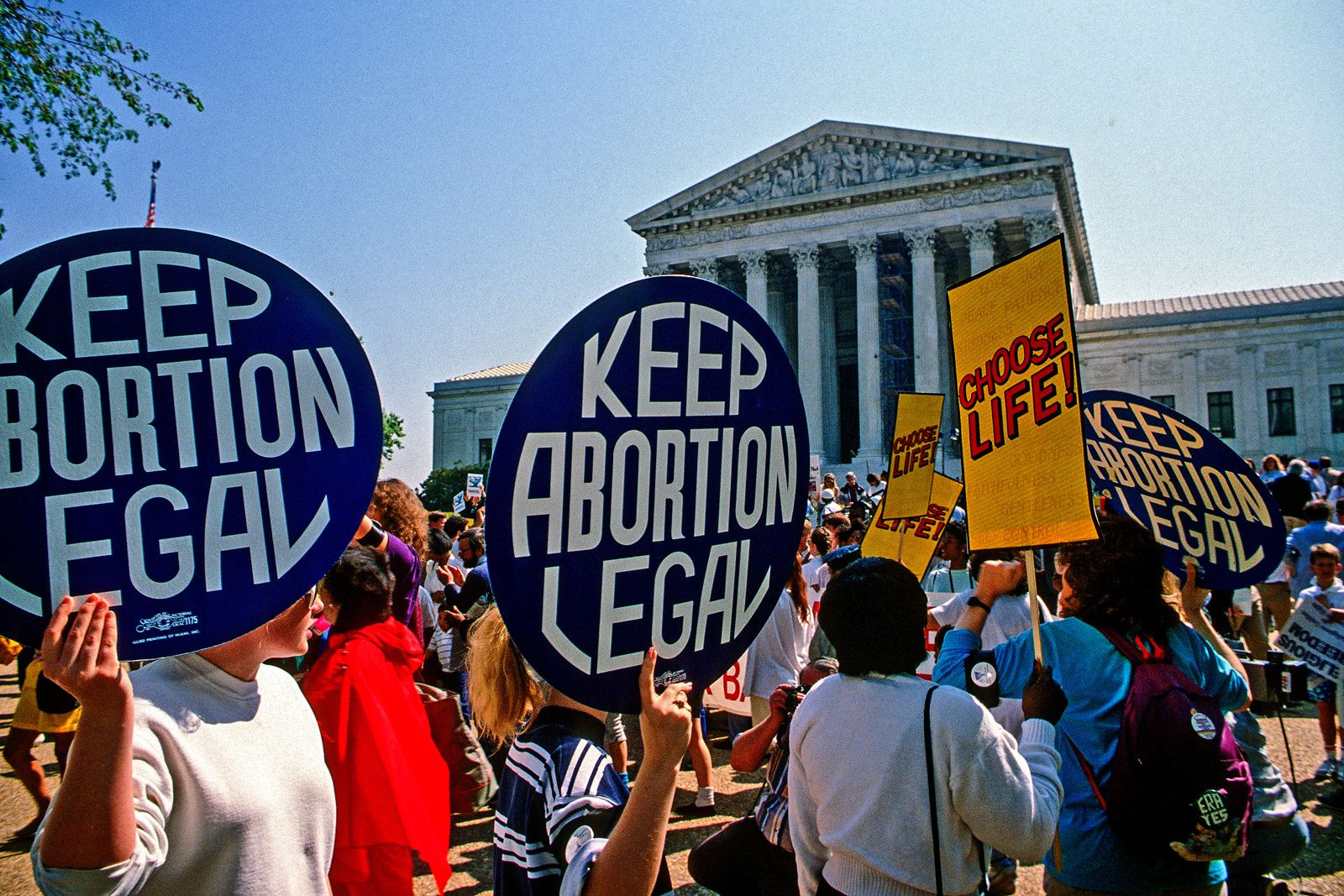
Repeated challenges to Roe v. Wade after 1973 narrowed the decision’s scope but did not overturn it. In Planned Parenthood of Southeastern Pennsylvania v. Casey (1992), the Supreme Court established that restrictions on abortion are unconstitutional if they place an “undue burden” on a person seeking an abortion before the fetus is viable. In Gonzales v. Carhart (2007), the Court upheld the federal Partial-Birth Abortion Ban Act (2003), which prohibited a rarely used abortion procedure known as intact dilation and evacuation. In Whole Woman’s Health v. Hellerstedt (2016), the Court invoked its decision in Casey to strike down two provisions of a Texas law requiring that abortion clinics meet the standards of ambulatory surgical centers and that doctors performing abortions have admitting privileges at a nearby hospital. Four years later, in June Medical Services L.L.C. v. Russo (2020), the Court invoked Whole Woman’s Health to declare unconstitutional a Louisiana statute that was, as the majority noted, nearly identical to Texas’s admitting-privileges law.




In May 2021 the Supreme Court agreed to review in its October 2021 term a lower court’s decision to strike down a Mississippi state law, adopted in 2018, that banned most abortions after the 15th week of pregnancy, well before the point of fetal viability. Although the law was plainly unconstitutional under Roe v. Wade and Planned Parenthood v. Casey, Mississippi lawmakers passed the measure in the hope that an inevitable legal challenge would eventually make its way to the Supreme Court, where a conservative majority of justices would overturn or drastically reduce the scope of those decisions. The single question that the Court agreed to consider in the case, Dobbs v. Jackson Women’s Health Organization, was whether bans on all pre-viability abortions are unconstitutional. In May 2022 an apparent draft of a majority opinion in the case, written by Justice Samuel A. Alito, Jr., was leaked to a political news publication in an extraordinary breach of the traditional secrecy in which the Court conducts its deliberations. The opinion, dated February 2022, indicated that the Court had voted to uphold the Mississippi law and to overturn both Roe v. Wade and Planned Parenthood v. Casey. As expected, both Roe and Casey were overturned (5–4) in the Court’s official decision in Dobbs, issued in June 2022, in which Alito held that there is no constitutional right to abortion. Soon after the decision was handed down, several states adopted laws that drastically limited the availability of abortion.
In 1998, having undergone two religious conversions, McCorvey publicly declared her opposition to abortion. However, in the documentary AKA Jane Roe (2020), a dying McCorvey claimed that she had been paid by antiabortion groups to support their cause.