
- Born:
- November 14, 1895, Philadelphia, Pennsylvania, U.S.
- Died:
- May 31, 1972 (aged 76)
- Subjects Of Study:
- lobotomy
- transorbital lobotomy


Walter Jackson Freeman II
-
Who was Walter Jackson Freeman II?
Walter Jackson Freeman II (1895–1972) was an American neurologist who, with neurosurgeon James W. Watts, introduced prefrontal lobotomy to the United States, a surgical procedure involving severing nerve pathways in the brain as a radical therapeutic measure for mental disorders.
Freeman modified a surgical technique for the prefrontal cortex and described his version of the operation as lobotomy. In 1945, he streamlined the procedure, replacing it with transorbital lobotomy. Freeman toured the country, performing lobotomies in hospitals and other settings. By the late 1960s, he had performed or supervised more than 3,500 lobotomies. His last lobotomy was in February 1967.
Freeman's use of lobotomy made him a controversial figure. An estimated 490 individuals died as a result of the treatment.
2 Britannica SourcesCreated from Britannica articles using AI. AI can make mistakes, so verify using Britannica articles. -
What was Walter Jackson Freeman II known for?
Walter Jackson Freeman II (1895–1972) was an American neurologist known for introducing prefrontal lobotomy to the United States, a surgical procedure involving the destruction of nerve pathways in the brain to treat mental disorders. In 1936, Freeman modified a technique for prefrontal cortex surgery, renaming it lobotomy, and together with James W. Watts, performed the first prefrontal lobotomy in the U.S.
Later, Freeman developed the transorbital lobotomy in 1945, a quicker and less expensive procedure. He toured the country, performing lobotomies in hospitals and other settings. Freeman performed or supervised approximately 3,500 lobotomies, but the high mortality rate and questionable methods made him a controversial figure.
2 Britannica SourcesCreated from Britannica articles using AI. AI can make mistakes, so verify using Britannica articles. -
What is a lobotomy?
A lobotomy is a surgical procedure where nerve pathways in a lobe of the brain are severed from other areas, once used to treat severely disturbed patients with mental illnesses like schizophrenia and bipolar disorder.
American neurologist Walter J. Freeman II (1895-1972) streamlined a version of the procedure in 1945, called transorbital lobotomy, where he used a pick-like instrument forced through the eye sockets to sever brain connections. Freeman performed or supervised over 3,500 lobotomies by the late 1960s. The practice declined in the mid-1950s with the introduction of more effective medications, and is rarely performed today.
3 Britannica SourcesCreated from Britannica articles using AI. AI can make mistakes, so verify using Britannica articles. -
How did Freeman's lobotomy technique differ from earlier methods?
Walter Freeman refined the lobotomy technique by developing the transorbital lobotomy, which he believed was more effective, less expensive, and faster than the standard lobotomy. Earlier methods involved opening the skull to sever nerve pathways, whereas Freeman's transorbital method involved inserting an ice pick-like instrument through the eye sockets to pierce the bone and sever brain connections. This procedure could be performed in less than 10 minutes, and Freeman toured the country performing it in various settings.
3 Britannica SourcesCreated from Britannica articles using AI. AI can make mistakes, so verify using Britannica articles. -
Why did some doctors and patients disagree with Freeman's methods?
Walter Freeman's methods faced opposition from doctors and patients due to the high risks, questionable success rates, and ethical concerns associated with lobotomies.
Many neurosurgeons resisted lobotomies by the 1940s, citing a lack of research and low success rates. Freeman's high fatality rate, estimated at 490 deaths out of 3,500 lobotomies, and his perceived arrogance and recklessness further diminished his standing in the medical community.
Patients, like Howard Dully, who underwent lobotomies, expressed deep regret and feelings of being harmed rather than helped by the procedure. Dully stated, "Walter Freeman's operation was supposed to relieve suffering. In my case, it did just the opposite".
Additionally, Freeman's lack of scientific rigor and his willingness to perform lobotomies in non-clinical settings, such as hotel rooms, raised serious ethical questions.
2 Britannica SourcesCreated from Britannica articles using AI. AI can make mistakes, so verify using Britannica articles. -
What impact did Walter Jackson Freeman II have on the field of psychiatry?
Walter Jackson Freeman II, an American neurologist, significantly impacted psychiatry through his advocacy and refinement of the prefrontal lobotomy. Partnering with neurosurgeon James W. Watts, he introduced the procedure to the United States in 1936, modifying a technique developed by António Egas Moniz. Freeman streamlined the lobotomy, developing the transorbital approach in 1945, which was faster and less expensive than the standard method.
Despite initial skepticism from the medical community, Freeman's promotion of lobotomy led to its widespread adoption as a treatment for mental disorders, particularly before the advent of effective antipsychotic medications. However, his methods were controversial due to the procedure's risks, including significant side effects and a notable mortality rate. By the late 1960s, Freeman had performed or supervised over 3,500 lobotomies.
3 Britannica SourcesCreated from Britannica articles using AI. AI can make mistakes, so verify using Britannica articles.
Walter Jackson Freeman II (born November 14, 1895, Philadelphia, Pennsylvania, U.S.—died May 31, 1972) was an American neurologist who, with American neurosurgeon James W. Watts, was responsible for introducing to the United States prefrontal lobotomy, an operation in which the destruction of neurons and neuronal tracts in the white matter of the brain was considered therapeutic for patients with mental disorders. Freeman’s use of and public advocacy for the procedure and others like it made him a controversial figure.
Education and early career
Freeman’s father, Walter Jackson Freeman, was an otolaryngologist (an ear, nose, and throat doctor), and his maternal grandfather, William Williams Keen, was a prominent surgeon. Freeman did not express a strong interest in medicine in his youth, but, after receiving a bachelor’s degree in 1916 from Yale University, he enrolled as a medical student at the University of Pennsylvania and earned a medical degree (1920). He subsequently worked as an intern in pathology at the Hospital of the University of Pennsylvania and in 1923 traveled to Europe to study neurology. Upon his return to the United States the following year, Freeman took a position as the director of laboratories at Saint Elizabeths Hospital, then a leading psychiatric institution in Washington, D.C. Freeman’s initial perception of the hospital’s patient wards was marked in part by disgust and fear. Later he described mental disorders and the fate of affected individuals as a social tragedy, and he came to believe that such disorders arose from organic causes, such as abnormal neuronal function, rather than from unconscious mental processes, as was emphasized by psychoanalysis.
The rise of prefrontal lobotomy
In 1926 Freeman began teaching in Washington, D.C., both at the U.S. Naval Medical School and at Georgetown University, where he served without pay and later (1931) earned a Ph.D. Also in 1926 he was appointed a professor of neurology and chair of the neurology department at George Washington University. By the 1930s he had begun to use oxygen therapy as a treatment for mental illness. He later experimented with various chemical treatments and in 1938 began using electroshock therapy.



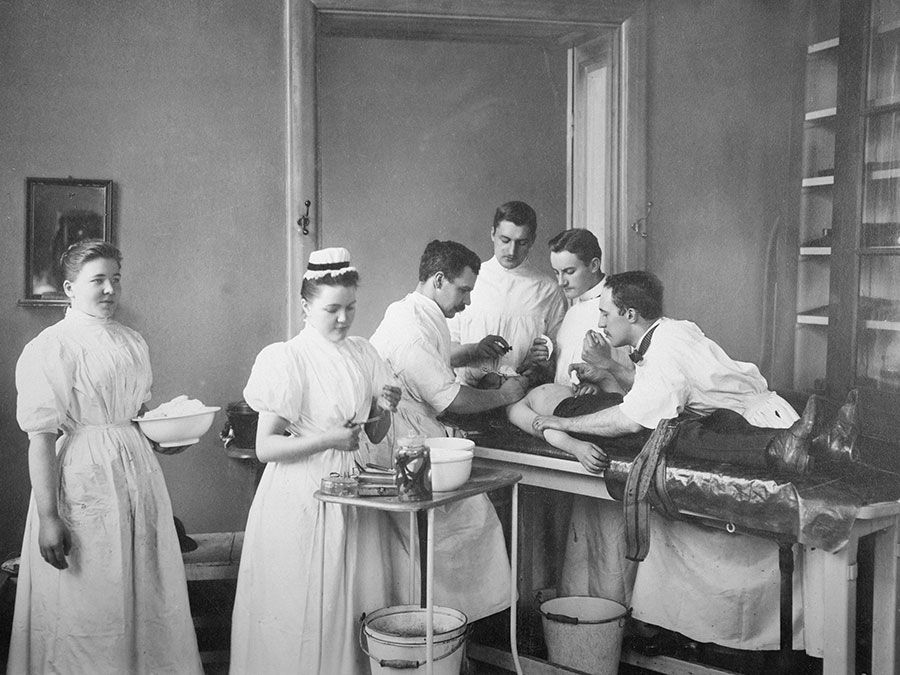
The possibility of surgical intervention had presented itself in 1935, however, when Freeman learned of a frontal lobe ablation (the surgical removal of tissue) technique that had been used on chimpanzees in task-performance experiments. Following ablation, one of the animals in the study experienced reduced agitation upon making an incorrect choice during a memory task (although the operation made the other chimpanzee in the study more agitated). The same year, Portuguese neurophysician António Egas Moniz, with the help of Portuguese surgeon Pedro Almeida Lima, modified a surgical technique for the prefrontal cortex in the frontal lobe of the brain and tested it on a human subject. Moniz experimented with ethyl alcohol, injecting the chemical through the holes in order to destroy areas of tissue thought to be involved in causing mental illness. He subsequently created an instrument known as the leukotome, which contained a deployable wire loop designed to cut sections of tissue. (Later models used a steel band to compress tissue cores.) The procedure of drilling holes in the front of the head and creating cores of brain matter with the instrument became known as prefrontal leukotomy.
In 1936 Freeman modified Moniz’s technique, describing his version of the operation as “lobotomy.” On September 14 that year Freeman and Watts performed the first prefrontal lobotomy operation in the United States, on a 63-year-old housewife who was suffering from insomnia and agitated depression (mixed bipolar disorder, in which manic and depressive symptoms occur together). Although the medical community was skeptical of the procedure and many physicians disapproved of it, Freeman believed it would change psychiatric medicine for the better and found the popular media to be an ally in his efforts to promote its use. Freeman and Watts performed a number of “standard” lobotomies, many of which were carried out at their private practice in Washington, D.C.
Development of transorbital lobotomy
By 1945 Freeman had begun to lose confidence in the effectiveness of standard lobotomy, and thus he set to work on refining a procedure known as transorbital lobotomy, which was not only less expensive and faster than standard lobotomy but also, Freeman believed, more effective. Transorbital lobotomy was first attempted in 1937 by Italian psychosurgeon Amarro Fiamberti. Fiamberti performed the operation by forcing a thin tube (cannula) or a leukotome through the bony orbit at the back of the eye socket and injecting alcohol (or formalin) into the frontal lobe. Instead of a tube and alcohol, Freeman’s instrument of choice to penetrate through the bone was initially an ice pick and later a specially designed leukotome, which he manipulated by hand to destroy the neuronal tracts in the brain that were thought to give rise to mental illness. In January 1946 he performed his first transorbital lobotomy procedure, operating on a depressed and violent 29-year-old woman. The procedure was deemed a success; the patient was able to return to a relatively normal life.
Freeman did not share his plans for transorbital lobotomy with Watts, and, after finding out about it, Watts argued that such procedures should not be performed in their private offices. From that point on, Freeman performed the procedure elsewhere and for a period of time toured the country, operating on patients in hospitals and sometimes in other settings, such as hotel rooms. Watts later parted ways with Freeman, who performed his last lobotomy in February 1967, when a patient he operated on died from a brain hemorrhage.
The trusted destination for professionals, college students, and lifelong learners.
SUBSCRIBE


A controversial treatment
While Freeman’s work found many supporters, his courting of the media reflected an arrogance and recklessness that placed many peoples’ lives and health at risk. Of the 3,500 lobotomies he performed or supervised during his career, an estimated 490 individuals died as a result of the treatment. His attitude and fatality rate, combined with his lack of interest in describing a scientific basis for the procedure, left him with little authority in the medical community. But Freeman’s desire to help the mentally afflicted—who often lived in mental institutions, where neglect was rampant and a successful return to society unlikely—was, by all appearances, genuine. His promotion of lobotomy as a psychiatric treatment at a time when antipsychotic drugs were not widely available for mental disorders also broke important ground for the field of neurosurgery.