

- Born:
- August 17, 1601, Beaumont-de-Lomagne, France
- Died:
- January 12, 1665, Castres (aged 63)
- Notable Works:
- “Introduction to Loci”

Pierre de Fermat
-
Who was Pierre de Fermat?
Pierre de Fermat (1601–1665) was a French mathematician renowned as the founder of modern number theory. Fermat, along with René Descartes, were the leading mathematicians in the first half of the 17th century.
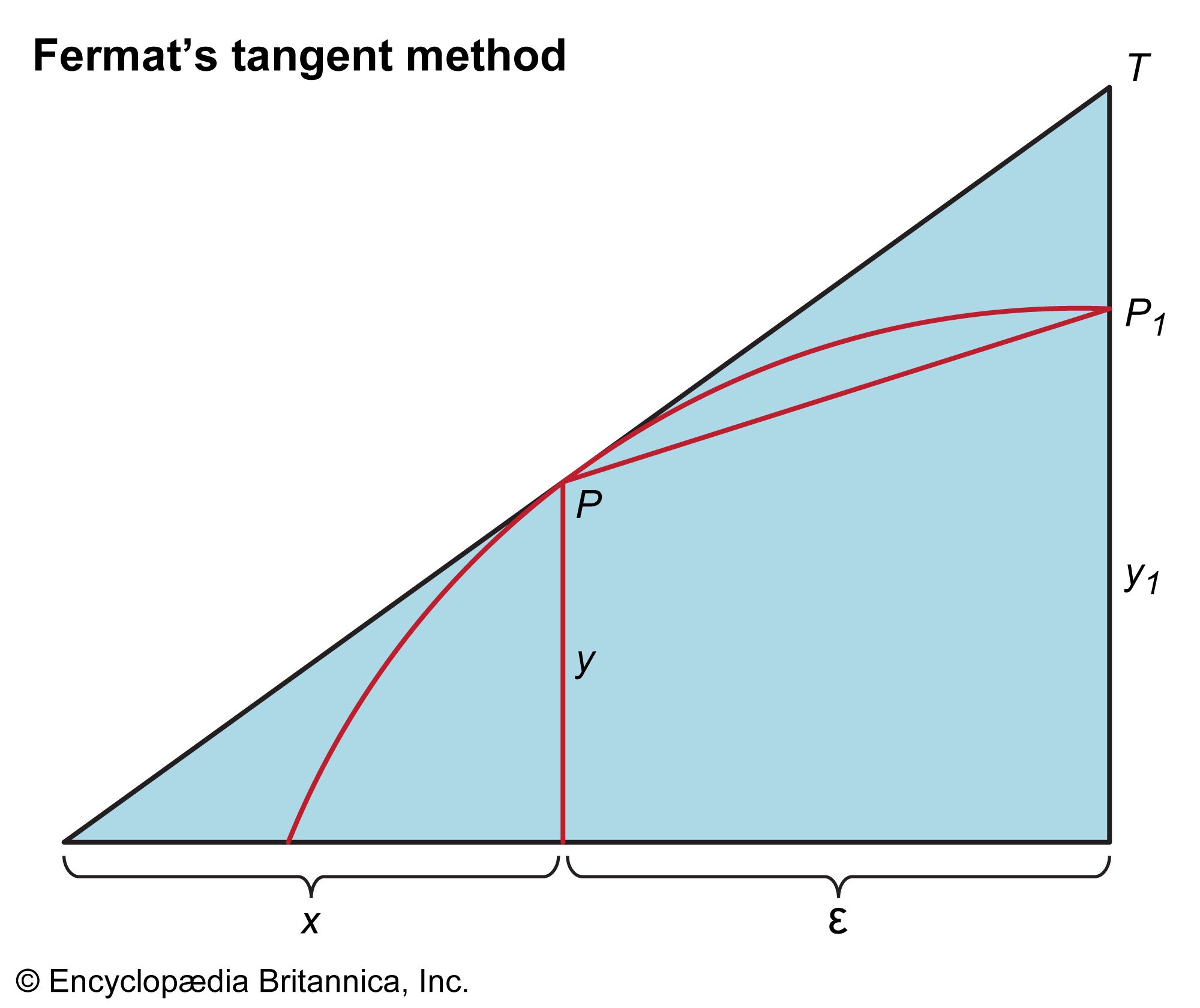
Fermat's contributions include the fundamental principle of analytic geometry and methods for finding tangents to curves and their maximum and minimum points. He also co-founded the theory of probability with Blaise Pascal. His work inspired discoveries in number theory, including his lesser theorem.
Fermat is also known for his "last theorem," which states that there are no natural numbers x, y, and z such that (x^n + y^n = z^n), where n is a natural number greater than 2.
3 Britannica SourcesCreated from Britannica articles using AI. AI can make mistakes, so verify using Britannica articles. -
What is Pierre de Fermat famous for in mathematics?
Pierre de Fermat (1601–1665) was a French mathematician renowned as the founder of modern number theory. Fermat made significant contributions to analytic geometry, independently discovering its fundamental principles. His methods for finding tangents to curves and their maximum and minimum points led to his recognition as an inventor of differential calculus.
Fermat is celebrated for his work in higher arithmetic, particularly his theorems on prime numbers. Among his contributions is Fermat's lesser theorem, which states that if ( p ) is a prime number and ( a ) is any positive integer, then ( a^p - a ) is divisible by ( p ). Another significant contribution is Fermat's last theorem, which states that there are no natural numbers ( x ), ( y ), and ( z ) such that ( x^n + y^n = z^n ) when ( n ) is a natural number greater than 2.
3 Britannica SourcesCreated from Britannica articles using AI. AI can make mistakes, so verify using Britannica articles. -
What is Fermat's Last Theorem?
Fermat's Last Theorem states that there are no natural numbers x, y, and z that can satisfy the equation (x^n + y^n = z^n) when n is a natural number greater than 2.
Pierre de Fermat, a French mathematician, wrote in his copy of Arithmetica in 1637 that he had discovered a remarkable proof of this theorem, but the margin was too small to contain it.
Fermat's Last Theorem remained unproven for centuries. Though proofs for specific values of n were found, a general proof eluded mathematicians until Andrew Wiles, with assistance from Richard Taylor, finally devised a proof published in 1995.
3 Britannica SourcesCreated from Britannica articles using AI. AI can make mistakes, so verify using Britannica articles. -
How did Fermat write and share his mathematical discoveries?
Pierre de Fermat, a French mathematician, made significant contributions to number theory, analytic geometry, and probability theory. Fermat often shared his discoveries through correspondence with other mathematicians and thinkers, such as Blaise Pascal.
Fermat was reluctant to publish his work, which somewhat limited his influence. He communicated his theorems and conjectures in letters, often without providing proofs. Marin Mersenne, a mathematician and theologian, also helped Fermat communicate with other scholars. Fermat's "last theorem" remained unsolved for centuries until the late 20th century.
1 Britannica SourceCreated from Britannica articles using AI. AI can make mistakes, so verify using Britannica articles. -
What other important areas of mathematics did Fermat work on?
Pierre de Fermat was a prolific French mathematician who made significant contributions to several areas of mathematics during the 17th century. Fermat is credited as a founder of modern number theory. He also co-founded probability theory along with Blaise Pascal. Independently of René Descartes, Fermat discovered the fundamental principle of analytic geometry. Fermat developed methods for finding tangents to curves and their maximum and minimum points, which led him to be regarded as an inventor of differential calculus. In optics, Fermat is known for the "Fermat's principle".
4 Britannica SourcesCreated from Britannica articles using AI. AI can make mistakes, so verify using Britannica articles. -
How did Fermat's ideas influence later mathematicians and math history?
Pierre de Fermat significantly shaped mathematics, despite publishing little, by posing influential questions in number theory that persisted for centuries. Fermat's work includes Fermat's Last Theorem, concerning the equation (x^n + y^n = z^n), which remained unsolved for over 300 years, stimulating extensive research in number theory.
Fermat's lesser theorem has become a crucial tool in modern number theory. His investigations into the properties of prime numbers, such as those of the form (4k + 1), also left a lasting impact. Carl Friedrich Gauss found applications for Fermat numbers, further demonstrating their significance. Fermat’s method of infinite descent also provided a novel approach to proving impossibility.
His principle of least time influenced the wave theory of light. Fermat's analytical methods were eventually justified by Isaac Newton. Although his notation was outdated, Fermat's work laid the groundwork for modern calculus and number theory.
4 Britannica SourcesCreated from Britannica articles using AI. AI can make mistakes, so verify using Britannica articles.
Pierre de Fermat (born August 17, 1601, Beaumont-de-Lomagne, France—died January 12, 1665, Castres) was a French mathematician who is often called the founder of the modern theory of numbers. Together with René Descartes, Fermat was one of the two leading mathematicians of the first half of the 17th century. Independently of Descartes, Fermat discovered the fundamental principle of analytic geometry. His methods for finding tangents to curves and their maximum and minimum points led him to be regarded as the inventor of the differential calculus. Through his correspondence with Blaise Pascal he was a co-founder of the theory of probability.
Life and early work
Little is known of Fermat’s early life and education. He was of Basque origin and received his primary education in a local Franciscan school. He studied law, probably at Toulouse and perhaps also at Bordeaux. Having developed tastes for foreign languages, classical literature, and ancient science and mathematics, Fermat followed the custom of his day in composing conjectural “restorations” of lost works of antiquity. By 1629 he had begun a reconstruction of the long-lost Plane Loci of Apollonius, the Greek geometer of the 3rd century bce. He soon found that the study of loci, or sets of points with certain characteristics, could be facilitated by the application of algebra to geometry through a coordinate system. Meanwhile, Descartes had observed the same basic principle of analytic geometry, that equations in two variable quantities define plane curves. Because Fermat’s Introduction to Loci was published posthumously in 1679, the exploitation of their discovery, initiated in Descartes’s Géométrie of 1637, has since been known as Cartesian geometry.
In 1631 Fermat received the baccalaureate in law from the University of Orléans. He served in the local parliament at Toulouse, becoming councillor in 1634. Sometime before 1638 he became known as Pierre de Fermat, though the authority for this designation is uncertain. In 1638 he was named to the Criminal Court.



Analyses of curves
Fermat’s study of curves and equations prompted him to generalize the equation for the ordinary parabola ay = x2, and that for the rectangular hyperbola xy = a2, to the form an - 1y = xn. The curves determined by this equation are known as the parabolas or hyperbolas of Fermat according as n is positive or negative. He similarly generalized the Archimedean spiral r = aθ. These curves in turn directed him in the middle 1630s to an algorithm, or rule of mathematical procedure, that was equivalent to differentiation. This procedure enabled him to find equations of tangents to curves and to locate maximum, minimum, and inflection points of polynomial curves, which are graphs of linear combinations of powers of the independent variable. During the same years, he found formulas for areas bounded by these curves through a summation process that is equivalent to the formula now used for the same purpose in the integral calculus. Such a formula is: 
It is not known whether or not Fermat noticed that differentiation of xn, leading to nan - 1, is the inverse of integrating xn. Through ingenious transformations he handled problems involving more general algebraic curves, and he applied his analysis of infinitesimal quantities to a variety of other problems, including the calculation of centres of gravity and finding the lengths of curves. Descartes in the Géométrie had reiterated the widely held view, stemming from Aristotle, that the precise rectification or determination of the length of algebraic curves was impossible; but Fermat was one of several mathematicians who, in the years 1657–59, disproved the dogma. In a paper entitled “De Linearum Curvarum cum Lineis Rectis Comparatione” (“Concerning the Comparison of Curved Lines with Straight Lines”), he showed that the semicubical parabola and certain other algebraic curves were strictly rectifiable. He also solved the related problem of finding the surface area of a segment of a paraboloid of revolution. This paper appeared in a supplement to the Veterum Geometria Promota, issued by the mathematician Antoine de La Loubère in 1660. It was Fermat’s only mathematical work published in his lifetime.

Disagreement with other Cartesian views
Fermat differed also with Cartesian views concerning the law of refraction (the sines of the angles of incidence and refraction of light passing through media of different densities are in a constant ratio), published by Descartes in 1637 in La Dioptrique; like La Géométrie, it was an appendix to his celebrated Discours de la méthode. Descartes had sought to justify the sine law through a premise that light travels more rapidly in the denser of the two media involved in the refraction. Twenty years later Fermat noted that this appeared to be in conflict with the view espoused by Aristotelians that nature always chooses the shortest path. Applying his method of maxima and minima and making the assumption that light travels less rapidly in the denser medium, Fermat showed that the law of refraction is consonant with his “principle of least time.” His argument concerning the speed of light was found later to be in agreement with the wave theory of the 17th-century Dutch scientist Christiaan Huygens, and in 1849 it was verified experimentally by A.-H.-L. Fizeau.
Through the mathematician and theologian Marin Mersenne, who, as a friend of Descartes, often acted as an intermediary with other scholars, Fermat in 1638 maintained a controversy with Descartes on the validity of their respective methods for tangents to curves. Fermat’s views were fully justified some 30 years later in the calculus of Sir Isaac Newton. Recognition of the significance of Fermat’s work in analysis was tardy, in part because he adhered to the system of mathematical symbols devised by François Viète, notations that Descartes’s Géométrie had rendered largely obsolete. The handicap imposed by the awkward notations operated less severely in Fermat’s favourite field of study, the theory of numbers; but here, unfortunately, he found no correspondent to share his enthusiasm. In 1654 he had enjoyed an exchange of letters with his fellow mathematician Blaise Pascal on problems in probability concerning games of chance, the results of which were extended and published by Huygens in his De Ratiociniis in Ludo Aleae (1657).
The trusted destination for professionals, college students, and lifelong learners.
SUBSCRIBE

