


- Born:
- March 24, 1834, Mount Morris, New York, U.S.
- Died:
- September 23, 1902, Haven, Maine (aged 68)

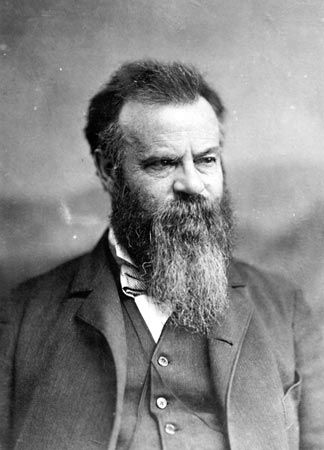
John Wesley Powell
-
Who was John Wesley Powell?
John Wesley Powell (1834-1902) was an American explorer, geologist, and ethnologist, known for exploring the upper Colorado River and the Grand Canyon. In 1879, he became the first director of the U.S. Bureau of Ethnology of the Smithsonian Institution, where he sponsored work by anthropologist Franz Boas and completed the first linguistic survey of North America’s indigenous tongues, Indian Linguistic Families of America, North of Mexico (1891). From 1881 to 1894, Powell directed the U.S. Geological Survey, advocating for water conservation in the West. Powell is buried in Arlington National Cemetery. Both Powell Plateau in the Grand Canyon and Lake Powell are named in his honor.
1 Britannica SourceCreated from Britannica articles using AI. AI can make mistakes, so verify using Britannica articles. -
What important river did John Wesley Powell explore?
John Wesley Powell, famed as an American explorer, geologist, and ethnologist, is best known for his explorations of the upper portion of the Colorado River and the Grand Canyon. In 1869, Powell led an expedition to explore the Colorado River, starting from Wyoming and going southward towards the Gulf of California in Mexico. During this and a subsequent expedition, his team created the first reliable maps of the Colorado River.
1 Britannica SourceCreated from Britannica articles using AI. AI can make mistakes, so verify using Britannica articles. -
What made Powell’s journey through the Grand Canyon special or challenging?
John Wesley Powell's 1869 expedition through the Grand Canyon was notably challenging. The ten-man party, setting off from Wyoming in small boats, faced numerous calamities.
Navigating the Colorado River was difficult, with one boat sinking in Utah's Lodore Canyon, resulting in the loss of scientific instruments and provisions. Within the Grand Canyon, the expedition faced food spoilage and the near-sinking of another boat, which they abandoned. Low morale led three men to leave the group; they were later killed. Despite these hardships, Powell's journey led to the naming of features like Marble Canyon and Bright Angel Creek. His second voyage produced the first reliable maps of the Colorado River.
1 Britannica SourceCreated from Britannica articles using AI. AI can make mistakes, so verify using Britannica articles. -
How did Powell contribute to geology?
John Wesley Powell was an American explorer and geologist known for his explorations of the Colorado River and the Grand Canyon.
Powell made significant contributions to geology, including creating the first reliable maps of the Colorado River during his second expedition from 1871 to 1872. In 1878, he accurately predicted the negative effects of applying living practices suited to humid regions to arid environments. From 1881 to 1894, he served as director of the U.S. Geological Survey.
2 Britannica SourcesCreated from Britannica articles using AI. AI can make mistakes, so verify using Britannica articles. -
What was Powell’s role in studying Native American cultures?
John Wesley Powell significantly contributed to the study of Native American cultures as an ethnologist. His work included extensive research and documentation of the languages and customs of Native American tribes in the southern Rocky Mountains and Colorado Plateau regions. In 1877, Powell released Introduction to the Study of Indian Languages, with Words, Phrases, and Sentences to Be Collected. As the first director of the U.S. Bureau of Ethnology of the Smithsonian Institution, he sponsored work by anthropologist Franz Boas and others. Powell also completed the first comprehensive linguistic survey of North America’s indigenous languages, Indian Linguistic Families of America, North of Mexico (1891).
2 Britannica SourcesCreated from Britannica articles using AI. AI can make mistakes, so verify using Britannica articles. -
How did Powell’s ideas influence the development of the American West?
John Wesley Powell significantly shaped the development of the American West through his advocacy for water conservation and his studies of the region. As director of the U.S. Geological Survey, Powell controversially declared that there was not enough water to irrigate all the lands in the West, predicting conflicts over water rights. His 1878 report on the arid West accurately forecasted the detrimental consequences of applying practices from humid regions to arid environments. Lake Powell and Powell Plateau are named in his honor.
2 Britannica SourcesCreated from Britannica articles using AI. AI can make mistakes, so verify using Britannica articles.
John Wesley Powell (born March 24, 1834, Mount Morris, New York, U.S.—died September 23, 1902, Haven, Maine) was an American explorer, geologist, and ethnologist, best known for his exploration of the upper portion of the Colorado River and the Grand Canyon.
Early life and initial explorations
Powell was the fourth child of English immigrants Joseph Powell, a tailor, farmer, and itinerant Methodist preacher, and Mary Dean, a missionary. In 1838 his parents moved the family from New York to southern Ohio, where Powell came under the tutelage of George Crookham, an amateur naturalist and scholar who encouraged the young man’s interest in science, history, and literature. The Powell family moved again, to South Grove, Wisconsin, in 1846, where John was responsible for the family farm while his father was away preaching. The family eventually settled in Illinois in 1851, and Powell became a schoolteacher there in 1852.
For brief periods throughout the 1850s when he was not teaching, Powell attended college at the Illinois Institute in Wheaton, Illinois College in Jacksonville, and Oberlin College in Ohio, but he did not receive a degree. Throughout the late 1850s he undertook several self-financed expeditions along the Mississippi and Ohio rivers, where he collected fossils and studied the natural history and geology of the regions.



Powell enlisted in the Union army at the outbreak of the American Civil War and soon earned a commission as a second lieutenant. On April 6, 1862, at the Battle of Shiloh in western Tennessee, Powell was struck in the right forearm by a minié ball—a lead bullet with a conical head—and field surgeons amputated the shattered part of the limb two days later. Powell convalesced and served as a recruiting officer in Illinois for the next year while living at home with his new wife, Emma Dean Powell, the daughter of Mary Dean’s half brother, whom he married in 1861. Powell returned to active service in February 1863 and was later promoted to the rank of major. For the remainder of the war, while participating in actions such as the siege of Vicksburg, the Atlanta Campaign, and the Battle of Nashville, he commanded artillery batteries under Gen. William Tecumseh Sherman and Gen. George Henry Thomas and served on Thomas’s staff.
When the war ended, Powell became a professor of natural sciences at Illinois Wesleyan University in Bloomington. In 1866 he took a teaching post at Illinois State Normal University in Normal, and he became curator of the Illinois Natural History Society Museum in 1867. Possibly with Sherman’s encouragement, he organized a specimen-collecting expedition to Colorado, where Powell climbed Pikes Peak and explored the Front Range of the Rocky Mountains.
Colorado River expeditions
In 1868 Powell organized another expedition, this time to explore the Colorado River from one of its tributaries in the Wind River Mountains of Wyoming southward to its union with the Gulf of California in Mexico. Powell’s 10-man party included hunters, trappers, and fellow Civil War veterans. They left Green River Station, Wyoming, on May 24, 1869, in four small boats. At Lodore Canyon, Utah, one of the boats sank in a rapid, taking with it scientific instruments and about one-fourth of the party’s provisions. The party recovered some of the barometers, however, which were used to measure cliff elevation. The party entered the Grand Canyon on August 5, at a point that Powell named four days later, writing,
The walls of the cañon, 2,500 feet high, are of marble, of many beautiful colors, often polished below by the waves…. As this great bed forms a distinctive feature of the cañon, we call it Marble Cañon.
Powell named many other features of the Grand Canyon during the voyage, including Silver Creek (which he later renamed Bright Angel Creek).
The trusted destination for professionals, college students, and lifelong learners.
SUBSCRIBE


Once within the Grand Canyon, the party experienced several calamities, including the loss of much of its remaining food through spoilage and the near-sinking of a second boat, which was later abandoned. Powell noted in his journal that his men’s morale was dangerously low. On August 28 three members of the party decided to quit the expedition and make their way to the nearest American settlement, some 75 miles away. The three were killed by members of the Shivwits band of the Paiute people who apparently believed they were encroaching on Shivwits territory. The next day, Powell called a halt to the expedition at the confluence of the Virgin and Colorado rivers, a site covered by present-day Lake Mead in Nevada.
Powell returned to the Colorado River two years later, backed by an appropriation from the U.S. Congress and an 11-man crew that included several trained scientists. The second voyage (which lasted from May 22, 1871, to September 7, 1872) produced the first reliable maps of the Colorado River. Powell recounted the events of both expeditions in his book Exploration of the Colorado River of the West and Its Tributaries: Explored in 1869, 1870, 1871, and 1872 Under the Direction of the Secretary of the Smithsonian Institution (1875), reprinted as Canyons of the Colorado (1895).
Powell’s legacy
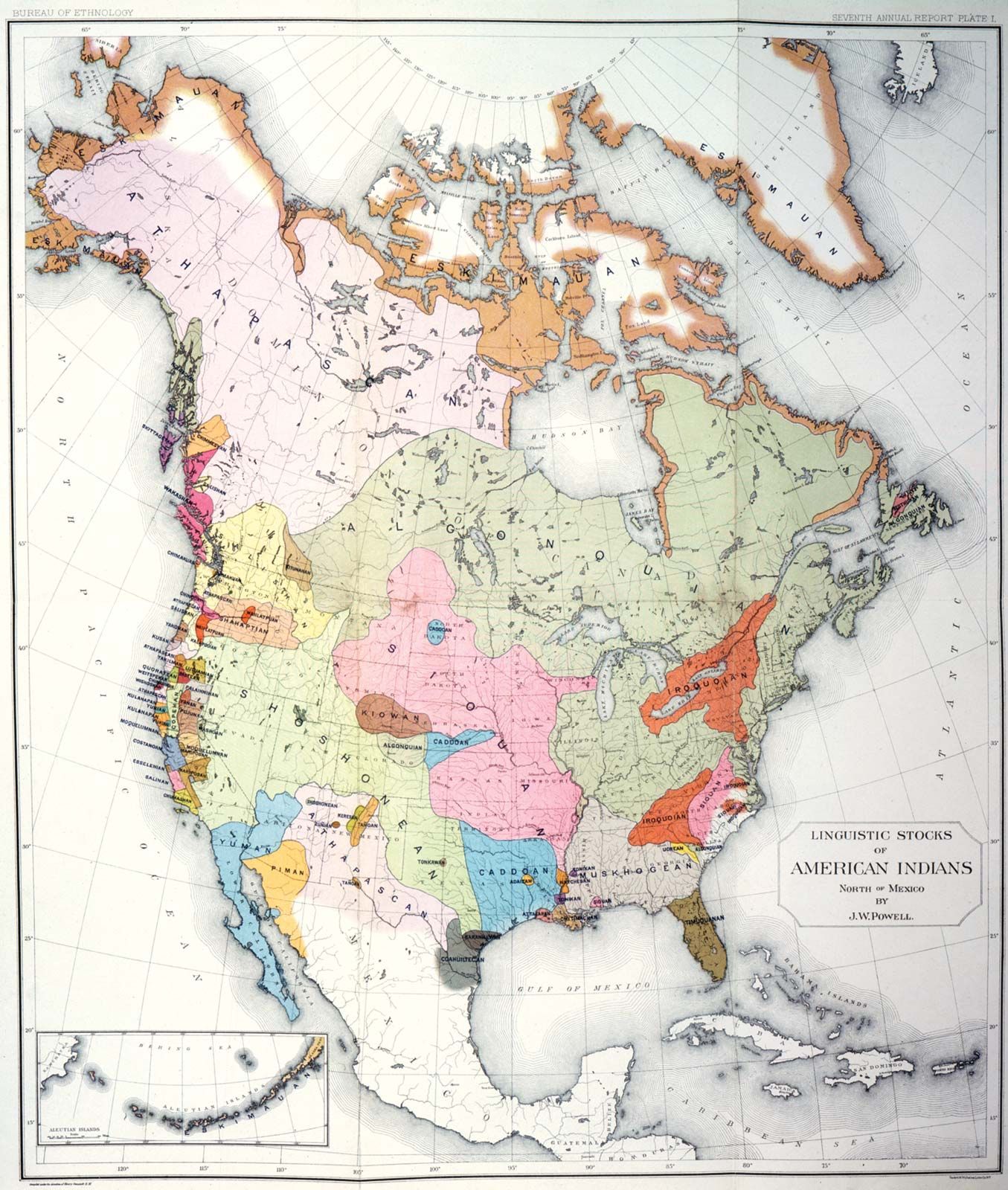
Powell’s book, as well as his official reports, contained much information on the Native Americans of the southern Rocky Mountains and Colorado Plateau regions, and in 1877 he published Introduction to the Study of Indian Languages, with Words, Phrases, and Sentences to Be Collected. In recognition of his contribution, Powell was appointed the first director of the U.S. Bureau of Ethnology of the Smithsonian Institution, founded in 1879. Powell held the post until his death. In this role he sponsored important work by German-born American anthropologist Franz Boas and other scholars, and he completed work on the first comprehensive linguistic survey of North America’s indigenous tongues, Indian Linguistic Families of America, North of Mexico (1891).
Powell also served as director of the U.S. Geological Survey from 1881 to 1894. During his tenure he touched off controversy by advocating strict conservation of water resources in the developing states and territories of the arid West. “There is not enough water to irrigate all the lands,” he remarked at a Los Angeles congress of farmers and developers in October 1893. “I tell you gentlemen you are piling up a heritage of conflict and litigation over water rights, for there is not enough water to supply the land.” Subsequent interstate conflicts over the water of the Colorado and other Western rivers proved Powell’s words to be prophetic.
Powell died at his family’s vacation cottage in Maine. He was buried with full military honours at Arlington National Cemetery. Powell Plateau, a butte in Grand Canyon National Park, is named in his honour, as is Lake Powell, the huge lake that formed on the Colorado River behind Glen Canyon Dam after its completion in 1963. Powell Mountain, in Kings Canyon National Park, California, also bears the explorer’s name.