


- In full:
- Antoine-Henri Becquerel
- Born:
- December 15, 1852, Paris, France
- Died:
- August 25, 1908, Le Croisic (aged 55)
- Awards And Honors:
- Nobel Prize (1903)
- Subjects Of Study:
- radiation
- radioactivity
- uranium


Henri Becquerel
-
Who was Henri Becquerel?
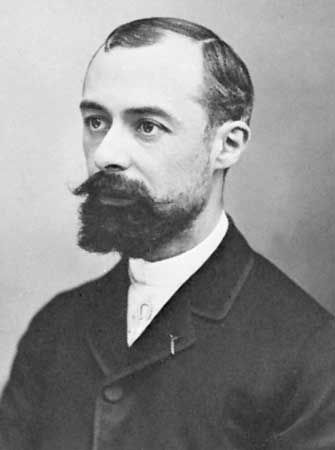
Henri Becquerel (1852–1908) was a French physicist celebrated for his discovery of radioactivity while studying uranium and other substances. His work earned him a share of the 1903 Nobel Prize in Physics, which he shared with Pierre and Marie Curie.
Coming from a distinguished family of scientists, including his father Alexandre-Edmond Becquerel, Henri made further contributions to the field by measuring the deflection of beta particles in electric and magnetic fields and connected them to J.J. Thomson's electron. Becquerel also noted the physiological effects of radiation, observing burns from carrying radioactive samples, which later spurred medical research and applications.
1 Britannica SourceCreated from Britannica articles using AI. AI can make mistakes, so verify using Britannica articles. -
What is Henri Becquerel best known for discovering?
Henri Becquerel, a French physicist (1852–1908), is best known for his discovery of radioactivity while investigating uranium and other substances. In 1903, he shared the Nobel Prize in Physics with Pierre and Marie Curie for this discovery.
Becquerel also measured the deflection of beta particles in electric and magnetic fields, demonstrating they were the same as J.J. Thomson's electron. Additionally, he observed uranium X losing its radiating ability over time while uranium regained its radioactivity. Becquerel's observation of a burn caused by carrying radium in his pocket led to the medical use of radiation.
2 Britannica SourcesCreated from Britannica articles using AI. AI can make mistakes, so verify using Britannica articles. -
What is radioactivity, the phenomenon that Becquerel discovered?
Henri Becquerel, a French physicist, is credited with discovering radioactivity while studying uranium and other substances. Radioactivity is a property of matter where energy and subatomic particles are emitted spontaneously from unstable atomic nuclei. An unstable nucleus decays into a more stable configuration by emitting specific particles or electromagnetic energy. Becquerel's further contributions include measuring the deflection of beta particles in electric and magnetic fields and observing the decay and regeneration of uranium's radiating ability. For his discovery of radioactivity, Becquerel shared the 1903 Nobel Prize in Physics with Pierre and Marie Curie.
4 Britannica SourcesCreated from Britannica articles using AI. AI can make mistakes, so verify using Britannica articles. -
How did Becquerel discover radioactivity?
In 1896, Henri Becquerel, while investigating the connection between X-rays and luminescence, discovered radioactivity.
Becquerel stored photographic plates and uranium salts in a drawer. Expecting slight fogging, he found sharp images of the salts. He determined that uranium salts emit penetrating radiation independent of external influences and can discharge electrified bodies by ionizing air molecules.
In 1898, Pierre and Marie Curie discovered polonium and radium and coined the term radioactivity. Becquerel's discovery that beta particles are the same as electrons, and his observation of the physiological effects of radiation, further contributed to the field. For his discovery of radioactivity, Becquerel shared the 1903 Nobel Prize in Physics with the Curies.
2 Britannica SourcesCreated from Britannica articles using AI. AI can make mistakes, so verify using Britannica articles. -
What was the impact of Becquerel's discovery on science and medicine?
Henri Becquerel's 1896 discovery of radioactivity through his investigations of uranium revolutionized scientific understanding of the atom. His work, for which he shared the 1903 Nobel Prize in Physics with Pierre and Marie Curie, demonstrated that atoms were not indivisible or immutable, but could change and emit significant energy.
Becquerel also observed the physiological effects of radiation. His 1901 report of a burn from carrying a radioactive sample led to medical investigations and the use of radioactive materials in medicine. Becquerel's findings catalyzed the development of quantum mechanics and nuclear physics.
2 Britannica SourcesCreated from Britannica articles using AI. AI can make mistakes, so verify using Britannica articles. -
Did Henri Becquerel receive any awards or recognition for his work?
Yes, Henri Becquerel received awards and recognition for his work. For his discovery of radioactivity, Becquerel shared the 1903 Nobel Prize for Physics with the Curies. He also received other medals and memberships in foreign societies. Becquerel's own Academy of Sciences elected him its president and one of its permanent secretaries.
2 Britannica SourcesCreated from Britannica articles using AI. AI can make mistakes, so verify using Britannica articles.
Henri Becquerel (born December 15, 1852, Paris, France—died August 25, 1908, Le Croisic) was a French physicist who discovered radioactivity through his investigations of uranium and other substances. In 1903 he shared the Nobel Prize for Physics with Pierre and Marie Curie.
He was a member of a scientific family extending through several generations, the most notable being his grandfather Antoine-César Becquerel (1788–1878), his father, Alexandre-Edmond Becquerel (1820–91), and his son Jean Becquerel (1878–1953).
Education and training

After his early schooling at the Lycée Louis-le-Grand, Henri received his formal scientific education at the École Polytechnique (1872–74) and engineering training at the École des Ponts et Chaussées (Bridges and Highways School; 1874–77). In addition to his teaching and research posts, Becquerel was for many years an engineer in the Department of Bridges and Highways, being appointed chief engineer in 1894. His first academic situation was in 1876 as assistant teacher at the École Polytechnique, where in 1895 he succeeded to the chair of physics. Concurrently, he was assistant naturalist to his father at the museum, where he also assumed the physics professorship upon his father’s death.




Electricity, magnetism, optical phenomena, and energy were major areas of physical investigation during the 19th century. For several years the young man’s research was concerned with the rotation of plane-polarized light by magnetic fields, a subject opened by Michael Faraday and to which Henri’s father had also contributed. Henri then concerned himself with infrared radiation, examining, among other things, the spectra of different phosphorescent crystals under infrared stimulation. Of particular significance, he extended the work of his father by studying the relation between absorption of light and emission of phosphorescence in some uranium compounds.
By 1896 Henri was an accomplished and respected physicist—a member of the Académie des Sciences since 1889—but more important than his research thus far were his expertise with phosphorescent materials, his familiarity with uranium compounds, and his general skill in laboratory techniques, including photography. Together, these were to place the discovery of radioactivity within his reach.
Systematic study of radiation
At the end of 1895, Wilhelm Röntgen discovered X rays. Becquerel learned that the X rays issued from the area of a glass vacuum tube made fluorescent when struck by a beam of cathode rays. He undertook to investigate whether there was some fundamental connection between this invisible radiation and visible light such that all luminescent materials, however stimulated, would also yield X rays. To test this hypothesis, he placed phosphorescent crystals upon a photographic plate that had been wrapped in opaque paper so that only a penetrating radiation could reach the emulsion. He exposed his experimental arrangement to sunlight for several hours, thereby exciting the crystals in the customary manner. Upon development, the photographic plate revealed silhouettes of the mineral samples, and, in subsequent experiments, the image of a coin or metal cutout interposed between the crystal and paper wrapping. Becquerel reported this discovery to the Académie des Sciences at its session on February 24, 1896, noting that certain salts of uranium were particularly active.
He thus confirmed his view that something very similar to X rays was emitted by this luminescent substance at the same time it threw off visible radiation. But the following week Becquerel learned that his uranium salts continued to eject penetrating radiation even when they were not made to phosphoresce by the ultraviolet in sunlight. To account for this novelty he postulated a long-lived form of invisible phosphorescence; when he shortly traced the activity to uranium metal, he interpreted it as a unique case of metallic phosphorescence.
The trusted destination for professionals, college students, and lifelong learners.
SUBSCRIBE


During 1896 Becquerel published seven papers on radioactivity, as Marie Curie later named the phenomenon; in 1897, only two papers; and in 1898, none. This was an index of both his and the scientific world’s interest in the subject, for the period saw studies of numerous radiations (e.g., cathode rays, X rays, Becquerel rays, “discharge rays,” canal rays, radio waves, the visible spectrum, rays from glowworms, fireflies, and other luminescent materials), and Becquerel rays seemed not especially significant. The far more popular X rays could take sharper shadow photographs and faster. It required the extension in 1898 of radioactivity to another known element, thorium (by Gerhard Carl Schmidt and independently by Marie Curie), and the discovery of new radioactive materials, polonium and radium (by Pierre and Marie Curie and their colleague, Gustave Bémont), to awaken the world and Becquerel to the significance of his discovery.
Further contributions
Returning to the field he had created, Becquerel made three more important contributions. One was to measure, in 1899 and 1900, the deflection of beta particles, which are a constituent of the radiation in both electric and magnetic fields. From the charge to mass value thus obtained, he showed that the beta particle was the same as Joseph John Thomson’s recently identified electron. Another discovery was the circumstance that the allegedly active substance in uranium, uranium X, lost its radiating ability in time, while the uranium, though inactive when freshly prepared, eventually regained its lost radioactivity. When Ernest Rutherford and Frederick Soddy found similar decay and regeneration in thorium X and thorium, they were led to the transformation theory of radioactivity, which explained the phenomenon as a subatomic chemical change in which one element spontaneously transmutes into another. Becquerel’s last major achievement concerned the physiological effect of the radiation. Others may have noticed this before him, but his report in 1901 of the burn caused when he carried an active sample of the Curies’ radium in his vest pocket inspired investigation by physicians, leading ultimately to medical use.
For his discovery of radioactivity, Becquerel shared the 1903 Nobel Prize for Physics with the Curies; he was also honoured with other medals and memberships in foreign societies. His own Academy of Sciences elected him its president and one of its permanent secretaries.