
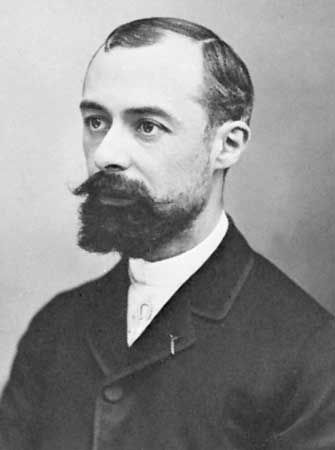
Henri Becquerel, (born Dec. 15, 1852, Paris, France—died Aug. 25, 1908, Le Croisic), French physicist. His grandfather, Antoine-César (1788–1878), was one of the founders of the field of electrochemistry, and his father, Alexandre-Edmond (1820–91), made important studies of light phenomena. Henri likewise studied phosphorescent materials as well as uranium compounds and employed photography in his experiments. He is remembered for his discovery of radioactivity, which occurred when he found that the element uranium (in a sample of pitchblende) emitted invisible rays that could darken a photographic plate. His 1901 report of a burn caused by a sample of Marie Curie’s radium that he carried in his vest pocket led to investigations by physicians and ultimately the medical use of radioactive substances. In 1903 he shared a Nobel Prize for Physics with the Curies. The unit of radioactivity, the becquerel (Bq), is named for him.
verifiedCite
While every effort has been made to follow citation style rules, there may be some discrepancies.
Please refer to the appropriate style manual or other sources if you have any questions.
Select Citation Style
Henri Becquerel summary
Below is the article summary. For the full article, see Henri Becquerel.